

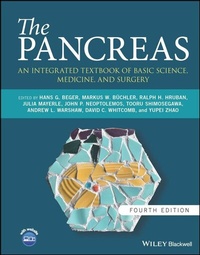
The Pancreas
Description

The newest edition of the essential guide to pancreatic medicine
The fourth edition of The Pancreas: An Integrated Textbook of Basic Science, Medicine, and Surgery integrates the cutting-edge research of recent years to update its presentation of this fast-growing subject. It details every known disorder of the pancreas, grounding them in a thorough understanding of pancreatic function, enhanced with high quality illustration and graphs. It also includes step-by-step guidance for relevant endoscopic techniques and surgical procedures.
The Pancreas readers will also find:
* New comprehensive insights into three pancreatic diseases: autoimmune pancreatitis, cystic neoplasms, and neuroendocrine tumors
* An editorial team with decades of clinical and research experience in the US, Europe, and Asia
* Over 500 downloadable illustrations for use in scientific presentations
The Pancreas is a foundational reference for clinicians and researchers in gastroenterology and gastrointestinal surgery.
More details
Other editions
Additional editions
Persons
Hans G. Beger, MD, FACS (Hon.), JSS (Hon.), CSS (Hon.), Professor Emeritus of Surgery, University of Ulm, Ulm, Germany.
Markus W. Büchler, MD, FACS (Hon.), FRCS (Hon.), FASA (Hon.) Professor of Surgery, University of Heidelberg, Heidelberg, Germany.
Ralph H. Hruban, MD, Baxley Professor and Director, Department of Pathology and Director of the Sol Goldman Pancreatic Research Center, Johns Hopkins University School of Medicine, Baltimore, USA.
Julia Mayerle, MD, Professor of Internal Medicine, Gastroenterology and Hepatology, Chair Department of Medicine II, LMU Klinikum, Ludwig-Maximilians-University, Munich, Germany.
John P. Neoptolemos, MA, MB, BCHIR, MD FRCS, FMEDSCI, MAE Professor of Surgery, Department of Surgery, University of Heidelberg, Heidelberg, Germany.
Tooru Shimosegawa, MD, PhD, Professor Emeritus Department of Gastroenterology, Tohoku University Graduate School of Medicine, Sendai, Miyagi, Japan.
Andrew L. Warshaw, MD, FACS, FRCSEd (Hon.), W. Gerald Austen Distinguished Professor of Surgery, Harvard Medical School, and Surgeon-in-Chief Emeritus, Massachusetts General Hospital, Boston, USA.
David C. Whitcomb, MD, PhD, Professor of Medicine, Cell Biology & Physiology, and Human Genetics, Division of Gastroenterology, Hepatology, and Nutrition, University of Pittsburgh and UPMC, Pennsylvania, USA.
Yupei Zhao, MD, FICS (Hon.), FACS (Hon.), FRCS (Engl) (Hon.), FCSHK (Hon.), Professor of Surgery, Department of General Surgery, Peking Union Medical College Hospital, Beijing, P.R. China.
Content
About the Companion Website xvii
Section 1 Anatomy of the Pancreas 1
1 Development of the Pancreas and Related Structures 3 Brian Lewis and Junhao Mao
2 Anatomy, Histology, and Fine Structure of the Pancreas 9 Daniel S. Longnecker and Elizabeth D. Thompson
3 Congenital and Inherited Anomalies of the Pancreas 23 Heiko Witt and Martin Zenker
Section 2 Physiology and Pathophysiology of Pancreatic Functions 33
4 Physiology of Acinar Cell Secretion 35 Ole H. Petersen
5 Physiology of Duct Cell Secretion 48 Wei- Yin Lin, Paramita Sarkar, and Shmuel Muallem
6 Physiology and Pathophysiology of Function of Sphincter of Oddi 56 Savio George Barreto and James Toouli
7 Neurohormonal and Hormonal Control of Pancreatic Secretion 65 Chung Owyang and Matthew J. DiMagno
8 Regulation of Pancreatic Protein Synthesis and Growth 75 Maria Dolors Sans and John A. Williams
9 Fibrogenesis in the Pancreas: The Role of Pancreatic Stellate Cells 86 Minoti V. Apte, Romano C. Pirola, and Jeremy S. Wilson
10 Pancreatic Endocrine-Exocrine Relationship 98 Kenichiro Furuyama and Yoshiya Kawaguchi
Section 3 Acute Pancreatitis 105
11 Epidemiology and Etiology of Alcohol- Induced Pancreatitis 107 Jeremy S. Wilson, Romano C. Pirola, and Minoti V. Apte
12 Epidemiology and Etiology of Biliary Acute Pancreatitis 119 Ippei Ikoma, Ko Tomishima, and Hiroyuki Isayama
13 Genetic Factors in Acute Pancreatitis 128 Mitchell L. Ramsey and Georgios I. Papachristou
14 The Role of the Intestine and Mesenteric Lymph in the Development of Organ Dysfunction in Severe Acute Pancreatitis 138 Alistair B.J. Escott, Anthony R.J. Phillips, and John A. Windsor
15 The Role of Neurogenic Inflammation in Pancreatitis 146 Metrah Mohammad Nader and Jami L. Saloman
16 Molecular, Biochemical, and Metabolic Abnormalities of Acute Pancreatitis 155 Ujjwal M. Mahajan, F. Ulrich Weiss, Markus M. Lerch, and Julia Mayerle
17 Histopathology of Acute Pancreatitis 164 Günter Klöppel
18 Severity Classification of Acute Pancreatitis 170 John A. Windsor
19 Clinical Assessment and Biochemical Markers to Objectify Severity and Prognosis 176 Bettina M. Rau and Claus Schäfer
20 Acute Pancreatitis Associated with Congenital Anomalies 185 Charlotte S. Austin, Christopher R. Schlieve, Andrew L. Warshaw, and Tracy C. Grikscheit
21 Acute Pancreatitis in Children 191 Mark E. Lowe and Véronique D. Morinville
22 Acute Pancreatitis Associated with Metabolic, Infections and Drug- Related Diseases 199 Ali A. Aghdassi, Mats L. Wiese, Quang Trung Tran, and Markus M. Lerch
23 Radiologic Diagnosis and Staging of Severe Acute Pancreatitis 208 Yoshihisa Tsuji
24 Conservative Therapy of Acute Pancreatitis: Volume Substitution and Enteral and Parenteral Nutrition 222 Steven M. Hadley, Jr. and Timothy B. Gardner
25 ICU Treatment of Severe Acute Pancreatitis 230 Scott R. Gunn and David C. Whitcomb
26 Clinical Course and Medical Treatment of Acute Pancreatitis- Use of Antibiotics in Severe Acute Pancreatitis: Indications and Limitations 238 Rainer Isenmann and Mathias Wittau
27 Indications for Interventional and Surgical Treatment of Necrotizing Pancreatitis 244 Lily V. Saadat and Thomas E. Clancy
28 Management of Infected Necrosis: Step- Up Approach 254 Hester C. Timmerhuis, Marc G. Besselink, and Hjalmar C. van Santvoort
29 Management of Infected Pancreatic Necroses: An Endoscopic Approach 260 Todd H. Baron
30 Minimally Invasive Debridement and Lavage of Necrotizing Pancreatitis 266 Kulbir Mann and Michael G.T. Raraty
31 Open Surgical Debridement of Necrotizing Pancreatitis: Late Postoperative Morbidity and Outcome 271 Dongya Huang, Zipeng Lu, and Yi Miao
32 Endoscopic Treatment of Acute Biliary Pancreatitis 278 Ichiro Yasuda, Tsuyoshi Mukai, and Toru Ito
33 Strategies for the Treatment of Pancreatic Pseudocysts and Walled- Off Necrosis After Acute Pancreatitis: Interventional Endoscopic Approaches 284 Georg Beyer and Julia Mayerle
34 Pseudocysts and Walled- Off Necrosis After Acute Pancreatitis: Surgical Approach 288 Naohiro Sata, Masaru Koizumi, and Alan Kawarai Lefor
35 Management of Fluid Collection in Acute Pancreatitis 294 Georg Beyer, Simon Sirtl, Christoph Ammer- Herrmenau, and Albrecht Neesse
36 Management of Pancreatic Fistula in Acute Pancreatitis 300 Marta Sandini, Thilo Hackert, and Markus W. Büchler
37 Long- Term Outcome After Acute Pancreatitis 306 Christin Tjaden and Thilo Hackert
Section 4 Chronic Pancreatitis 315
38 Definition and Classification of Chronic Pancreatitis 317 David C. Whitcomb
39 Molecular Understanding of Chronic Pancreatitis 326 Bomi Lee, Monique T. Barakat, and Sohail Z. Husain
40 Natural History of Recurrent Acute and Chronic Pancreatitis 334 Rohit Das, Jorge D. Machicado, and Dhiraj Yadav
41 Pediatric Recurrent Acute and Chronic Pancreatitis: Role of Pancreas Divisum 344 Jiri Snajdauf, Michal Rygl, Barbora Kucerova, and Natalia Newland
42 Clinical and Laboratory Diagnosis of Chronic Pancreatitis 349 Georg Beyer, Markus M. Lerch, and Julia Mayerle
43 Abdominal Imaging for the Diagnosis of Chronic Pancreatitis 357 Atsushi Irisawa and Akira Yamamiya
44 Endoscopic Ultrasound for Diagnosis of Chronic Pancreatitis Versus Pancreatic Cancer 366 J. Enrique Domínguez- Muñoz, Julio Iglesias- García, José Lariño- Noia, and Daniel de la Iglesia- García
45 Hereditary Pancreatitis and Complex Genetic Causes 375 Celeste Shelton Ohlsen and David C. Whitcomb
46 Epidemiology and Pathophysiology of Tropical Chronic Pancreatitis 383 Shailesh V. Shrikhande and Savio G. Barreto
47 CFTR- Associated Pancreatic Disease 390 Chee Y. Ooi and Aliye Uc
48 Alcohol and Smoking in Chronic Pancreatitis 396 Atsushi Masamune, Kazuhiro Kikuta, and Kiyoshi Kume
49 Idiopathic and Rare Causes of Chronic Pancreatitis 404 Morihisa Hirota and Tooru Shimosegawa
50 Early Chronic Pancreatitis 412 Kazuhiro Kikuta and Atsushi Masamune
51 Chronic Pancreatitis with Inflammatory Mass in the Pancreatic Head 418 Ulrich F. Wellner, Kim C. Honselmann, and Tobias Keck
52 Structural Complications: Strictures, Stones, Pseudocysts, and Vascular Complications 424 Xiaodong Tian, Xiaochao Guo, and Yinmo Yang
53 Nutritional Evaluation and Support: An Overview 430 Sinead N. Duggan and Stephen J. O'Keefe
54 Exocrine Pancreatic Insufficiency 436 Chris E. Forsmark
55 Bone Disease in Chronic Pancreatitis 442 Sinead N. Duggan
56 Diabetes from Exocrine Pancreatic Disease 445 Nao Fujimori, Tetsuhide Ito, and Yoshihiro Ogawa
57 Oxidative Stress and Antioxidants in Chronic Pancreatitis 451 Soumya Jagannath Mahapatra and Pramod Kumar Garg
58 Pain Mechanisms in Chronic Pancreatitis 460 Pierluigi Di Sebastiano, Fabio Francesco di Mola, Tommaso Grottola, and Rossana Percario
59 Pain Management in Chronic Pancreatitis 467 Louise Kuhlmann, Søren S. Olesen, and Asbjørn M. Drewes
60 Adjunctive Therapy in Chronic Pancreatitis 474 Anna Evans Phillips
61 Pancreatic Cancer Risks in Chronic Pancreatitis 480 Patrick Maisonneuve and Albert B. Lowenfels
62 Evidence of Endoscopic and Interventional Treatment of Chronic Pancreatitis and Pseudocysts 486 Jörg Schirra, Simon Sirtl MD, Markus M. Lerch, and Julia Mayerle
63 Major Pancreatic Resection for Chronic Pancreatitis: Indication, Goals, and Limitations 496 Faik G. Uzunoglu and Jakob R. Izbicki
64 Pancreatic Drainage Procedures: Techniques and Results 501 Ulrich F. Wellner, Dirk Bausch, and Tobias Keck
65 Duodenum- Preserving Pancreatic Head Resections for Chronic Pancreatitis: Techniques and Results 506 Hans G. Beger, Bertram Poch, Yang Yinmo, and Waldemar Uhl
66 Total Pancreatectomy with Islet Autotransplant 515 Greg Beilman, Zachary Bergman, and Melena Bellin
67 Minimally Invasive Surgical Management of Chronic Pancreatitis 523 Gilbert Z. Murimwa, Herbert J. Zeh III, and Matthew R. Porembka
Section 5 Autoimmune Pancreatitis 533
68 Epidemiology of Autoimmune Pancreatitis 535 Terumi Kamisawa
69 Molecular Immunology and Pathogenesis of Autoimmune Pancreatitis 540 Yoh Zen
70 Clinical Manifestation of Type 1 Autoimmune Pancreatitis 546 Tooru Shimosegawa
71 Clinical Manifestation of Type 2 Autoimmune Pancreatitis 554 Nicolò de Pretis and Luca Frulloni
72 Clinical Diagnostic Criteria for Autoimmune Pancreatitis 561 Tooru Shimosegawa
73 Laboratory Diagnosis of Autoimmune Pancreatitis 568 J- Matthias Löhr and Miroslav Vujasinovic
74 What is the Evidence Measuring Immune Markers 573 Shigeyuki Kawa, Takayuki Watanabe, and Norihiro Ashihara
75 Autoimmune Pancreatitis and IgG4- Related Disease 579 Kazuichi Okazaki, Tsukasa Ikeura, and Kazushige Uchida
76 Imaging Diagnosis of Autoimmune Pancreatitis 595 Kazuichi Okazaki, Makoto Takaoka, Tsukasa Ikeura, and Kazushige Uchida
77 Medical Management of Autoimmune Pancreatitis 600 Shounak Majumder and Suresh T. Chari
78 Management of Intractable Autoimmune Pancreatitis 605 Shounak Majumder and Suresh T. Chari
79 Long- Term Outcome After Treatment of Autoimmune Pancreatitis 609 Luca Frulloni and Nicolò de Pretis
Section 6 Neoplastic Tumors of the Exocrine Tissue: Benign Cystic Neoplasms of the Pancreas 615
80 Epidemiology of Cystic Neoplasms of the Pancreas 617 Shounak Majumder and Suresh T. Chari
81 Histologic Classification and Staging of Cystic Neoplasms 623 Noriyoshi Fukushima and Giuseppe Zamboni
82 Molecular Mechanisms of Cystic Neoplasia- 630 Nickolas Papadopoulos and Ralph H. Hruban
83 Clinical Presentation of Pancreatic Cystic Neoplasms 638 Masao Tanaka
84 Evaluation of Cystic Lesions Using EUS, MRI, and CT 642 Anne Marie Lennon and Atif Zaheer
85 Cytologic Evaluation of Cystic Neoplasms: The Role of Liquid Biopsy 652 Abdulwahab Ewaz and Michelle D. Reid
86 Natural History of Cystic Neoplasms: IPMN, MCN, SCN, and SPN 666 Rosa Klotz, Thilo Hackert, and Markus W. Büchler
87 Surveillance or Surgical Treatment in Asymptomatic Cystic Neoplasm 674 Klaus Sahora and Carlos Fernández- del Castillo
88 Artificial Intelligence in the Detection and Surveillance of Cystic Neoplasms 680 Linda C. Chu and Elliot K. Fishman
89 Oncologic Resection of IPMN and MCN: Open Approach¿Results 688 Marco Del Chiaro, Michael J. Kirsch, and Richard D. Schulick
90 Surgical Treatment of Cystic Neoplasms: Laparoscopic and Robotic Approach-Results 693 Benedict Kinny- Köster, Christopher L. Wolfgang, Markus W. Büchler, and Thilo Hackert
91 Robotic- assisted Resection of Cystic Neoplasms 700 Kimberly Kopecky and Jin He
92 Duodenum- preserving Pancreatic Head Resection for Cystic Neoplasms of the Pancreatic Head: Indications and Limitations 709 Hans G. Beger and Bertram Poch
93 Pancreatic Middle Segment Resection of Cystic Neoplasms: Indications and Limitations 715 Calogero Iacono and Mario De Bellis
0005474686.indd 11 05-25-2023 11:30:31
94 Tumor Enucleation for Cystic Neoplasms of the Pancreas: Indications and Limitations 723 Rachel C. Kim, C. Max Schmidt, and Henry A. Pitt
95 Duodenum- preserving Pancreatic Head Resection and Local Extirpation of SPTP in Children and Adolescents: Indications and long- term results 732 Jiri Snajdauf, Michal Rygl, Barbora Kucerova, and Natalia Newland
96 Management of Recurrence of Cystic Neoplasms 737 Anna Nießen, Christopher L. Wolfgang, Thilo Hackert, and Markus W. Büchler
97 Long- term Outcome after Observation and Surgical Treatment of Cystic Neoplasms: What is the Evidence? 744 Roberto Salvia, Giovanni Marchegiani, Giampaolo Perri, and Claudio Bassi
Section 7 Neoplastic Tumors of the Endocrine Pancreas: Neuroendocrine Tumors of the Pancreas 751
98 Epidemiology and Classification of Neuroendocrine Tumors of the Pancreas 753 J.J. Mukherjee, K.O. Lee, and Gregory Kaltsas
99 Pathology of Neuroendocrine Neoplasms 763 Atsuko Kasajima and Hironobu Sasano
100 Molecular Genetics of Neuroendocrine Tumors 771 Nickolas Papadopoulos and Ralph H. Hruban
101 What is the Origin of Pancreatic Endocrine Tumors? 781 Aurel Perren, Iacovos P. Michael, and Ilaria Marinoni
102 Clinical Manifestation of Endocrine Tumors of the Pancreas 791 Tetsuhide Ito, Keijiro Ueda, Nao Fujimori, and Robert T. Jensen
103 Evidence of Hormonal, Laboratory, Biochemical, and Instrumental Diagnostics of Neuroendocrine Tumors of the Pancreas 799 K.O. Lee, Gregory Kaltsas, and J.J. Mukherjee
104 Pancreatic Neuroendocrine Tumors in Multiple Neoplasia Syndromes 808 Anja Rinke and Thomas Matthias Gress
105 Nonfunctioning Pancreatic Neuroendocrine Neoplasms: Diagnosis and Management Principles 815 Takao Ohtsuka, Yuto Hozaka, and Hiroshi Kurahara
106 Medical and Nucleotide Treatment of Neuroendocrine Tumors of the Pancreas 820 Marina Tsoli and Gregory Kaltsas
107 Interventional Radiology in the Treatment of Pancreatic Neuroendocrine Tumors 829 Tetsuya Idichi, Hiroshi Kurahara, and Takao Ohtsuka
108 Enucleation of Benign, Neuroendocrine Tumors of the Pancreas 833 Frank Weber, Andreas Machens, and Henning Dralle
109 Duodenum- Preserving Pancreatic Head Resection or Local Extirpation of Neuroendocrine Tumors of the Pancreas Larger than 2 cm 841 Takashi Hatori
110 Individualized Surgery for Nonfunctional Pancreatic Neuroendocrine Tumors (NF- pNET) <2 cm: Indication, Surgical Principles, and Long- term Outcome 849 Charles de Ponthaud, Julien de Martino, and Sébastien Gaujoux
111 Surgical Treatment of Endocrine Tumors: Major Oncologic Resection 857 Frank Weber, Andreas Machens, and Henning Dralle
112 The Management of Insulinoma 865 Keijiro Ueda, Nao Fujimori, Robert T. Jensen, and Tetsuhide Ito
113 Evidence of Medical and Surgical Treatment of Gastrinoma 872 Ryuichiro Doi
114 Rare Neuroendocrine Tumors of Pancreas: Management and Evidence of Surgical Treatment 876 Ryuichiro Doi
115 Treatment of Neuroendocrine Neoplasia of the Pancreas and Biliary Tract 882 Andrea Frilling, Ashley K. Clift, and Vito Cicinnati
116 Survival after Treatment of Endocrine Tumors 891 Zhe Cao and Taiping Zhang
Section 8 Neoplastic Tumors of Exocrine Tissue: Pancreatic Cancer 897
117 Epidemiology of Pancreatic Cancer 899 Evelina Mocci and Alison P. Klein
118 Smoking, a Risk for Pancreatic Cancer: Experimental and Clinical Data 905 Uwe A. Wittel, Bradley R. Hall, and Surinder K. Batra
119 Molecular Understanding of the Development of Ductal Pancreatic Cancer 912 Jae W. Lee, Ralph H. Hruban, and Laura D. Wood
120 From Tissue Turnover to the Cell of Origin of Pancreatic Cancer: An Updated View 921 Bo Kong, Eva Thoma, and Christoph W. Michalski
121 Microbiome of Pancreatic Cancer: Involvement in Cancer Development and Chemo- /Immunotherapy 928 Xianjun Yu
122 Molecular Subtypes and Clinical Applications 934 Maarten F. Bijlsma and Peter Bailey
123 Tumor Microenvironment: Immune Cells and Immunosuppressive Functions of Carcinoma- associated Fibroblasts and Macrophages 942 Tony Pang, Zhihong Xu, Chamini Perera, and Minoti V. Apte
124 Familial Pancreatic Cancer 951 Alison P. Klein
125 Pathology of Exocrine Pancreatic Tumors 957 Meredith E. Pittman and Ralph H. Hruban
126 Pancreatic Cancer: Precancerous Lesions 969 Michael J. Pflüger, Michaël Noë, and Lodewijk A.A. Brosens
127 Clinical History and Risk Factors of Pancreatic Cancer 982 Norbert Hüser, Volker Aßfalg, and Helmut Friess
128 The Role of Endoscopic Ultrasonography in the Diagnosis and Differential Diagnosis of Neoplastic Lesions 989 Yoshiki Hirooka, Senju Hashimoto, and Eizaburo Ohno
129 Radiologic Diagnosis of Pancreatic Cancer: CT, MRI 997 Hannah S. Recht and Elliot K. Fishman
130 Screening of Hereditary Pancreatic Cancer 1012 Michael Goggins
131 The Role of PET in Diagnosis of Pancreatic Cancer and Cancer Recurrence 1021 Norbert Hüser, Volker Aßfalg, Isabel Rauscher, and Helmut Friess
132 Tumor Markers in Pancreatic Malignancies 1028 Shin Hamada and Atsushi Masamune
133 The Role of Laparoscopy and Peritoneal Cytology in the Management of Pancreatic Cancer 1033 Yosuke Kasai, Kyoichi Takaori, and Etsuro Hatano
134 Clinical Assessment and Staging of Advanced Pancreatic Cancer 1037 James M. Lindberg, Giles F. Whalen, and Jennifer LaFemina
135 Pancreatic Cancer: Indications for Resection 1047 Akimasa Nakao and Suguru Yamada
136 Pancreatoduodenectomy for Pancreatic Cancer: Short- and Long- term Outcome after Kausch- Whipple and Pylorus- preserving Pancreatoduodenectomy 1055 Benedict Kinny- Köster, John L. Cameron, and Jin He
137 Left Pancreatectomy for Body and Tail Cancer 1063 Jony van Hilst, Mohammad Abu Hilal, and Marc G Besselink
138 Total Pancreatectomy: Indications and Limitations 1071 Seiko Hirono and Hiroki Yamaue
139 Minimally Invasive Resection for Pancreatic Cancer 1078 Patricio M. Polanco, Imad Radi, and Herbert J. Zeh iii
140 Robotic Resection for Pancreatic Cancer 1093 Renyi Qin
141 Extended Radical Surgery for Pancreatic Cancer 1099 Thilo Hackert, Anna Nießen, and Markus W. Büchler
142 Palliative Pancreatic Resection: Is It Justified? 1108 Kira C. Steinkraus, Max Heckler, Christoph W. Michalski, and Felix J. Hüttner
143 Outcome of Patients after R0 Resection for Locally Advanced Pancreatic Cancer Combined with Hepatic Metastasectomy: Indications and Limitations 1113 Tingbo Liang
144 Bypass Surgery for Advanced Pancreatic Cancer 1117 Eva Thoma, Thilo Hackert, Christoph W. Michalski, and Felix J. Hüttner
145 Endoscopic and Interventional Palliation of Pancreatic Cancer 1122 Kazumasa Nagai and Takao Itoi
146 Neoadjuvant Treatment of Pancreatic Cancer: Evidence for Treatment Effect 1131 Robert A. Wolff
147 Locally Advanced Pancreatic Cancer: Does the Addition of Stereotactic Body Radiation Therapy to Neoadjuvant Chemotherapy Lead to a Significant Survival Improvement after R0 Resection? 1141 Marco Del Chiaro, Michael J. Kirsch, and Richard D. Schulick
148 Adjuvant Chemotherapy in Pancreatic Cancer: First Line and Second Line Treatment- Benefits of Survival 1143 Kulbir Mann, Robert P. Jones, Paula Ghaneh, and John P. Neoptolemos
149 Role of Radiation Therapy for Pancreatic Cancer 1153 Baho U. Sidiqi, Abhinav V. Reddy, Joseph M. Herman, and Amol K. Narang
150 Immunotherapy for Pancreatic Cancer: Checkpoint Blockade and Vaccine Therapy 1164 Arsen Osipov, Adrian G. Murphy, and Lei Zheng
151 Targeted Therapies for Pancreatic Cancer 1180 Anirban Maitra
152 Precision Cancer Medicine 1188 Grace Oh, Surajit Dhara, and Diane Simeone
153 Palliative Chemotherapy for Advanced Pancreatic Cancer: Treatment Modalities, Side- effects, and Benefits of Survival 1196 Christoph Springfeld and Thomas Seufferlein
154 Management of Pain in Pancreatic Cancer 1201 Annie W. Hsu, Ayodeji Omosule, and Michael Erdek
155 Management of Cancer Recurrence 1208 Oliver Strobel, Martin Loos, and Markus W. Büchler
156 Survival and Late Morbidity after Resection of Pancreatic Cancer 1218 Avinoam Nevler and Charles J. Yeo
Section 9 Periampullary Cancers and Tumors Other Than Pancreatic Cancer 1233
157 Periampullary Tumors: Clinical Presentation and Diagnostic Strategies 1235 Jon M. Harrison and Keith D. Lillemoe
158 Histology and Genetics of Cancer of the Papilla, Distal Common Bile Duct, and Duodenum 1242 Yue Xue, Michelle D. Reid, and Volkan Adsay
159 Adenoma and Adenocarcinoma of the Ampulla of Vater: Diagnosis and Management 1254 Sahin Coban, Omer Basar, and William R. Brugge
160 Endoscopic Treatment of Adenomas of the Ampulla of Vater: Techniques, Results, Benefits, and Limitations 1264 Natsuyo Yamamoto and Hiroyuki Isayama
161 Surgical Treatment of Papillary and Ampullary Tumors: Management and Long- term Results 1272 Norbert Hüser, Volker Aßfalg, and Helmut Friess
162 Surgical Treatment of Duodenal Cancer 1281 Fuyuhiko Motoi
163 Surgical Treatment of Distal Cholangiocarcinoma 1284 Shunsuke Onoe, Yukihiro Yokoyama, and Tomoki Ebata
164 Adjuvant and Palliative Chemotherapy of Periampullary Cancers 1291 Arachchige D.N.R. Ponweera, Paula Ghaneh, and John P. Neoptolemos
165 Long- term Survival After Resection of Periampullary Cancer 1299 Hideyuki Yoshitomi, Masayuki Ohtsuka, and Masaru Miyazaki
Section 10 Transplantation of the Pancreas 1309
166 Transplantation of Pancreatic Islets 1311 Joseph Sushil Rao, Melena D. Bellin, and Bernhard J. Hering
167 Transplantation of the Pancreas 1323 Rainer W.G. Gruessner and Angelika C. Gruessner
Index 1333
1
Development of the Pancreas and Related Structures
Brian Lewis and Junhao Mao
Department of Molecular, Cell and Cancer Biology, University of Massachusetts Chan Medical School, Worcester, MA, USA
Anatomy of the Pancreas
The pancreas is a unique exocrine and endocrine organ located in the retroperitoneal region of the upper abdominal cavity. In humans, when fully formed, the organ has a distinct head, body, and tail, with the head of the pancreas contacting the duodenal region of the intestines (the main pancreatic duct drains into the duodenum) and the tail of the pancreas abutting the spleen. The greatest mass of the organ is present in the head, which is composed of tissue derived from two independent anlagen (see later). In other mammals, such as dogs and mice, the organ has a far less distinct structure and is identified as an amorphous pink tissue adjacent to the mesentery that runs along the upper intestinal wall.
The cells of the pancreas are arranged into distinct lobules composed primarily of the digestive enzyme-producing cells of the exocrine pancreas, which are arranged into acini (so-called acinar cells), the ductal structures that conduct these digestive enzymes to the intestines, and distinct clusters of endocrine cells, the islets of Langerhans, that secrete hormones and function to regulate glucose uptake and release and serum glucose levels. There are five recognized cell types within the islets, the a, ß, d, e, and PP cells, which produce the hormones glucagon, insulin, somatostatin, ghrelin, and pancreatic polypeptide, respectively. The majority of the pancreatic tissue mass (more than 90-95%) is present within the exocrine compartment of the organ, with the islets of Langerhans, scattered throughout the tissue. The pancreas also has connective tissue, derived from the embryonic mesenchyme, which forms the septa that separate the many lobules of the organ. Mesenchyme-derived stromal cells are also present in the interlobular regions surrounding the pancreatic ducts, blood vessels, and nerves. In the following sections, we explore how these disparate cell types come together to form the pancreas.
Organogenesis in the Region of the Pancreas
Around day 14, the embryonic bilaminar germ disk is composed of a layer of epiblast and a layer of hypoblast. At this time, a faint groove appears along the longitudinal midline of the germ disk that develops into a structure called the primitive streak [1]. Around day 15, epiblast cells near the primitive streak undergo a morphologic change and migrate through the primitive streak into the space between the epiblast and hypoblast in a process known as gastrulation (Fig. 1.1). Some of the ingressing epiblast cells invade the hypoblast, which is eventually replaced by a new layer of epiblast-derived cells known as the definitive endoderm. Additional migrating epiblast cells occupy the space between the epiblast and the definitive endoderm to form a third layer of cells called the intraembryonic mesoderm (Fig. 1.1). As cells of the germinal disk migrate anteriorly to form a head process and lateral regions roll underneath to form an approximately cylindrical body shape, the endoderm is rolled into a tube that projects into the developing head region of the embryo surrounded by the mesoderm layer. This is the primitive digestive tube. The pancreas is specified by two separate outgrowths that arise on the dorsal and ventral surfaces of the primitive digestive tube. The epithelial cells of the pancreas originate from the interior lining of the primitive gut tube, which consists of a single layer of endoderm. A layer of mesenchyme, from which the muscle and connective tissue of the gastrointestinal organs are derived, surrounds the endoderm.
Figure 1.1 Germ disks sectioned through the region of the primitive streak, showing gastrulation. (a) On days 14 and 15, the ingressing epiblast cells replace the hypoblast to form the definitive endoderm. (b) The epiblast that ingresses on day 16 migrates between the endoderm and epiblast layers to form the intraembryonic mesoderm.
Source: Larsen 2001 [1]. Reproduced with permission of Elsevier.
The anterior regions of the endoderm form the foregut; regions posterior to the foregut form the midgut and hindgut. The most anterior regions of the foregut give rise to the esophagus and stomach. Just posterior to the foregut, the endoderm is continuous with the yolk sac, which extends outside the embryo, in a region known as the anterior intestinal portal. Endodermally derived cells close to the anterior intestinal portal specify the pancreas. The duodenum and liver are also specified by foregut endoderm in this region.
Thus, many gastrointestinal tissues are specified at the same time from a fairly restricted region of the gut endoderm. How are each of these organs specified in the appropriate anatomic location, and how do they differentiate properly into mature functional organs? The epithelial organs of the developing embryo originate as buds from the endoderm as the appropriate temporal and spatial cues are received. Thus, proper initiation and location of endodermally derived organs are regulated by the activation status of important signal transduction pathways involved in animal development, including the hedgehog, Notch, and fibroblast growth factor (FGF) signaling pathways.
Early Pancreatic Development
During the fourth week of gestation, two buds appear on the dorsal and ventral sides of the foregut near the anterior intestinal portal. These epithelial buds indicate the specification of the pancreas. These buds initially grow and differentiate independently, but later fuse to form a single organ. The anlage on the dorsal side, the dorsal pancreatic bud, appears first and gives rise to the dorsal pancreas. The cells of the dorsal pancreas will give rise to the head, body, and tail of the mature pancreas. The second pancreatic anlage appears shortly after the appearance of the dorsal pancreatic bud. This bud, which appears on the ventral side of the gut tube, is appropriately called the ventral pancreatic bud and develops into the ventral pancreas, which forms part of the head of the pancreas. Both pancreatic buds develop simultaneously, and the proliferating epithelial cells grow as projections into the surrounding mesenchymal tissue. During this time, the development of the intestines, and importantly the duodenum, continues. Rotation and asymmetric growth of the duodenum move the originally ventral part to a dorsal location, carrying with it the ventral pancreas and the primordial common bile duct. As the duodenum begins to rotate into its appropriate anatomic location, the ventral pancreas also rotates around the gut tube such that the ventral and dorsal pancreata lie adjacent to each other. These pancreatic rudiments then fuse to form a single organ. While both developing pancreatic buds independently form pancreatic ducts, the lumens of which are continuous with the lumen of the primitive gut, after they fuse their primary ducts anastomose to form the main pancreatic duct (Fig. 1.2). The region of the primary duct of the ventral pancreas proximal to the duodenum fuses with the primary duct of the dorsal pancreas and becomes the primary drainage into the duodenum, entering the duodenum immediately adjacent to the common bile duct. The proximal region of the primary duct of the dorsal pancreas sometimes remains as an accessory drainage but often regresses. The ducts sometimes fail to fuse, in which event two independent duct systems drain into the duodenum.
Figure 1.2 Contributions of the dorsal and ventral pancreas to the definitive organ. The ventral pancreas becomes most of the head. The dorsal pancreas becomes the remainder of the head, plus the body and tail. The duct of the dorsal pancreas contributes a large part of the main pancreatic duct plus the accessory duct. The duct of the ventral pancreas becomes the part of the main duct nearest the duodenum.
Signaling Governing Early Pancreatic Development
Early pancreatic development and establishing pancreatic identity are governed by the interplay between several critical transcription factors and intercellular signaling pathways. PDX1 and PTF1A are among the earliest transcription factors expressed in the pancreatic progenitor populations, and their functions are critical for pancreatic development [2-5]. In mice, PDX1 expression is first detected in the primitive gut tube at embryonic day 8.5 (E8.5), which corresponds to ~25-27 days in humans. PDX1 expression demarcates the prospective pancreatic domain, which is then followed by PTF1A expression in pancreatic endoderm at E9.5 [5-7]. Mice lacking either transcription factor display pancreatic agenesis [2, 3, 5, 8].
In addition to the transcription factors, several key intercellular signaling pathways between gut endoderm and mesenchyme, including the hedgehog, FGF, Notch and Hippo pathways, play important roles in establishing the pancreatic identity and controlling the expression of these transcription factors. Research studies have shown that sonic hedgehog (SHH), the ligand of the hedgehog pathway, is excluded from the prospective pancreatic region, but is present in the region of foregut that becomes the duodenum, and ectopic expression of SHH in the pancreas induces an intestinal fate, suggesting...
