

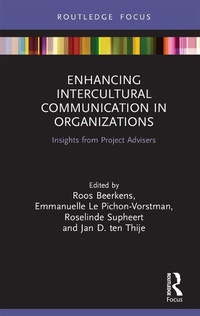
Enhancing Intercultural Communication in Organizations
Insights from Project Advisers
1st Edition
Published on 1. June 2020
166 pages
978-1-000-06900-6 (ISBN)
Description

This book provides a qualitative analysis of the process of consultancy, to prove how intercultural communication can solve issues rising from multiculturalism in organizations and policymaking.
Experts in intercultural consultancy examine 12 different cases from real situations, focusing on interviews with clients and the way advice is presented and discussed with them, and on collected data and the process by which it is gathered. The book proves how the mechanisms of intercultural communication can be used to foster respectful relationships between people of different cultural and linguistic backgrounds and contribute to the success of the project or organization in question.
This book will be a key resource for scholars and students involved in intercultural communication, management, and consultancy, as well as professionals that are confronted in their work with diversity and would like to know more about intercultural consultancy.
Additional questions for discussion and readings are available as e-resources on the Routledge Website.
Experts in intercultural consultancy examine 12 different cases from real situations, focusing on interviews with clients and the way advice is presented and discussed with them, and on collected data and the process by which it is gathered. The book proves how the mechanisms of intercultural communication can be used to foster respectful relationships between people of different cultural and linguistic backgrounds and contribute to the success of the project or organization in question.
This book will be a key resource for scholars and students involved in intercultural communication, management, and consultancy, as well as professionals that are confronted in their work with diversity and would like to know more about intercultural consultancy.
Additional questions for discussion and readings are available as e-resources on the Routledge Website.
More details
Series
Edition
1. Auflage
Language
English
Place of publication
London
United Kingdom
Publishing group
Taylor & Francis Ltd
Target group
College/higher education
Product notice
Reflowable
Illustrations
3 Tables, black and white; 5 Line drawings, black and white; 11 Illustrations, black and white
ISBN-13
978-1-000-06900-6 (9781000069006)
Copyright in bibliographic data and cover images is held by Nielsen Book Services Limited or by the publishers or by their respective licensors: all rights reserved.
Schweitzer Classification
Other editions
Additional editions
Roos Beerkens | Emmanuelle Le Pichon-Vorstman | Roselinde Supheert
Enhancing Intercultural Communication in Organizations
Insights from Project Advisers
Book
08/2022
1st Edition
Routledge
€36.10
Shipment within 15-20 days
Roos Beerkens | Emmanuelle Le Pichon-Vorstman | Roselinde Supheert
Enhancing Intercultural Communication in Organizations
Insights from Project Advisers
Book
07/2020
1st Edition
Routledge
€77.00
Shipment within 15-20 days
Persons
Roos Beerkens works as a lecturer at the Department of Language, Literature and Communication, University of Utrecht. She teaches within the Master's programme in Intercultural Communication and is the internship coordinator for the programme. She has gained experience as a trainer in intercultural competences and is working on research concerning the effectiveness of intercultural competences training. She received a summa cum laude for her PhD research at the University of Muenster, Germany, where she analysed Dutch-German communication in the border area. She has five years of experience as a communication consultant in the field of internal intercultural communication. She worked for a communication agency, carrying out projects for a variety of organizations.
Emmanuelle Le Pichon-Vorstman is a lecturer at Utrecht University and at the University of Toronto, Ontario Institute for Studies in Education. She is Head of the Centre de Recherches en Education Franco-Ontarienne (CREFO). Her keen interest in migration policy has led her to conduct research studies on issues related to multilingual education, particularly on the education of newly arrived migrant pupils in Europe and indigenous pupils in Suriname in collaboration with the Rutu Foundation. She has worked as a consultant, researcher, evaluator, and reviewer for several international organizations and international journals. She has participated in policy analyses, notably for the European Commission and the Migration Policy Institute.
Roselinde Supheert received her MPhil degree in linguistics from Cambridge University (1985) and obtained her PhD degree at Utrecht University (1995). Her research focuses on reception, intercultural communication. She teaches English language and literature, and intercultural communication, at Utrecht University. She has also worked as adviser to the English Department and to the Faculty of Humanities of Utrecht University in projects including the application of student peer review in proficiency teaching, curriculum development, and English proficiency, and internationalization and the use of non-native English as a classroom language.
Jan D. ten Thije is a senior lecturer at the Department of Languages, Literature and Communication at Utrecht University. His main fields of research concern institutional discourse in multicultural and international settings, receptive multilingualism, intercultural training, language education, and functional pragmatics. Since 2007 he has coordinated the Master's programme in Intercultural Communication. He is connected to the Utrecht Institute of Linguistics (UiL-OTS) at the Department of Languages, Literature and Communication at Utrecht University. He has been engaged in intercultural counselling and training activities in urban, academic, and European Committee constellations.
Emmanuelle Le Pichon-Vorstman is a lecturer at Utrecht University and at the University of Toronto, Ontario Institute for Studies in Education. She is Head of the Centre de Recherches en Education Franco-Ontarienne (CREFO). Her keen interest in migration policy has led her to conduct research studies on issues related to multilingual education, particularly on the education of newly arrived migrant pupils in Europe and indigenous pupils in Suriname in collaboration with the Rutu Foundation. She has worked as a consultant, researcher, evaluator, and reviewer for several international organizations and international journals. She has participated in policy analyses, notably for the European Commission and the Migration Policy Institute.
Roselinde Supheert received her MPhil degree in linguistics from Cambridge University (1985) and obtained her PhD degree at Utrecht University (1995). Her research focuses on reception, intercultural communication. She teaches English language and literature, and intercultural communication, at Utrecht University. She has also worked as adviser to the English Department and to the Faculty of Humanities of Utrecht University in projects including the application of student peer review in proficiency teaching, curriculum development, and English proficiency, and internationalization and the use of non-native English as a classroom language.
Jan D. ten Thije is a senior lecturer at the Department of Languages, Literature and Communication at Utrecht University. His main fields of research concern institutional discourse in multicultural and international settings, receptive multilingualism, intercultural training, language education, and functional pragmatics. Since 2007 he has coordinated the Master's programme in Intercultural Communication. He is connected to the Utrecht Institute of Linguistics (UiL-OTS) at the Department of Languages, Literature and Communication at Utrecht University. He has been engaged in intercultural counselling and training activities in urban, academic, and European Committee constellations.
Content
Introduction; Key Concepts; Part I: Policymakers; Case Study 1 Advising Municipalities on Schooling Newly Arrived Migrant Pupils; Case Study 2 Intercultural Communication Between a Municipality and Polish Migrants; Case Study 3 Internal Communication at the University of Aruba; Case Study 4 Lingua Receptiva at the Directorate-General for Translation (DGT) of the European Commission; PART II: Commercial Organizations; Case Study 5 Acquisition Within One country: How Two Organizational Cultures Come Together; Case Study 6 Enhancing Team Effectiveness for an Executive Team in Saudi Arabia; PART III: Education; Case Study 7 Advising Parents on Bilingual Education of Their Children; Case Study 8: Advising Linguistically Diverse Schools on Developing a School-wide Language Policy; Case Study 9 Shifting From a Monolingual to a Plurilingual Pedagogical Practice; PART IV: Non-profit Organizations; Case Study 10 Improving Specialized Mental Healthcare and Social Services for Deaf and Hard of Hearing Newcomers; Case Study 11 A Model Village Constitution for Indigenous Traditional Leaders in Suriname; Case Study 12 Photographers' Handling of Cultural Rituals and Conventions of Bereaved Parents After the Loss of a Child; Concluding Chapter
