

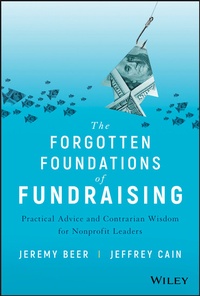
The Forgotten Foundations of Fundraising
Description

More details
Other editions
Additional editions
Content
Chapter 1
Civil Society, Yes; Sheepskins on the Wall, No-or, the Cons of Being Pro
This is a book for people who hate these kinds of books.
This book is also an act of reclamation. We aim to take back fundraising from the professionals and the degreed class, with their impenetrable jargon and their fetishized algorithms and their extortionate fees, and return it to its proper owners: Catholic-school moms, CEOs of smaller nonprofits, symphony orchestra development officers, idealistic think-tankers.the people who are the heart and soul of American civil society. Because civil society is not an exclusive club; it's a participatory democracy. It is citizenship in glorious action.
We don't like to bask in self-adulation, at least no more than any relatively normal person does. We don't like to toot our own horns, write our own press releases, or pen advertisements for ourselves. We don't want to come off as what sixth-grade girls used to call "conceited."
But, oh heck, let's.
Nah, we won't, but we do need to give you a brief and unadorned corporate resume in anticipatory response to a reader's inevitable question: "Just who are these guys, and why should I listen to them?"
We are Jeremy Beer and Jeff Cain. In 2009, we founded American Philanthropic, a consultancy that shuns secret formulas and magic bullets. Instead, AmPhil provides empirically based strategic guidance, essential tools, and practical training. Though the authors hold doctorates in Psychology and English Literature, respectively, please don't hold that against us: This book is academese-free, and not once will we use the words instantiate or semiotics.
Though our two names are blazoned on the cover, this really is a collaborative effort by all 30 or so of us at American Philanthropic, where Jeremy is now Principal Partner while Jeff toils as the CEO of CrossFit. Also pitching in for this effort was our friend Bill Kauffman, who is neither cross nor fit.
We and our colleagues have worked with hundreds of nonprofits over the last decade and helped them raise more than oodles but fewer than gazillions of dollars-we won't insult your intelligence by hanging a precise number on it, the way many consultants do. We learned much of what follows from our clients. And we learned by trial and error, by instinct and empiricism, by following promising leads down dead-end roads and stumbling into unexpected revelations. Our intention is to jump the reader 10 years ahead of where we were when we launched American Philanthropic.
Simplify, simplify, simplify is a simplistic mantra, but if you do two things well, you will raise ample funds: (1) Find new donors, and (2) cultivate the donors you have, moving them up the giving ladder. That's it.
Well, it's a little more complicated than that. Likewise, you could say that offensive football consists of just two things-running and passing the ball-but success depends upon how well you execute a variety of plays, formations, and strategies. In the case of fundraising, your playbook primarily consists of direct mail, meetings, and foundation grants. Down, set, hut. Perform these well and you'll raise more than enough money.
Fundraising isn't rocket science; in fact, the asocial father of rocket science, Robert Goddard, who was often distracted and unpleasant, would have been a lousy fundraiser, though the charismatic Werner von Braun might have done just fine if the space flight thing didn't work out for him.
What the world of fundraising is, though, is a banquet for those who feast on bad ideas.
In the early years of the company, we were continually surprised at our success. At first we thought that we were getting away with something, pulling the wool over our clients' eyes. After all, we had modest experience in fundraising and, at some level, felt that we were not qualified to teach others. We did in fact have a lot to learn. Over the years, though, and with the help of our wise clients and superb colleagues, we have found a way of doing things that works. We're still learning on the fly; anyone who has stopped learning has started to atrophy, and the next stop is complacent mediocrity. But we now understand more completely where we stand in the bigger scheme of fundraising professionals and nonprofit consulting companies. To borrow a lyric from those puckish nonconformists of the first wave of British rock, the Kinks, we're not like everybody else.
Some of the conventional wisdom about fundraising is, we have found, self-serving nonsense spooned out by consultants who benefit from its tenets. When we launched American Philanthropic, we had no reason or incentive to dissent from this conventional wisdom. Its bland certitudes seemed unobjectionable, if uninspiring.
But the realities of guiding hundreds of small and medium nonprofits toward fiscal health jolted us into the realization that the bland certitudes of the conventional wisdom are based on gross misunderstandings of human nature and why people give money to nonprofits. In obsessing over numbers, outcomes, and its endlessly advertised "rationalism," the fundraising establishment has often excluded the human factor from its calculations.
To the extent American Philanthropic has been successful, it is in part because we operate under no grand theory, no peremptory ideology. We take a simple nuts-and-bolts approach that we call, jokingly, DIRT. (Every scam artist and grifter who carries a business card identifying himself as a consultant traffics in acronyms; we chose ours with tongue only partly in cheek, since dirt is, quite literally, down to earth, and that's where we operate.)
We will dig into DIRT in the second chapter. For now, let's just point out that DIRT is what feeds the grassroots, and this humble agrarian metaphor fits the American Philanthropic philosophy. We stand, first and last, for civil society and for the idea that ordinary Americans-working in concert and motivated by love and fellowship and strong conviction within the private associations, societies, and charitable organizations that give America its pith, its heart, its spirit-are more valuable than the entire run of top-down, heavily credentialed, remote-controlled nonprofit Godzillas.
Don't be cowed by the arcane-often inane-language of the professional fundraiser. You don't need a degree in fundraising or a certificate in philanthropy, although several of our best friends in the field are so credentialed. "Let every sheep keep its own skin,"1 as Henry David Thoreau famously dismissed the acquisition of diplomas. Given that both of AmPhil's founders possess a PhD, we are not in full accord with the Thoreauvian sentiment, but we appreciate its implicit endorsement of native common sense and American autodidacticism over pedantic displays of formal learning.
If you are reasonably bright and interpersonally normal, you already have the necessary skills to raise money for your nonprofit. We'll give you the tools and tell you what you need to know. Follow our advice-get down in the DIRT-and you'll be successful. You'll also save yourself a lot of grief, not to mention money. (Doctorates in philanthropy don't come cheap!)
In the chapters that follow, we'll tell you how to find donors and how to keep them, how to plan for organizational success and how to achieve it, and how best to employ mailings, meetings, events, donor clubs, planned giving, foundation outreach, and more in furtherance of your nonprofit's goals.
We mentioned civil society, which has about it the whiff of a buzzword, an empty vocable of the sort used by hack political speechwriters.
It's not. Civil society is just a faintly pretentious name for America. For the essence of America is voluntary human collaboration and mutual aid. It is community, sodality, solidarity, pursued collectively but noncoercively.
Civil society is what makes America America. It is the Little League, the volunteer fire department, the quilting guild, the historical society, the Society of St. Vincent de Paul and the deacons of the Presbyterian Church and the African Methodist Episcopal Church choir and the Candy Stripers and the town's concert band and the reggae circle and the Gilbert & Sullivan amateur troupe and the Village Green Preservation Society. And sure, a rung or two up the ladder it also includes your city's aquarium, museums, liberal arts college, and other well-heeled institutions.
Though diminished, service clubs remain the civic backbone of many communities: Rotary, Lions, Kiwanis, Zonta, Elks. They are part of the American legacy of voluntary associations. They undergird our communities; without them, we may as well be free-floating atoms, unconnected and wanton.
Alexis de Tocqueville, the keen-eyed French observer of the American scene during the Jacksonian era, marveled at the profusion of voluntary associations within the new republic:
Americans of all ages, all conditions, and all dispositions constantly form associations. They have not only commercial and manufacturing companies, in which all take part, but associations of a thousand other kinds, religious, moral, serious, futile, general or restricted, enormous or diminutive. The Americans make associations to give entertainments, to found seminaries, to build...
