

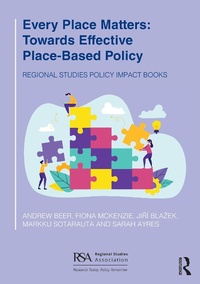
Every Place Matters
Towards Effective Place-Based Policy
1st Edition
Published on 8. December 2020
84 pages
978-1-000-34229-1 (ISBN)
Description

Across the globe policy makers implement, and academics teach and undertake research upon, place-based policy. But what is place-based policy, what does it aspire to achieve, what are the benefits of place-based approaches relative to other forms of policy, and what are the key determinants of success for this type of government intervention? This Policy Expo examines these questions, reviewing the literature and the experience of places and their governments around the world. We find place-based policies are essential in contemporary economies, providing solutions to otherwise intractable challenges such as the long-term decline of cities and regions. For those working in public sector agencies the success or failure of place-based policies is largely attributable to governance arrangements, but for researchers the community that is the subject of this policy effort, and its leadership, determines outcomes. This Policy Expo explores the differing perspectives on place-based policy and maps out the essential components of effective and impactful actions by government at the scale of individual places.
Reviews / Votes
"Cohesion policy targets all regions and cities in the EuropeanUnion in order to promote sustainable growth and job
creation and improve the quality of life. It is the EU expression
of a place-based policy and the most important investment
policy in the EU budget. This Policy Expo examines a range
of place-based policies throughout the world, emphasises
the specific cities vis-a-vis spatially blind policies, and identifies
the conditions for success. It is a major contribution to help
policy makers and researchers in their design of programmes
and policies. This book will provide benefits to all, in particular
those living in the regions most affected by economic, social,
environmental and demographic change."
Marc Lemaitre, Director-General, DG Regional and Urban
Policy, European Commission.
"Every place matters. Economic well-being and social
and political progress depend on making the most of the
potential of places. This Expo represents the ultimate guide to
designing and implementing better and more incisive placebased
policies for all, wherever you are in the world."
Andres Rodriguez-Pose, Professor of Economic Geography,
London School of Economics. "Cohesion policy targets all regions and cities in the European Union in order to promote sustainable growth and job creation and improve the quality of life. It is the EU expression of a place-based policy and the most important investment policy in the EU budget. This Policy Expo examines a range of place-based policies throughout the world, emphasises the specific cities vis-a-vis spatially blind policies, and identifies the conditions for success. It is a major contribution to help policy makers and researchers in their design of programmes and policies. This book will provide benefits to all, in particular those living in the regions most affected by economic, social, environmental and demographic change."
Marc Lemaitre, Director-General, DG Regional and Urban Policy, European Commission.
"Every place matters. Economic well-being and social and political progress depend on making the most of the potential of places. This Expo represents the ultimate guide to designing and implementing better and more incisive place-based policies for all, wherever you are in the world."
Andres Rodriguez-Pose, Professor of Economic Geography, London School of Economics.
More details
Series
Edition
1. Auflage
Language
English
Place of publication
London
United Kingdom
Publishing group
Taylor & Francis Ltd
Target group
College/higher education
Professional and scholarly
Illustrations
2 Tables, color; 46 Line drawings, color; 46 Illustrations, color
ISBN-13
978-1-000-34229-1 (9781000342291)
Copyright in bibliographic data and cover images is held by Nielsen Book Services Limited or by the publishers or by their respective licensors: all rights reserved.
Schweitzer Classification
Other editions
Additional editions
Book
12/2020
1st Edition
Routledge
€43.32
Shipment within 15-20 days
Persons
Andrew Beer is the Executive Dean, UniSA Business, University of South Australia.
Fiona McKenzie is Principal Researcher, Land Use and Population Research, in the Victorian Government's Department of Environment, Land, Water and Planning, Australia.
Jiri Blazek is an Associate Professor at the Department of Social Geography and Regional Development, Charles University, Czech Republic.
Markku Sotarauta is Professor of Regional Development in the Faculty of Management and Business at Tampere University, Finland.
Sarah Ayres is Professor of Public Policy and Governance at the University of Bristol, UK.
Fiona McKenzie is Principal Researcher, Land Use and Population Research, in the Victorian Government's Department of Environment, Land, Water and Planning, Australia.
Jiri Blazek is an Associate Professor at the Department of Social Geography and Regional Development, Charles University, Czech Republic.
Markku Sotarauta is Professor of Regional Development in the Faculty of Management and Business at Tampere University, Finland.
Sarah Ayres is Professor of Public Policy and Governance at the University of Bristol, UK.
Content
Preamble
Authors
Executive Summary
Key Recommendations
1. What is Place-Based Policy?
1.1 Introduction
1.2 Defining place
1.3 Policy and place
1.4 Place-based versus spatially blind policies
1.5 Subjective aspects of place-based policy
1.6 Structure of the book
2. What are the Benefits of Place-Based Policy?
2.1 Introduction
2.2 Generating economic growth
2.2.1 Innovation and place-based policy
2.2.2 Universities and place-based policy
2.3 Creating better policy outcomes
2.4 Improving well-being
2.5 Responding to economic shocks and supporting transition
2.6 Addressing disadvantage
2.7 Conclusions
3. Requirements and Challenges of Place-Based Policy
3.1 Introduction
3.2 Governance
3.2.1 The governance of Smart Specialisation
3.3 Leadership
3.4 Policy Challenges
3.4.1 Faltering expectations
3.4.2 Vested interests
3.4.3 Lack of financial resources
3.4.4 Measuring success
3.5 Conclusions
4. Outcomes of Place-Based Policy: What Works and What Does Not?
4.1 Introduction
4.2 Place-based policies in response to an economic shock: the Latrobe Valley in Gippsland, Australia
4.3 Place-based policies for innovation and economic growth: Finland and Sweden
4.4 Placed-based innovation policies and the role of time frame and support by political leaders: South Moravia, Czechia
4.5 Place-based adaptation using collaborative governance: Nova Scotia, Canada
4.6 Place-based policy to address economic disadvantage: City of Iida, Nagano Prefecture, Japan
4.7 Conclusions
5. Conclusions: Questions Answered, Issues Remaining
5.1 How can governments and communities best deliver place-based policy?
5.2 What are the barriers to, and enablers of, the successful implementation of place-based policies?
5.3 What is the role of city or regional leadership in place-based policy, and what is the relationship with systems of governance?
5.4 Can we identify instances of the successful implementation of place-based policies?
5.5 What are the key lessons for policy-makers, the academiccommunity and major institutions seeking to enable place-based policy?
5.6 How can we build a community of practice around place-based policy in order to enable better social, economic and environmental outcomes?
5.7 Final observations
Glossary
Authors
Executive Summary
Key Recommendations
1. What is Place-Based Policy?
1.1 Introduction
1.2 Defining place
1.3 Policy and place
1.4 Place-based versus spatially blind policies
1.5 Subjective aspects of place-based policy
1.6 Structure of the book
2. What are the Benefits of Place-Based Policy?
2.1 Introduction
2.2 Generating economic growth
2.2.1 Innovation and place-based policy
2.2.2 Universities and place-based policy
2.3 Creating better policy outcomes
2.4 Improving well-being
2.5 Responding to economic shocks and supporting transition
2.6 Addressing disadvantage
2.7 Conclusions
3. Requirements and Challenges of Place-Based Policy
3.1 Introduction
3.2 Governance
3.2.1 The governance of Smart Specialisation
3.3 Leadership
3.4 Policy Challenges
3.4.1 Faltering expectations
3.4.2 Vested interests
3.4.3 Lack of financial resources
3.4.4 Measuring success
3.5 Conclusions
4. Outcomes of Place-Based Policy: What Works and What Does Not?
4.1 Introduction
4.2 Place-based policies in response to an economic shock: the Latrobe Valley in Gippsland, Australia
4.3 Place-based policies for innovation and economic growth: Finland and Sweden
4.4 Placed-based innovation policies and the role of time frame and support by political leaders: South Moravia, Czechia
4.5 Place-based adaptation using collaborative governance: Nova Scotia, Canada
4.6 Place-based policy to address economic disadvantage: City of Iida, Nagano Prefecture, Japan
4.7 Conclusions
5. Conclusions: Questions Answered, Issues Remaining
5.1 How can governments and communities best deliver place-based policy?
5.2 What are the barriers to, and enablers of, the successful implementation of place-based policies?
5.3 What is the role of city or regional leadership in place-based policy, and what is the relationship with systems of governance?
5.4 Can we identify instances of the successful implementation of place-based policies?
5.5 What are the key lessons for policy-makers, the academiccommunity and major institutions seeking to enable place-based policy?
5.6 How can we build a community of practice around place-based policy in order to enable better social, economic and environmental outcomes?
5.7 Final observations
Glossary
