

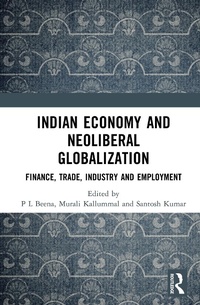
Indian Economy and Neoliberal Globalization
Finance, Trade, Industry and Employment
1st Edition
Published on 20. December 2022
406 pages
978-1-000-78673-6 (ISBN)
Description

This book assesses the effects of globalization and neoliberal economic regimes in low- and middle-income countries, primarily on industries, investment and trade; finance and credit; and employment, gender and development.
The volume - written to honour the rich academic work of the eminent economist Professor C. P. Chandrasekhar - addresses issues which are relevant to emerging economies and their concerns around development, investment, financial planning and adopting new technologies. It analyses the new financial systems and institutions and the dominance of global finance in policymaking in these countries and their effects in the postpandemic period. It examines the changing contours of finance, trade and labour models and laws in developing countries to assess the risks and concerns of economic crises and challenges. The volume does justice to an assessment of the macroeconomic and developmental implications of neoliberal policies in India while offering an insightful overview of the new economic practices and policies. It also offers suggestions and measures to address concerns regarding banking and global liquidity, reinforce robust strategies for growth in both small and large industries and bring in reform.
This book will be of interest to scholars and students of economics, political economy, finance and trade, development studies and South Asian studies.
The volume - written to honour the rich academic work of the eminent economist Professor C. P. Chandrasekhar - addresses issues which are relevant to emerging economies and their concerns around development, investment, financial planning and adopting new technologies. It analyses the new financial systems and institutions and the dominance of global finance in policymaking in these countries and their effects in the postpandemic period. It examines the changing contours of finance, trade and labour models and laws in developing countries to assess the risks and concerns of economic crises and challenges. The volume does justice to an assessment of the macroeconomic and developmental implications of neoliberal policies in India while offering an insightful overview of the new economic practices and policies. It also offers suggestions and measures to address concerns regarding banking and global liquidity, reinforce robust strategies for growth in both small and large industries and bring in reform.
This book will be of interest to scholars and students of economics, political economy, finance and trade, development studies and South Asian studies.
More details
Edition
1. Auflage
Language
English
Place of publication
London
United Kingdom
Publishing group
Taylor & Francis Ltd
Target group
College/higher education
Professional and scholarly
Product notice
Reflowable
Illustrations
84 Tables, black and white; 83 Line drawings, black and white; 83 Illustrations, black and white
ISBN-13
978-1-000-78673-6 (9781000786736)
Copyright in bibliographic data and cover images is held by Nielsen Book Services Limited or by the publishers or by their respective licensors: all rights reserved.
Schweitzer Classification
Other editions
Additional editions
P. L. Beena | Murali Kallummal | Santosh Kumar
Indian Economy and Neoliberal Globalization
Finance, Trade, Industry and Employment
Book
08/2024
1st Edition
Routledge India
€64.40
Shipment within 10-20 days
P. L. Beena | Murali Kallummal | Santosh Kumar
Indian Economy and Neoliberal Globalization
Finance, Trade, Industry and Employment
Book
12/2022
1st Edition
Routledge India
€187.30
Shipment within 10-20 days
Persons
P L Beena is Associate Professor at the Centre for Development Studies, Thiruvananthapuram, Kerala, India.
Murali Kallummal is Professor at the Centre for WTO Studies, Indian Institute of Foreign Trade, New Delhi, India.
Santosh Kumar is Associate Professor of Economics in Department of Commerce, Shri Ram College of Commerce, University of Delhi, India.
Murali Kallummal is Professor at the Centre for WTO Studies, Indian Institute of Foreign Trade, New Delhi, India.
Santosh Kumar is Associate Professor of Economics in Department of Commerce, Shri Ram College of Commerce, University of Delhi, India.
Content
List of Figures
List of Tables
List of Contributors
Foreword
1 Introduction
P L BEENA, MURALI KALLUMMAL AND SANTOSH KUMAR
2 Is Global Economy Heading towards a Sovereign Debt Crisis?
ABHIJIT MUKHOPADHYAY
3 Global Liquidity and Emerging Market Economies
S. KRISHNAKUMAR
4 Our Preoccupation with Speculation and its Consequences for Commodity Derivatives Markets in India
ROSE MARY K ABRAHAM
5 Rural Credit and Growth in Indian Agriculture
AKANKSHA PRATIK SONKER
6 Decline of DFIs in India during Post-Financial Liberalisation
SANTOSH KUMAR
7 Impact of India's Bilateral Investment Treaties on FDI Quality: A Firm-Level Analysis
AMRITA GOLDAR
8 India's Tariff Jumping FDI: A Case of Overseas Investment Flows under ASEAN-India FTA
MURALI KALLUMMAL AND SOMDUTTA BANERJEE
9 Mergers and Acquisitions and Antitrust Implications: Evidence from the High-Tech Manufacturing Sector
P L BEENA AND SMRUTI RANJAN SAHOO
10 Industrialisation and Role of MSMEs in India: With a special Reference to Punjab
JATINDER SINGH
11 Bridging the Gap: A Critical Assessment of the Digital Divide in India
GAUTAM KUMAR JHA
12 Liberalisation of Petroleum Product Prices in India: Expectation and Reality
ANIMESH KUMAR
13 An Enquiry into India's Labour Market Flexibility: Learning from the Literature
DEVANGANA JHA
14 Female Employment in the Retail Trade Sector in India
BINDU OBEROI
15 Women's Workforce Participation and Spousal Violence: Insights from India
ARPITA BISWAS AND ANJANA THAMPI
Index
List of Tables
List of Contributors
Foreword
1 Introduction
P L BEENA, MURALI KALLUMMAL AND SANTOSH KUMAR
2 Is Global Economy Heading towards a Sovereign Debt Crisis?
ABHIJIT MUKHOPADHYAY
3 Global Liquidity and Emerging Market Economies
S. KRISHNAKUMAR
4 Our Preoccupation with Speculation and its Consequences for Commodity Derivatives Markets in India
ROSE MARY K ABRAHAM
5 Rural Credit and Growth in Indian Agriculture
AKANKSHA PRATIK SONKER
6 Decline of DFIs in India during Post-Financial Liberalisation
SANTOSH KUMAR
7 Impact of India's Bilateral Investment Treaties on FDI Quality: A Firm-Level Analysis
AMRITA GOLDAR
8 India's Tariff Jumping FDI: A Case of Overseas Investment Flows under ASEAN-India FTA
MURALI KALLUMMAL AND SOMDUTTA BANERJEE
9 Mergers and Acquisitions and Antitrust Implications: Evidence from the High-Tech Manufacturing Sector
P L BEENA AND SMRUTI RANJAN SAHOO
10 Industrialisation and Role of MSMEs in India: With a special Reference to Punjab
JATINDER SINGH
11 Bridging the Gap: A Critical Assessment of the Digital Divide in India
GAUTAM KUMAR JHA
12 Liberalisation of Petroleum Product Prices in India: Expectation and Reality
ANIMESH KUMAR
13 An Enquiry into India's Labour Market Flexibility: Learning from the Literature
DEVANGANA JHA
14 Female Employment in the Retail Trade Sector in India
BINDU OBEROI
15 Women's Workforce Participation and Spousal Violence: Insights from India
ARPITA BISWAS AND ANJANA THAMPI
Index
