

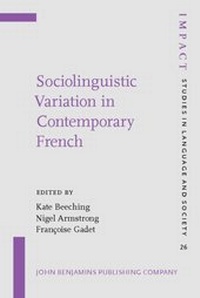
Sociolinguistic Variation in Contemporary French
1st Edition
Published on 14. October 2009
XI, 257 pages
978-90-272-8899-8 (ISBN)
Description

Divided into three main sections on Phonology, Syntax and Semantics, this new volume on variation in French aims to provide a snapshot of the state of sociolinguistic research inside and outside metropolitan France. From a diatopic perspective, varieties in France, Belgium, Switzerland, Africa and Canada are considered, mainly with respect to phonological features but also focusing on syntactic and lexical evolutions (the relative clause in Ivorian French and discourse markers in Canadian French). The acquisition of stylistic features of French figures in chapters on both first and second language learners and variation across different genres is addressed with respect to non-standard non-finite forms. Finally, a section on semantic change traces the way that interactional and other socio-historical factors affect word meaning. The volume will appeal to (socio-)linguists with an interest in contemporary French as well as to advanced undergraduates and post-graduate students of French and specialists in the field.
More details
Other editions
Additional editions
Kate Beeching | Nigel Armstrong | Francoise Gadet
Sociolinguistic Variation in Contemporary French
Book
10/2009
John Benjamins Publishing Co
€104.94
Shipment within 10-15 days
Persons
Content
- Sociolinguistic Variation in Contemporary French
- Editorial page
- Title page
- LCC data
- Table of contents
- Introduction
- In defense of quantitative approaches
- Overview of the volume
- References
- I. Phonological variation and leveling
- Introduction
- References
- Perception and production in French dialect leveling
- Introduction: definition of leveling
- Perceptions of leveling
- Dialect leveling in the production of French
- Summary and concluding remarks
- References
- The sociolinguistic relevance of regional categories
- Introduction
- Regional French in Belgium and standardization
- Word-final consonant devoicing: sociolinguistic and phonetic perspectives
- Data collection and analysis
- Results
- Discussion
- Conclusion
- References
- Appendix
- Prosodic style-shifting as audience design
- Introduction
- Research questions
- Preliminary observations
- Methods
- Results
- Summary and conclusion
- References
- The immigrant factor in phonological leveling
- Immigration and vernacular French
- The Maghrebians in Paris, Grenoble and Marseille
- Lille
- Linguistic and sociolinguistic comparison of 1995 and 2005 corpora
- Conclusion
- References
- A prototype-theoretic model of Southern French
- Introduction
- The significance of prototype theory for the linguistics of varieties
- Methodology
- Correlation of perception and production data
- Summary and discussion
- Conclusion
- References
- The law of position revisited
- Introduction
- The presence of two norms: Reference French vs. Southern French
- Dialect contact and leveling
- Methodology
- Results
- Conclusion
- References
- II. Stylistic and syntactic variation
- Introduction
- References
- Variation in first and second language French
- Introduction
- Looking at variation
- Data
- Results
- Discussion
- Conclusion
- References
- Appendix
- French preadolescents' perceptions of stylistic variation
- Introduction
- Context of the study, problems addressed and hypotheses
- Methodology for data collection and analysis: perceptions of stylistic variation collected in individual interviews
- Results: what are the preadolescents' perceptions about stylistic variation and how do social factors influence these perceptions?
- Analysis of the open question in the experimental situation: confirmation of the social diversity influence in preadolescents' declared perceptions of variation
- Some comments on style in recordings made under natural conditions: highlighting the 'eux / nous' ('them / us') issue
- Conclusion
- Transcription conventions
- References
- Sociolinguistic variation in African French
- Introduction
- French in Ivory Coast: Sociolinguistic profile
- French in Ivory Coast: A general linguistic description
- The relative in Ivorian French: a morphosyntactic description
- Inter-, intra- and extrasystemic motivations
- Conclusion
- References
- Register variation in the nonstandarduse of non-finite forms
- Introduction / General considerations
- Participles and gerunds: open to register variation
- Infinitives: not prone to register variation
- Towards a hybridization of the spoken and written codes?
- Conclusion
- References
- III. Lexical variation and semantic change
- Introduction
- References
- Discourse markers and regional variation in French
- Introduction to the Field
- Markers which Derive from Perception/Cognition Verbs, and the Case of Coudon in Quebec French
- Markers derived from temporal/consecutive items, and the case of pis in Quebec French
- Overall conclusion
- References
- Sociolinguistic factorsand the pragmaticalization of bonin contemporary spoken French
- Introduction
- Qualitative and quantitative analysis of bon in the CRFP, with some references to the ESLO (1968) Corpus and the Beeching (1988) Corpus
- Conclusion
- References
- From 'luck' to 'wealth'
- Introduction
- The semantic change of fortuné in Modern French: from 'happy' to 'rich'
- The proscription of the modern use of fortuné in dictionaries
- Fortuné's prevailing sense and its stylistic redistribution in contemporary French
- The euphemistic use of fortuné
- Conclusion
- References
- Appendix
- Index
- The series IMPACT: Studies in language and society
