

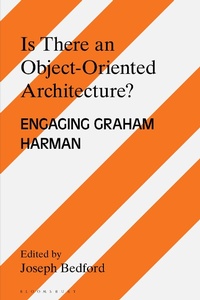
Is there an Object Oriented Architecture?
Engaging Graham Harman
1st Edition
Published on 20. February 2020
200 pages
978-1-350-13346-4 (ISBN)
Description

Bringing Graham Harman's philosophy into direct confrontation with contemporary architectural theory in new and creative ways, Is There an Object-Oriented Architecture? provides a dialogue between Harman and six of the world's leading architectural thinkers, Adam Sharr, Lorens Holm, Jonathan Hale, Peg Rawes, Patrick Lynch and Peter Carl.
Harman's object-oriented philosophy is one that sees the universe as a carnival of equal "objects" with no hierarchy between humans and nonhumans. In his model, unicorns, triangles, bicycles, neutrons, and humans are all things with enduring essences that outlast their partial transformations. It is a strikingly democratic vision of the universe that knocks humans off their ontological pedestal as arbiters of what is real. It also radically challenges the very precepts of architectural theory, the structure of which remains stubbornly human-centric as it seeks to give form to the human being's place at the centre of the cosmos.
In this new book, each thinker develops the implications of Harman's philosophy for the future of architecture by entering into a direct exchange with the philosopher and his thinking, both questioning him and questioning with him.
Harman's object-oriented philosophy is one that sees the universe as a carnival of equal "objects" with no hierarchy between humans and nonhumans. In his model, unicorns, triangles, bicycles, neutrons, and humans are all things with enduring essences that outlast their partial transformations. It is a strikingly democratic vision of the universe that knocks humans off their ontological pedestal as arbiters of what is real. It also radically challenges the very precepts of architectural theory, the structure of which remains stubbornly human-centric as it seeks to give form to the human being's place at the centre of the cosmos.
In this new book, each thinker develops the implications of Harman's philosophy for the future of architecture by entering into a direct exchange with the philosopher and his thinking, both questioning him and questioning with him.
More details
Series
Edition
1. Auflage
Language
English
Place of publication
London
United Kingdom
Publishing group
Bloomsbury Publishing PLC
Target group
College/higher education
Illustrations
10 bw illus
ISBN-13
978-1-350-13346-4 (9781350133464)
Copyright in bibliographic data and cover images is held by Nielsen Book Services Limited or by the publishers or by their respective licensors: all rights reserved.
Schweitzer Classification
Other editions
Additional editions
Book
08/2021
Bloomsbury Academic
€59.67
Shipment within 15-20 days
Book
02/2020
Bloomsbury Academic
€136.60
Shipment within 15-20 days
Person
Joseph Bedford is Assistant Professor, school of architecture and design, Virginia Tech University, USA. He is an historian, theorist and architectural educator. He was trained in architecture at Cambridge University, The Cooper Union and Princeton University, and is the holder of the 2008-2009 Rome Prize at the British School in Rome.
Graham Harman is Distinguished Professor of Philosophy at SCI-Arc in Los Angeles, USA and Professor of Philosophy at the European Graduate School. His work on the metaphysics of objects led to the development of object-oriented ontology and he is a central figure in the speculative realism trend in contemporary philosophy. His most recent books include Object-Oriented Ontology: A New Theory of Everything (2018) and Speculative Realism: An Introduction (2018)
Graham Harman is Distinguished Professor of Philosophy at SCI-Arc in Los Angeles, USA and Professor of Philosophy at the European Graduate School. His work on the metaphysics of objects led to the development of object-oriented ontology and he is a central figure in the speculative realism trend in contemporary philosophy. His most recent books include Object-Oriented Ontology: A New Theory of Everything (2018) and Speculative Realism: An Introduction (2018)
Content
prelims
acknowledgements
Introduction: Joseph Bedford (Virginia Tech), Object-Oriented Architecture
Chapter 1: Graham Harman (SCi-art, USA and the European Graduate School, Switzerland), What is Object-Oriented Architecture?
Chapter 2: Adam Sharr (Newcastle University, UK): The Circus, the Canon and a House with One Wall
Chapter 3: Lorens Holm (Dundee University, UK), Architecture and its Objects
Chapter 4: Peter Carl (London Metropolitan University, UK), Practical Wisdom, Morals and Ethics
Chapter 5: Patrick Lynch (Lynch Architects), The Resistance of Things
Chapter 6: Peg Rawes (University College London, UK), Nonhuman Architectural Ecologies
Chapter 7: Jonathan Hale (Nottingham University, UK), Coping Without Noticing
bibliography
index
acknowledgements
Introduction: Joseph Bedford (Virginia Tech), Object-Oriented Architecture
Chapter 1: Graham Harman (SCi-art, USA and the European Graduate School, Switzerland), What is Object-Oriented Architecture?
Chapter 2: Adam Sharr (Newcastle University, UK): The Circus, the Canon and a House with One Wall
Chapter 3: Lorens Holm (Dundee University, UK), Architecture and its Objects
Chapter 4: Peter Carl (London Metropolitan University, UK), Practical Wisdom, Morals and Ethics
Chapter 5: Patrick Lynch (Lynch Architects), The Resistance of Things
Chapter 6: Peg Rawes (University College London, UK), Nonhuman Architectural Ecologies
Chapter 7: Jonathan Hale (Nottingham University, UK), Coping Without Noticing
bibliography
index
