

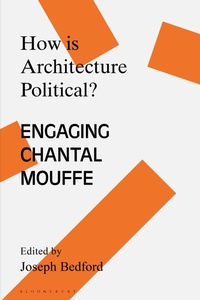
How is Architecture Political?
Engaging Chantal Mouffe
1st Edition
Published on 7. March 2024
192 pages
978-1-350-26307-9 (ISBN)
Description

Chantal Mouffe has transformed the contemporary understanding of politics through her re-reading of political theory inspired by anti-foundationalist philosophy-based on Saussure's linguistics, Freud's psychoanalysis and Derrida's deconstruction. Her writings have challenged the centrist, post-political ideology of the 1990s and presciently diagnosed the emergence of right-wing populism seen today with Trump and Brexit. For Mouffe, such populism is the result of the failed centrist conception of politics reduced to technical management. She has called for a "return to politics" on the view that social antagonisms cannot be reconciled but must be channeled into an agonistic form of institutionally stabilized struggle.
This book brings Chantal Mouffe's agonistic model of politics into direct dialogue with architecture and inquiries into the role that architecture plays constructing the political order of society, either by concealing or revealing its antagonisms and ideological conflicts. In doing so, it asks in what ways architecture operates politically; whether institutionally, in terms of its spaces and its part in forming cities, or as an aesthetic object with mediatic agency. Through this detailed exchange between Mouffe and four of the world's leading architectural thinkers; Reinhold Martin, Ines Weizman, Pier Vittorio Aureli and Sarah Whiting, a debate unfolds within the book that tests the implications of Mouffe's agonistic model of politics for architectural practice today. Through this, Bedford explores how architectural history, architectural drawing, the making of spectacular monuments, the design and policies behind housing, and the making of public and private space, all potentially contribute to the formulation of the channeling of social conflict into an agonistic form.
This book brings Chantal Mouffe's agonistic model of politics into direct dialogue with architecture and inquiries into the role that architecture plays constructing the political order of society, either by concealing or revealing its antagonisms and ideological conflicts. In doing so, it asks in what ways architecture operates politically; whether institutionally, in terms of its spaces and its part in forming cities, or as an aesthetic object with mediatic agency. Through this detailed exchange between Mouffe and four of the world's leading architectural thinkers; Reinhold Martin, Ines Weizman, Pier Vittorio Aureli and Sarah Whiting, a debate unfolds within the book that tests the implications of Mouffe's agonistic model of politics for architectural practice today. Through this, Bedford explores how architectural history, architectural drawing, the making of spectacular monuments, the design and policies behind housing, and the making of public and private space, all potentially contribute to the formulation of the channeling of social conflict into an agonistic form.
More details
Series
Edition
1. Auflage
Language
English
Place of publication
London
United Kingdom
Publishing group
Bloomsbury Publishing PLC
Target group
Professional and scholarly
Illustrations
20 bw photos
ISBN-13
978-1-350-26307-9 (9781350263079)
Copyright in bibliographic data and cover images is held by Nielsen Book Services Limited or by the publishers or by their respective licensors: all rights reserved.
Schweitzer Classification
Other editions
Additional editions
Book
10/2025
Bloomsbury Academic
€43.60
Shipment within 15-20 days
Book
04/2024
Bloomsbury Academic
€116.80
Shipment within 15-20 days
Person
Joseph Bedford is Associate Professor of History and Theory at Virginia Tech, USA. He holds a PhD from Princeton University, degrees from Cambridge University and the Cooper Union, and is the founding editor of Attention: The Audio Journal for Architecture and The Architecture Exchange, a platform for theoretical exchange in architecture.
Content
Acknowledgements
1. Introduction: How is Architecture Political?, Joseph Bedford (Virginia Tech, USA)
2. Can Architecture be Political?, Pier Vittorio Aureli (École Polytechnique Fédérale de Lausanne, Switzerland)
3. Polis - Oikos, Reinhold Martin (Columbia University, USA)
3. Mobilizing Dissent: The Possible Architecture of the Governed, Ines Weizman (Academy of Fine Arts, Vienna, Austria)
4. Agonistic Practice, Sarah Whiting (Harvard University, USA)
5. The Politics of Architecture, Round Table
6. How to Envisage the Political Dimension of Architecture, Chantal Mouffe (University of Westminster, UK)
Afterword: Chantal Mouffe
Bibliography
Index
1. Introduction: How is Architecture Political?, Joseph Bedford (Virginia Tech, USA)
2. Can Architecture be Political?, Pier Vittorio Aureli (École Polytechnique Fédérale de Lausanne, Switzerland)
3. Polis - Oikos, Reinhold Martin (Columbia University, USA)
3. Mobilizing Dissent: The Possible Architecture of the Governed, Ines Weizman (Academy of Fine Arts, Vienna, Austria)
4. Agonistic Practice, Sarah Whiting (Harvard University, USA)
5. The Politics of Architecture, Round Table
6. How to Envisage the Political Dimension of Architecture, Chantal Mouffe (University of Westminster, UK)
Afterword: Chantal Mouffe
Bibliography
Index
