

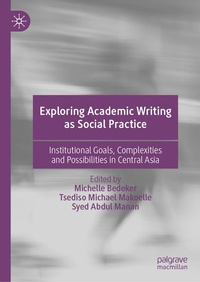
Exploring Academic Writing as Social Practice
Description

This book poses a provocative question: what happens when academic writing is imported not just as a skill set, but as an ideology, one that dictates whose knowledge counts, which languages belong, and how scholarly voice should sound? Focusing on English-medium instruction (EMI) universities in Central Asia, the book reimagines academic writing as a social practice rooted in power, identity, and institutional histories. Across chapters, contributors examine how students and educators negotiate imported norms, develop scholarly voice, and contest epistemic hierarchies through feedback, supervision, and writing groups. Rather than adopting global prescriptions, the book foregrounds local pedagogies, culturally embedded challenges, and creative responses to writing in EMI university contexts. As one of the first regionally grounded academic literacies volumes in Central Asia, this book offers essential insights for scholars of writing development, decolonial education, and the politics of knowledge production in global higher education reform.
More details
Other editions
Additional editions
Persons
Michelle Bedeker is Head of Education at New Uzbekistan University. She holds a PhD in Language and Literacy Studies. Her research critically explores multilingual education and pedagogy using postcolonial and interdisciplinary frameworks, with a focus on equity, multilingualism, and critical engagement with global education reforms in the Central Asian context.
Tsediso Michael Makoelle is the Dean of Education at the University of Fort Hare, South Africa. He holds a PhD in Inclusive Education (Manchester, UK) and a DEd in Educational Leadership (South Africa). As a Nelson Mandela Scholar, he has made significant contributions to educational inclusion, leadership, and higher education reform.
Syed Abdul Manan heads the Research Ethics Department at the Graduate School of Education, Nazarbayev University, Kazakhstan. His research, teaching, and supervision interests include language education policy and planning, EMI, multilingual practices, World Englishes, and language policy issues concerning the politics, economics, and sociology of language, as well as linguistic rights and social justice.
Content
Chapter 1 The Academic Literacies Approach for Diversity Academic Writing as a Social Practice in Higher Education in Central Asia.- Chapter 2 Embedding a culture and pedagogy of social practices in a University Learning and Teaching Centre Policy, connection and professional learning.- Chapter 3 Designing English Academic Writing Support A Social Practices Framework.- Chapter 4 A Social Practices Lens to Explore an Academic Foundation Programme in Kazakhstan.- Chapter 5 Faculty Academic Writing Views and Practices Why do we need a Social Practice Lens in Kazakhstan.-Chapter 6 I steal time from my courses to teach academic writing A social practices view of academic writing at two universities in Kazakhstan.- Chapter 7 Navigating Ambiguity to Achieve Clarity Complexities in Providing Thesis Writing Support from the Perspectives of Two Academic English Instructors.- Chapter 8 Leveraging the Triadic Componential Framework for Academic Writing Task Design A Social Practice Lens.- Chapter 9 I have shaped my own path to follow A Social Practices View to Scaffolding Graduate Students Scholarly Voice and Identities in Academic Writing.- Chapter 10 I only encountered academic writing when I prepared for my IELTS exam A Social Practice View of Graduate Students Navigation of Academic Writing.- Chapter 11 EMI and students academic writing challenges A Social Practice View to support policy and practice.- Chapter 12 Exploring the Role of ChatGPT in Foundation Year Students Academic Literacy Practices.- Chapter 13 AI and the Emergence of New Academic Writing Literacies Graduate Student Perspectives on Its Affordances and Challenges.- Chapter 14 Academic Writing as Social Practice in Central Asia then, now and way forward.
