

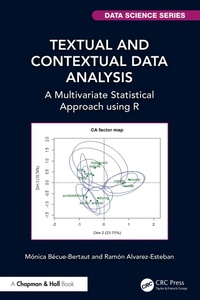
Textual and Contextual Data Analysis
A Multivariate Statistical Approach using R
Will be published approx. on 22. July 2026
250 pages
978-1-040-45571-5 (ISBN)
Description

Multidimensional statistical analysis of textual data is a powerful technique that enables researchers to uncover deeper insights into the context and meaning of documents. This book addresses the challenge of jointly analyzing textual and contextual data, presenting rigorous theoretical foundations alongside practical methodologies. By incorporating metadata and contextual information, readers can extract richer, more nuanced information from textual corpora, making this book an essential resource for statisticians, data scientists, and linguistics experts.
The book explores a wide range of textual data, from open-ended survey responses and political speeches to legal texts, literary works, and technical reports. It also examines the diverse contextual variables that shape these texts, such as sociodemographic characteristics, chronology, political affiliations, and external influences. Through real-world examples, readers will learn how to apply exploratory multivariate statistical methods to compare, characterize, and reveal the underlying structure of textual data. Each chapter builds on the previous one, offering a systematic approach to encoding, analyzing, and visualizing textual and contextual data. Topics include machine learning methods like latent semantic analysis and correspondence analysis, clustering techniques, restricted clustering defined by contextual data, and advanced visualization tools. The book also introduces methodologies for analyzing multilingual corpora and isolated texts, emphasizing the importance of discourse strategies and thematic contrasts.
This book is not only a guide to advanced statistical methods but also a practical toolkit for researchers working with diverse corpora. Whether analyzing legal databases, sensory evaluations, or political speeches, readers will find robust techniques to uncover patterns, relationships, and strategies within their data. By combining textual and contextual analysis, this book empowers readers to make meaningful comparisons and draw actionable conclusions.
KEY FEATURES:
* Comprehensive coverage of methods for jointly analyzing textual and contextual data.
* Practical applications to diverse corpora, including legal texts, political speeches, and sensory evaluations.
* Systematic comparison of machine learning methods like latent semantic analysis and correspondence analysis.
* Advanced visualization techniques, including interactive, 3D, and animated graphics.
* Methodologies for analyzing multilingual corpora and isolated texts, with a focus on discourse strategies.
The book explores a wide range of textual data, from open-ended survey responses and political speeches to legal texts, literary works, and technical reports. It also examines the diverse contextual variables that shape these texts, such as sociodemographic characteristics, chronology, political affiliations, and external influences. Through real-world examples, readers will learn how to apply exploratory multivariate statistical methods to compare, characterize, and reveal the underlying structure of textual data. Each chapter builds on the previous one, offering a systematic approach to encoding, analyzing, and visualizing textual and contextual data. Topics include machine learning methods like latent semantic analysis and correspondence analysis, clustering techniques, restricted clustering defined by contextual data, and advanced visualization tools. The book also introduces methodologies for analyzing multilingual corpora and isolated texts, emphasizing the importance of discourse strategies and thematic contrasts.
This book is not only a guide to advanced statistical methods but also a practical toolkit for researchers working with diverse corpora. Whether analyzing legal databases, sensory evaluations, or political speeches, readers will find robust techniques to uncover patterns, relationships, and strategies within their data. By combining textual and contextual analysis, this book empowers readers to make meaningful comparisons and draw actionable conclusions.
KEY FEATURES:
* Comprehensive coverage of methods for jointly analyzing textual and contextual data.
* Practical applications to diverse corpora, including legal texts, political speeches, and sensory evaluations.
* Systematic comparison of machine learning methods like latent semantic analysis and correspondence analysis.
* Advanced visualization techniques, including interactive, 3D, and animated graphics.
* Methodologies for analyzing multilingual corpora and isolated texts, with a focus on discourse strategies.
More details
Series
Language
English
Place of publication
London
United Kingdom
Publishing group
Taylor & Francis Ltd
Target group
Professional and scholarly
Illustrations
36 Tables, black and white; 3 Line drawings, color; 64 Line drawings, black and white; 2 Halftones, black and white; 3 Illustrations, color; 66 Illustrations, black and white
File size
17,57 MB
ISBN-13
978-1-040-45571-5 (9781040455715)
Copyright in bibliographic data and cover images is held by Nielsen Book Services Limited or by the publishers or by their respective licensors: all rights reserved.
Schweitzer Classification
Other editions
Additional editions
Monica Becue-Bertaut | Ramon Alvarez-Esteban
Textual and Contextual Data Analysis
A Multivariate Statistical Approach using R
Book
approx. 07/2026
1st Edition
Chapman & Hall/CRC
€130.50
Not yet published
Persons
Dr. Monica Becue-Bertaut taught statistics and data science at the Universitat Politenica de Catalunya and offered numerous guest lectures on textual data science in different countries. She has published several books and chapters on this topic, and she has helped design software related to textual data science, including SPAD.T and the R package Xplortext. She is an elected fellow of the International Statistical Institute and a Chevalier des Palmes Academiques, a distinction bestowed by the French government.
Dr. Ramon Alvarez-Esteban is an associate professor at the University of Leon (Spain), where he teaches multivariate data analysis and R. His research interests include textual data analysis, climate change models, and integrated statistical and geospatial techniques. He is an author and the maintainer of the Xplortext R package (Statistical Analysis of Textual Data), which has been available on the CRAN website since 2017.
Dr. Ramon Alvarez-Esteban is an associate professor at the University of Leon (Spain), where he teaches multivariate data analysis and R. His research interests include textual data analysis, climate change models, and integrated statistical and geospatial techniques. He is an author and the maintainer of the Xplortext R package (Statistical Analysis of Textual Data), which has been available on the CRAN website since 2017.
Content
Preface 1. Consideration of Additional Information Called Contextual Data 2. SVD-Based Methods in Textual Analysis: An Overview 3. Clustering Methods 4. Constrained Clustering Defined by the Contextual Data into the Analysis 5. Textual Data Visualization 6. Textual Data and Contextual Data Playing a Symmetric Role 7. Correspondence Analysis on a Generalized Aggregate Lexical Table 8. Structure and Organization of a Text 9. Extension of Multivariate Statistical Methods to Multilingual Corpus Bibliography Index List of Figures List of Tables
