

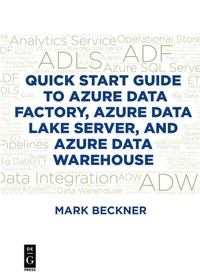
Quick Start Guide to Azure Data Factory, Azure Data Lake Server, and Azure Data Warehouse
Description

With constantly expanding options such as Azure Data Lake Server (ADLS) and Azure SQL Data Warehouse (ADW), how can developers learn the process and components required to successfully move this data? Quick Start Guide to Azure Data Factory, Azure Data Lake Server, and Azure Data Warehouse teaches you the basics of moving data between Azure SQL solutions using Azure Data Factory. Discover how to build and deploy each of the components needed to integrate data in the cloud with local SQL databases.
Mark Beckner's step by step instructions on how to build each component, how to test processes and debug, and how to track and audit the movement of data, will help you to build your own solutions instantly and efficiently. This book includes information on configuration, development, and administration of a fully functional solution and outlines all of the components required for moving data from a local SQL instance through to a fully functional data warehouse with facts and dimensions.
More details
Other editions
Additional editions
Person
Mark Beckner is an enterprise solutions expert. With over 20 years of experience, he leads his firm Inotek Group, specializing in business strategy and enterprise application integration with a focus in health care, CRM, supply chain and business technologies.
He has authored numerous technical books, including Administering, Configuring, and Maintaining Microsoft Dynamics 365 in the Cloud , Using Scribe Insight , BizTalk 2013 Recipes , BizTalk 2013 EDI for Health Care , BizTalk 2013 EDI for Supply Chain Management , Microsoft Dynamics CRM API Development , and more. Beckner also helps up-and-coming coders, programmers, and aspiring tech entrepreneurs reach their personal and professional goals.
Mark has a wide range of experience, including specialties in BizTalk Server, SharePoint, Microsoft Dynamics 365 Silverlight, Windows Phone 7.5, SQL Server, SQL Server Reporting Services (SSRS), .NET Framework, .NET Compact Framework, C#, VB.NET, ASP.NET, and Scribe.
Beckner's expertise has been featured in Computerworld , Entrepreneur , IT Business Edge , SD Times , UpStart Business Journal , and more.
He graduated from Fort Lewis College with a bachelor's degree in computer science and information systems. Mark is married to his wife, Sara, and they live in Colorado with their two children, Ciro and Iyer.
Content
- Intro
- About De/G PRESS
- Acknowledgments
- About the Author
- Contents
- Introduction
- Chapter 1: Copying Data to Azure SQL Using Azure Data Factory
- Chapter 2: Azure Data Lake Server and ADF Integration
- Chapter 3: Azure Data Warehouse and Data Integration using ADF or External Tables
- Index
