

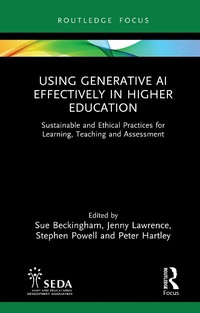
Using Generative AI Effectively in Higher Education
Sustainable and Ethical Practices for Learning, Teaching and Assessment
1st Edition
Published on 14. June 2024
154 pages
978-1-040-10823-9 (ISBN)
Description

Using Generative AI Effectively in Higher Education explores how higher education providers can realise their role and responsibility in harnessing the power of generative artificial intelligence (GenAI) ethically and sustainably.
This rich collection of established and evaluated practices from across global higher education offers a practical guide to leading an agile institutional response to emerging technologies, building critical digital literacy across an entire institution, and embedding the ethical and sustainable use of GenAI in teaching, learning, and assessment. Including reflections from stakeholders testifying to the value of the approaches outlined, the book examines how higher education can equip staff and students with the critical-digital literacy necessary to use GenAI in work, study, and social life responsibly and with integrity. It provides an evidence-based resource for any kind of higher education (HE) provider (modern, college-based, and research-focused) looking for inspiration and approaches which can build GenAI capability and includes chapters on the development of cross-institutional strategy, policies and processes, pedagogic practices, and critical-digital literacy.
This resource will be invaluable to educational leaders, educational developers, learning developers, learning technologists, course administrators, quality assurance staff, and HE teachers wishing to embrace and adapt to a GenAI-enabled world.
This rich collection of established and evaluated practices from across global higher education offers a practical guide to leading an agile institutional response to emerging technologies, building critical digital literacy across an entire institution, and embedding the ethical and sustainable use of GenAI in teaching, learning, and assessment. Including reflections from stakeholders testifying to the value of the approaches outlined, the book examines how higher education can equip staff and students with the critical-digital literacy necessary to use GenAI in work, study, and social life responsibly and with integrity. It provides an evidence-based resource for any kind of higher education (HE) provider (modern, college-based, and research-focused) looking for inspiration and approaches which can build GenAI capability and includes chapters on the development of cross-institutional strategy, policies and processes, pedagogic practices, and critical-digital literacy.
This resource will be invaluable to educational leaders, educational developers, learning developers, learning technologists, course administrators, quality assurance staff, and HE teachers wishing to embrace and adapt to a GenAI-enabled world.
More details
Series
Edition
1. Auflage
Language
English
Place of publication
London
United Kingdom
Publishing group
Taylor & Francis Ltd
Target group
Professional and scholarly
Illustrations
7 Tables, black and white; 9 Line drawings, black and white; 5 Halftones, black and white; 14 Illustrations, black and white
ISBN-13
978-1-040-10823-9 (9781040108239)
Copyright in bibliographic data and cover images is held by Nielsen Book Services Limited or by the publishers or by their respective licensors: all rights reserved.
Schweitzer Classification
Other editions
Additional editions
Sue Beckingham | Jenny Lawrence | Stephen Powell
Using Generative AI Effectively in Higher Education
Sustainable and Ethical Practices for Learning, Teaching and Assessment
Book
10/2025
1st Edition
Routledge
€31.60
Shipment within 10-20 days
Sue Beckingham | Jenny Lawrence | Stephen Powell
Using Generative AI Effectively in Higher Education
Sustainable and Ethical Practices for Learning, Teaching and Assessment
Book
06/2024
1st Edition
Routledge
€71.30
Shipment within 10-20 days
Persons
Sue Beckingham is a National Teaching Fellow and Associate Professor at Sheffield Hallam University, UK.
Jenny Lawrence is Professor of Higher Education and Director of the Oxford Brookes Centre for Academic Enhancement and Development, UK. She is also Senior Fellow of SEDA, Principal and National Teaching Fellow.
Stephen Powell is a freelance Higher Education consultant based in New Zealand and Principal Fellow of AdvanceHE.
Peter Hartley is a freelance Higher Education consultant, National Teaching Fellow, and Visiting Professor at Edge Hill University, UK.
Jenny Lawrence is Professor of Higher Education and Director of the Oxford Brookes Centre for Academic Enhancement and Development, UK. She is also Senior Fellow of SEDA, Principal and National Teaching Fellow.
Stephen Powell is a freelance Higher Education consultant based in New Zealand and Principal Fellow of AdvanceHE.
Peter Hartley is a freelance Higher Education consultant, National Teaching Fellow, and Visiting Professor at Edge Hill University, UK.
Content
1. Using Generative AI effectively in Higher Education
Part A: Institutional Strategies for Building Generative AI Capability2. Pedagogy and Policy in a Brave New World: A case study on the development of Generative AI literacy at the University of Liverpool
3. Supporting inclusion in academic integrity in the age of GenAI
Part B: Developing Generative AI Literacies4. Confidence enhancer, learning equalizer, and pedagogical ally: Exploring GenAI for students with English as an additional language
5. Integrating GenAI in Higher Education: Insights, perceptions, and a taxonomy of practice
6. "Understood the assignment": A UX-led investigation into student experiences of GenAI
Part C: Curriculum Design for a Generative AI Enabled World
7. Re-imagining Student Engagement in an AI-Enhanced Classroom: Strategies and Practices
8. The potential of AI text-to-image generation in medical education: The educator and students' perspective
9. Using Generative AI agents for scalable roleplay activities in the health sciences
10. Embracing GenAI in Education: A Path Towards Authentic Assessment
Part D: Assessment in a Generative AI Enabled World11. Generative AI and the implications for Authentic Assessment
12. Embracing Generative AI in Authentic Assessment; Challenges, Ethics and Opportunities
13. Process not product in the written assessment
14. Sustainable and ethical GenAI for the common good: looking back and forward
Part A: Institutional Strategies for Building Generative AI Capability2. Pedagogy and Policy in a Brave New World: A case study on the development of Generative AI literacy at the University of Liverpool
3. Supporting inclusion in academic integrity in the age of GenAI
Part B: Developing Generative AI Literacies4. Confidence enhancer, learning equalizer, and pedagogical ally: Exploring GenAI for students with English as an additional language
5. Integrating GenAI in Higher Education: Insights, perceptions, and a taxonomy of practice
6. "Understood the assignment": A UX-led investigation into student experiences of GenAI
Part C: Curriculum Design for a Generative AI Enabled World
7. Re-imagining Student Engagement in an AI-Enhanced Classroom: Strategies and Practices
8. The potential of AI text-to-image generation in medical education: The educator and students' perspective
9. Using Generative AI agents for scalable roleplay activities in the health sciences
10. Embracing GenAI in Education: A Path Towards Authentic Assessment
Part D: Assessment in a Generative AI Enabled World11. Generative AI and the implications for Authentic Assessment
12. Embracing Generative AI in Authentic Assessment; Challenges, Ethics and Opportunities
13. Process not product in the written assessment
14. Sustainable and ethical GenAI for the common good: looking back and forward
