

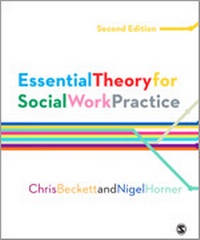
Essential Theory for Social Work Practice
2nd Edition
Published on 23. November 2015
288 pages
978-1-4739-1172-7 (ISBN)
Description

Focusing on what students really need to know, this book breaks down all of the key social work theory covered across a students' training, demystifying complex concepts by demonstrating their application to real-life practice. Multiple case studies highlight applied theory in different practice settings and across issues and challenges that students might face, while self-assessment exercises, practice notes, concise chapter summaries and discussion points help to consolidate their understanding.
New chapters bring the book right up to date and include Relationship-based Work, The Importance of Language, Political Perspectives and Environmental Intervention.
Written by two well-established and expert authors, this is the 'must-have' theory text for all social work students.
New chapters bring the book right up to date and include Relationship-based Work, The Importance of Language, Political Perspectives and Environmental Intervention.
Written by two well-established and expert authors, this is the 'must-have' theory text for all social work students.
More details
Other editions
Additional editions
Chris Beckett | Nigel Horner
Essential Theory for Social Work Practice
Book
12/2015
2nd Edition
SAGE Publications Ltd
€164.40
Shipment within 15-20 days
Chris Beckett | Nigel Horner
Essential Theory for Social Work Practice
Book
12/2015
2nd Edition
SAGE Publications Ltd
€82.60
Shipment within 15-20 days
Persons
Author
University of East Anglia, UK
Chris Beckett studied Psychology at Bristol University and qualified as a social worker at Bangor, North Wales, in 1980, going on to work for eighteen years as a social worker and social work manager, and then for fifteen years as a social work lecturer at Anglia Ruskin University and the University of East Anglia. He has had a parallel career for some time as a writer of fiction and is now a full-time writer. His novel, Dark Eden was the winner of the Arthur C. Clarke award for 2012.
Chris Beckett studied Psychology at Bristol University and qualified as a social worker at Bangor, North Wales, in 1980, going on to work for eighteen years as a social worker and social work manager, and then for fifteen years as a social work lecturer at Anglia Ruskin University and the University of East Anglia. He has had a parallel career for some time as a writer of fiction and is now a full-time writer. His novel, Dark Eden was the winner of the Arthur C. Clarke award for 2012.
Lincoln University
Nigel Horner is Head of the School of Health and Social Care at the University of Lincoln, where he teaches social work history, theory and methods, residential child care and ageing and older people. He began working in a London Borough Children's Home in 1972, before studying Sociology at Durham University. After a period as a Community Worker, he qualified in Social Work from Glasgow University in 1980, and thereafter worked in Mental Health, Child and Adolescent Mental Health Services, Fostering and Youth Offending settings. He is also a Senior Fellow in the Higher Education Academy.
Nigel Horner is Head of the School of Health and Social Care at the University of Lincoln, where he teaches social work history, theory and methods, residential child care and ageing and older people. He began working in a London Borough Children's Home in 1972, before studying Sociology at Durham University. After a period as a Community Worker, he qualified in Social Work from Glasgow University in 1980, and thereafter worked in Mental Health, Child and Adolescent Mental Health Services, Fostering and Youth Offending settings. He is also a Senior Fellow in the Higher Education Academy.
Content
What This Book is About
Chapter 1: Introduction and Using This Book
Chapter 2: What Do We Mean by Social Work Theory?
Chapter 3: The Use and Abuse of Theory
Social Work Roles
Chapter 4: The Roles We Play
Chapter 5: Relationship-Based Work
Chapter 6: The Use of Authority and Power
Chapter 7: Advocacy and Empowerment
Chapter 8: Working with Others: Working in a Team
Chapter 9: Environmental Intervention
Past, Present and Future
Chapter 10: Which Way to Look?
Chapter 11: The Power of the Past
Chapter 12: Searching the Present
Chapter 13: Exploring the Future
Chapter 14: The Importance of Language
Chapter 15: Working with People towards becoming Unstuck
The Wider Context
Chapter 16: Systems and System Levels
Chapter 17: Families as Systems
Chapter 18: Groups and Communities
Chapter 19: Political Perspectives
It's All Very Well in Theory.
Chapter 20: The Question of Evidence and the Problem of Uncertainty
Chapter 21: Talk and Substance
Chapter 22: The Limits of Theory
Chapter 23: Current Contexts and Contemporary Models of Social Work Practice
Chapter 1: Introduction and Using This Book
Chapter 2: What Do We Mean by Social Work Theory?
Chapter 3: The Use and Abuse of Theory
Social Work Roles
Chapter 4: The Roles We Play
Chapter 5: Relationship-Based Work
Chapter 6: The Use of Authority and Power
Chapter 7: Advocacy and Empowerment
Chapter 8: Working with Others: Working in a Team
Chapter 9: Environmental Intervention
Past, Present and Future
Chapter 10: Which Way to Look?
Chapter 11: The Power of the Past
Chapter 12: Searching the Present
Chapter 13: Exploring the Future
Chapter 14: The Importance of Language
Chapter 15: Working with People towards becoming Unstuck
The Wider Context
Chapter 16: Systems and System Levels
Chapter 17: Families as Systems
Chapter 18: Groups and Communities
Chapter 19: Political Perspectives
It's All Very Well in Theory.
Chapter 20: The Question of Evidence and the Problem of Uncertainty
Chapter 21: Talk and Substance
Chapter 22: The Limits of Theory
Chapter 23: Current Contexts and Contemporary Models of Social Work Practice
