
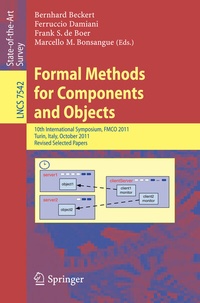
Formal Methods for Components and Objects
Description
Alles über E-Books | Antworten auf Fragen rund um E-Books, Kopierschutz und Dateiformate finden Sie in unserem Info- & Hilfebereich.
Formal methods have been applied successfully to the verification of medium-sized programs in protocol and hardware design for some time. However, their application to the development of large systems requires more emphasis on specification, modeling, and validation techniques supporting the concepts of reusability and modifiability, and their implementation in new extensions of existing programming languages like Java.
This book contains 20 revised papers submitted after the 10th Symposium on Formal Methods for Components and Objects, FMCO 2011, which was held in Turin, Italy, in October 2011. Topics covered include autonomic service-component ensembles; trustworthy eternal systems via evolving software, data, and knowledge; parallel patterns for adaptive heterogeneous multicore systems; programming for future 3D architectures with many cores; formal verification of object oriented software; and an infrastructure for reliable computer systems.
More details
Other editions
Additional editions

Persons
Content
System requirements
File format: PDF
Copy protection: Watermark-DRM (Digital Rights Management)
System requirements:
- Computer (Windows; MacOS X; Linux): Use the free software Adobe Reader, Adobe Digital Editions, or any other PDF viewer of your choice (see eBook Help).
- Tablet/Smartphone (Android; iOS): Install the free app Adobe Digital Editions or another reading app for eBooks, e.g., PocketBook (see eBook Help).
- E-reader: Bookeen, Kobo, Pocketbook, Sony, Tolino and many more (only limited: Kindle).
The file format PDF always displays a book page identically on any hardware. This makes PDF suitable for complex layouts such as those used in textbooks and reference books (images, tables, columns, footnotes). Unfortunately, on the small screens of e-readers or smartphones, PDFs are rather annoying, requiring too much scrolling.
This eBook uses Watermark-DRM, a „soft” copy protection. This means that there are no technical restrictions to prevent illegal distribution. However, there is a personalised watermark embedded in the eBook that can be used to identify the purchaser of the eBook in the event of misuse and to provide evidence for legal purposes.
For more information, see our eBook Help page.