

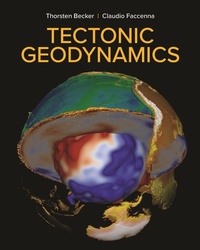
Tectonic Geodynamics
Description

A comprehensive, integrative approach to tectonics and geodynamics for students and researchers Over the past half century, major achievements have been made in the study of Earth's surface structure and kinematics and the internal dynamics of the lithosphere and mantle. Many of these advances have relied on the integration of data and models from plate tectonics and geodynamics, yet traditional divisions persist in how these two disciplines are taught and practiced. This textbook bridges the gap, connecting geophysical and geological approaches to understand the physical processes that shape our planet's evolution, from mantle convection to orogeny and earthquakes. An innovative approach to the solid Earth system, Tectonic Geodynamics provides a basis to explore the fundamental connections between the planet's deep interior dynamics and the surface.
- The first textbook to integrate tectonics, structural geology, geodynamics, geodesy, and seismology in a single volume
- Offers a physics-focused guide for understanding how the solid Earth system operates
- Uses a "no prerequisites" approach supported by an extensive appendix that includes a calculus and linear algebra primer and coverage of key topics such as coordinate systems and spectral analysis
- Includes a wealth of exercises and end-of-chapter review questions
- An ideal textbook for advanced undergraduates and graduate students in geology, geophysics, and related fields such as physics and engineering
- Invaluable for self-study and as a self-contained resource for researchers
- Supporting materials provided for instructors, including an instruction guide, full-color illustration package, and sample syllabi
More details
Other editions
Additional editions
Persons
Content
- Cover
- Contents
- Introduction
- Part I. Introduction to the Solid Earth System
- 1. An Exploration of Basic Solid Earth Structure and Dynamics
- 1.1. Topography
- 1.2. Geopotentials: Shape, spin, and geoid
- 1.3. Internal structure, temperature, and composition of Earth
- 1.4. Plate motions in the past and at present
- 1.5. Seismic tomography-3-D mantle structure
- Review questions and discussion topics 1
- II. Fundamental physics
- 2. Continuum Mechanics
- 2.1. Concept of a continuum
- 2.2. Displacements, velocities, and reference frames
- 2.3. Strain
- 2.4. Forces and stress
- 2.5. Constraining crustal deformation and stress
- Review questions and discussion topics 2
- 3. Elastic and Brittle Behavior of Rocks
- 3.1. Constitutive laws
- 3.2. Elasticity
- 3.3. Brittle failure
- 3.4. Earthquakes and friction
- Review questions and discussion topics 3
- 4. Viscous, Plastic, and Transient Behavior
- 4.1. Newtonian fluids
- 4.2. Non-Newtonian fluids
- 4.3. Combined material behavior and transient viscoelasticity
- 4.4. Attenuation and frequency-dependent moduli
- 4.5. Transient deformation throughout the seismic cycle
- Review questions and discussion topics 4
- 5. Lithospheric Strength from Complex Rock Rheology
- 5.1. Microphysical mechanisms for viscous creep
- 5.2. Piezometers and grain size evolution
- Expanded details 14: Grain size evolution laws
- 5.3. Averaging of heterogeneous media
- 5.4. Deformation maps
- 5.5. Strength of the lithosphere and upper mantle
- Review questions and discussion topics 5
- 6. Transfer of Momentum: Fluid Dynamics
- 6.1. Nondimensional numbers and flow regimes
- 6.2. Steady, unidirectional flow and the 1-D Stokes equation
- 6.3. Shear and pressure-driven flow
- 6.4. Density-driven flow: The Stokes sinker
- 6.5. Stream function solutions
- 6.6. Thin viscous sheets and gravitational potential energy
- 6.7. Postglacial rebound and glacial isostatic adjustment
- Review questions and discussion topics 6
- 7. Transfer of Energy: Heat Transport
- 7.1. Conduction of heat and budgets
- 7.2. Diffusion of heat and the conduction equation
- 7.3. Time-dependent solutions of the conduction equation
- 7.4. Convection
- Review questions and discussion topics 7
- 8. Mantle Convection
- 8.1. Numerical Rayleigh-Bénard convection experiments
- 8.2. Temperature and stress dependence of viscosity
- 8.3. Effect of phase transitions
- 8.4. Effects of 3-D spherical geometry and toroidal flow
- 8.5. Plate-generating convection models
- Review questions and discussion topics 8
- III. Tectonics and Mantle Dynamics
- 9. Global Mantle Circulation
- 9.1. The mantle wind: Predicting mantle flow
- 9.2. Surface topography
- 9.3. Time reversal of mantle convection
- 9.4. The geoid constraint on viscosity
- 9.5. Plate driving and crustal deformation studies
- 9.6. Seismic anisotropy as a constraint for mantle flow
- Review questions and discussion topics 9
- 10. Divergent Motions and Creation of the Lithosphere
- 10.1. The role of plumes in mantle convection
- 10.2. Rifting: Breaking continents apart
- 10.3. Oceanic spreading: Generating lithosphere
- 10.4. Plates as thermochemical boundary layers
- Review questions and discussion topics 10
- 11. Lateral Motion of the Lithosphere: Strike Slip
- 11.1. Introduction
- 11.2. Anatomy of a strike-slip fault zone
- 11.3. Tectonic context of strike-slip systems
- 11.4. Continental transforms and earthquake dynamics
- Review questions and discussion topics 11
- 12. Recycling the Lithosphere: Subduction
- 12.1. Introduction
- 12.2. Anatomy of a subduction zone
- 12.3. Trench forearc and sedimentary systems
- 12.4. Temperature, magmatism, and metamorphism
- 12.5. Arc volcanism
- 12.6. Back-arc systems
- 12.7. Slab and trench kinematics: Rollback
- 12.8. Flat slabs
- 12.9. Slab dynamics from force balance considerations
- 12.10. Subduction zone seismicity
- 12.11. Tectonics and dynamics of subduction evolution
- 12.12. Slab transport through the transition zone
- Review questions and discussion topics 12
- 13. Orogeny: Making Mountains
- 13.1. Introduction
- 13.2. Anatomy of orogenic belts
- 13.3. The kinematics of mountain building
- 13.4. Mechanics of mountain building
- 13.5. The elevation of mountain belts
- 13.6. Tectonics, climate, and erosion
- 13.7. Exhumation of deep-seated rock units
- 13.8. Dynamics of mountain building
- 13.9. Regional case histories
- 13.10. Orogeny, the Wilson cycle, and supercontinental assembly
- Review questions and discussion topics 13
- 14. Plate Tectonics and Planetary Evolution
- 14.1. Onset of plate tectonics
- 14.2. Different modes of early Earth heat transport
- 14.3. Parameterized thermal and volatile evolution models
- 14.4. Plate tectonics on other planets
- Outlook
- IV. Appendixes
- A. Reference Dataand Additional Figures
- A.1. Important constants and typical parameter values
- A.2. Geological timescale and magnetic reversals
- A.3. Phase diagrams
- A.4. Gravitational potentials for terrestrial planets
- A.5. Plate geometry, names, and motion statistics
- B. Additional Topics in Continuum Mechanics
- B.1. General conservation laws: One law to derive them all
- B.2. Strain compatibility equations
- B.3. Finite strain
- B.4. Relationship between moment tensors and fault plane solutions
- B.5. Rayleigh-Taylor instabilities
- C. Math and Statistics Notes
- C.1. Useful conventions and basic mathematical functions
- C.2. Calculus concepts
- C.3. Linear algebra
- C.4. Coordinate systems and spherical trigonometry
- C.5. Vector calculus: Divergence, curl, and tensors
- C.6. Spectral analysis
- C.7. Simple statistics and curve fitting
- Bibliography
- Acronyms
- Index
