

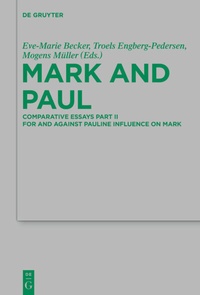
Mark and Paul
Description

This volume brings together an international group of scholars on Mark and Paul, respectively, who reopen the question whether Paul was a direct influence on Mark. On the basis of the latest methods in New Testament scholarship, the battle over Yes and No to this question of literary and theological influence is waged within these pages. In the end, no agreement is reached, but the basic issues stand out with much greater clarity than before. How may one relate two rather different literary genres, the apostolic letter and the narrative gospel? How may the theologies of two such different types of writing be compared? Are there sufficient indications that Paul lies directly behind Mark for us to conclude that through Paul himself and Mark the New Testament as a whole reflects specifically Pauline ideas? What would the literary and theological consequences of either assuming or denying a direct influence be for our reconstruction of 1st century Christianity? And what would the consequences be for either understanding Mark or Paul as literary authors and theologians? How far should we give Paul an exalted a position in the literary creativity of the first Christians? Addressing these questions are scholars who have already written seminally on the issue or have marked positions on it, like Joel Marcus, Margaret Mitchell, Gerd Theissen and Oda Wischmeyer, together with a group of up-coming and senior Danish scholars from Aarhus and Copenhagen Universities who have collaborated on the issue for some years. The present volume leads the discussion further that has been taken up in: "Paul and Mark" (ed. by O. Wischmeyer, D. Sim, and I. Elmer), BZNW 191, 2013.
More details
Other editions
Additional editions
Persons
Content
- Intro
- Mark and Paul - Introductory Remarks
- I. Histories and Contexts
- Mark as Allegorical Rewriting of Paul: Gustav Volkmar's Understanding of the Gospel of Mark
- Mark - Interpreter of Paul
- Paul and Mark - Mark and Paul
- A Critical Outline of the History of Research
- "Evangelium" im Markusevangelium
- Zum traditionsgeschichtlichen Ort des ältesten Evangeliums
- Earliest Christian literary activity: Investigating Authors, Genres and Audiences in Paul and Mark
- In the Beginning was the Congregation
- In Search of a Tertium Comparationis between Paul and Mark
- II. Texts and Interpretations Oda Wischmeyer
- Romans 1:1-7 and Mark 1:1-3 in Comparison
- Two Opening Texts at the Beginning of Early Christian Literature
- Man and the Son of Man in Mark 2:27-28
- An Exegesis of Mark 2:23-28 Focussing on the Christological Discourse in Mark 2:27-28 with an Epilogue Concerning Pauline Parallels
- Mark 7:1-23: A Pauline Halakah?
- Paul in Mark 8:34-9:1: Mark on what it is to be a Christian
- III. Topics and Perspectives
- The Politics of Beginnings - Cosmology, Christology and Covenant: Gospel Openings Reconsidered in the Light of Paul's Pneumatology
- Adam-Christ Typology in Paul and Mark: Reflections on a Tertium Comparationis
- Preliminary Remarks
- The Cross on the Way to Mark
- Persecution and Denial - Paradigmatic Apostolic Portrayals in Paul and Mark
- List of Contributors
- Index of Subjects and Names
- Index of References
