

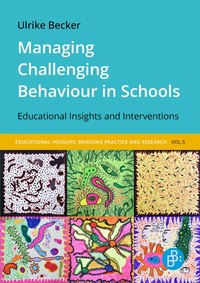
Managing Challenging Behaviour in Schools
Educational Insights and Interventions
1st Edition
Published on 17. March 2025
113 pages
978-3-8474-3241-8 (ISBN)
Description

Challenging behaviour of children and adolescents in everyday school life is often a sign of the difficult life situations in which they grow up. For teachers and educational professionals, dealing with the resulting conflicts is the biggest challenge. This book presents approaches and solutions for understanding and acting in difficult educational situations at school. In addition, an inclusive support approach offers impulses for school development to prevent challenging behaviour.
More details
Series
Language
English
Place of publication
Leverkusen-Opladen
United Kingdom
Target group
Professional and scholarly
education, teacher training
File size
8,22 MB
ISBN-13
978-3-8474-3241-8 (9783847432418)
DOI
10.3224/84743107
Copyright in bibliographic data and cover images is held by Nielsen Book Services Limited or by the publishers or by their respective licensors: all rights reserved.
Schweitzer Classification
Other editions
Additional editions
Book
03/2025
1st Edition
Verlag Barbara Budrich
€26.90
Shipment within 5-7 days
Person
Ulrike Becker is an adjunct professor at the Department of Education - Inclusion and Organisational Development, Faculty of Human Sciences at the University of Potsdam in Germany.
Content
Introduction
1. Education in times of social crisis
1.1 Psychosocial situation of children and adolescents against the background of social crises
1.2 School as a resilience factor
1.2.1 Classroom teaching
1.2.2 (Digital) learning at a distance
1.2.3 Closeness and distance in the educational relationship
1.3 Conclusion
2. Pupils with aggressive behaviour: Behaviour towards teachers
2.1 Theoretical considerations
2.2 Educational attitude
2.3 Cuts as solutions in everyday school life
2.3.1 Reset
2.3.2 From confrontation to closing unity
2.3.3 Paradoxical intervention
2.3.4 Redirect
2.3.5 Going out
2.3.6 Safe storage of dangerous objects
2.3.7 Place swap
2.3.8 Individual work order
2.3.9 Time Out
2.3.10 Trigger acoustic signal
2.4 Reparation instead of punishment
2.5 Conclusion
3. Pupils harm others
3.1 Theoretical considerations
3.2 Solutions for conflicts in everyday school life
3.2.1 Reactivation of sibling conflicts
3.2.2 Neglect
3.2.3 Bullying
3.2.4 Stigmatisation
3.2.5 Discrimination because of clan family names
3.2.6 Non-compliance with rules of faith
3.3 Conclusion
4. Pupils harm themselves
4.1 Theoretical considerations
4.2 Solutions for conflicts in everyday school life
4.2.1 Sensory overload
4.2.2 Separation anxiety
4.2.3 Self-harming behaviour such as scratching
4.2.4 Hyperactivity
4.2.5 Individual retreat
4.2.6 Blows to your own body
4.3 Conclusion
5. Parents who are difficult to reach
5.1 Legal framework for working with parents
5.2 Effect of parents on children's behaviour
5.3 Hard to reach parents
5.3.1 Causes of difficult accessibility
5.3.2 Solutions for conversations with parents
5.4 Conclusion
6. Prevention of challenging behaviour and conflicts
6.1 Prevention of challenging behaviour
6.2 School policy
6.3 School rules
6.4 Conclusion
7. Learning accesses for pupils with special needs in their emotional and social development
7.1 Inclusive and exclusive currents
7.2 Transition project
7.2.1 Theoretical background
7.2.2 Study results
7.2.3 Internal school organisation
7.2.4 Exchange and dissemination
7.3 Five learning accesses
7.3.1 Temporary learning group
7.3.2 Inclusive teaching
7.3.3 Counselling in a multi-professional team
7.3.4 Counselling with parents
7.3.5 Cooperation between schools and youth welfare services
7.4 Conclusion
8. Summary and outlook
8.1 Summary
8.2 Outlook
Literature
Index
1. Education in times of social crisis
1.1 Psychosocial situation of children and adolescents against the background of social crises
1.2 School as a resilience factor
1.2.1 Classroom teaching
1.2.2 (Digital) learning at a distance
1.2.3 Closeness and distance in the educational relationship
1.3 Conclusion
2. Pupils with aggressive behaviour: Behaviour towards teachers
2.1 Theoretical considerations
2.2 Educational attitude
2.3 Cuts as solutions in everyday school life
2.3.1 Reset
2.3.2 From confrontation to closing unity
2.3.3 Paradoxical intervention
2.3.4 Redirect
2.3.5 Going out
2.3.6 Safe storage of dangerous objects
2.3.7 Place swap
2.3.8 Individual work order
2.3.9 Time Out
2.3.10 Trigger acoustic signal
2.4 Reparation instead of punishment
2.5 Conclusion
3. Pupils harm others
3.1 Theoretical considerations
3.2 Solutions for conflicts in everyday school life
3.2.1 Reactivation of sibling conflicts
3.2.2 Neglect
3.2.3 Bullying
3.2.4 Stigmatisation
3.2.5 Discrimination because of clan family names
3.2.6 Non-compliance with rules of faith
3.3 Conclusion
4. Pupils harm themselves
4.1 Theoretical considerations
4.2 Solutions for conflicts in everyday school life
4.2.1 Sensory overload
4.2.2 Separation anxiety
4.2.3 Self-harming behaviour such as scratching
4.2.4 Hyperactivity
4.2.5 Individual retreat
4.2.6 Blows to your own body
4.3 Conclusion
5. Parents who are difficult to reach
5.1 Legal framework for working with parents
5.2 Effect of parents on children's behaviour
5.3 Hard to reach parents
5.3.1 Causes of difficult accessibility
5.3.2 Solutions for conversations with parents
5.4 Conclusion
6. Prevention of challenging behaviour and conflicts
6.1 Prevention of challenging behaviour
6.2 School policy
6.3 School rules
6.4 Conclusion
7. Learning accesses for pupils with special needs in their emotional and social development
7.1 Inclusive and exclusive currents
7.2 Transition project
7.2.1 Theoretical background
7.2.2 Study results
7.2.3 Internal school organisation
7.2.4 Exchange and dissemination
7.3 Five learning accesses
7.3.1 Temporary learning group
7.3.2 Inclusive teaching
7.3.3 Counselling in a multi-professional team
7.3.4 Counselling with parents
7.3.5 Cooperation between schools and youth welfare services
7.4 Conclusion
8. Summary and outlook
8.1 Summary
8.2 Outlook
Literature
Index
