

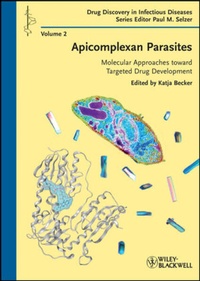
Apicomplexan Parasites
Molecular Approaches toward Targeted Drug Development
1st Edition
Published on 22. September 2011
XXII, 528 pages
978-3-527-63389-0 (ISBN)
Description

This handbook is the first dealing with the discovery of drugs directed against apicomplexan parasites. Amongst others, this group of endoparasites includes the causative agents of Malaria, Toxoplasmosis, and Babesiosis, the latter occurring mainly in animals. Written by renowned scientific experts from academia and industry, the book focuses on currentdrug development approaches for all apicomplexan diseases making it appealing to a large audience, ranging from research labs in academia to the human and veterinarian pharmaceutical industry. This work is the second volume of the new book series 'Drug Discovery in Infectious Diseases', edited by Prof. Dr Paul M. Selzer.
More details
Other editions
Additional editions
Book
02/2011
1st Edition
Wiley-Blackwell
€195.00
Shipment within 5-7 days
Software
02/2011
Wiley-VCH
€248.16
No shipping information available
Persons
Volume editor:
Prof. Dr. Katja Becker obtained her Academic Degree in Medicine at Heidelberg University. She carried out her doctoral-thesis as well as her Habilitation at the Biochemistry Centre, Heidelberg, before she obtained a Junior Group Leader Position at the Research Center for Infectious Diseases, Würzburg University. Since 2000 she holds the Chair of Nutritional Biochemistry at the Justus-Liebig University Giessen. Scientifically she focuses on the characterization of redox active proteins as drug targets. She has produced more than 170 scientific publications and received numerous scientific awards including the Carus Medal of the German Academy of Sciences Leopoldina and the Leuckart Medal of the German Society for Parasitology. Since June 2009 she is a member of the Leopoldina.
Series Editor:
Prof. Dr. Paul M. Selzer studied Biology, Parasitology, and Biochemistry at the University of Tübingen, Germany, where he also received his PhD in Biochemistry. He spent three years in the parasitology and tropical disease laboratory of Prof. James H. McKerrow at the University of California, San Francisco (UCSF). During his professional career he worked as researcher and scientific manager for several pharmaceutical companies, being currently employed by Intervet Innovation GmbH, Germany, part of a leading Animal Health company. Dr. Selzer is also a visiting Professor and teacher in Biochemistry, Bioinformatics, and Chemoinformatics at the University of Tübingen, and holds an Honorary Professorship in the Department of Infection and Immunity at the University of Glasgow, UK.
Prof. Dr. Katja Becker obtained her Academic Degree in Medicine at Heidelberg University. She carried out her doctoral-thesis as well as her Habilitation at the Biochemistry Centre, Heidelberg, before she obtained a Junior Group Leader Position at the Research Center for Infectious Diseases, Würzburg University. Since 2000 she holds the Chair of Nutritional Biochemistry at the Justus-Liebig University Giessen. Scientifically she focuses on the characterization of redox active proteins as drug targets. She has produced more than 170 scientific publications and received numerous scientific awards including the Carus Medal of the German Academy of Sciences Leopoldina and the Leuckart Medal of the German Society for Parasitology. Since June 2009 she is a member of the Leopoldina.
Series Editor:
Prof. Dr. Paul M. Selzer studied Biology, Parasitology, and Biochemistry at the University of Tübingen, Germany, where he also received his PhD in Biochemistry. He spent three years in the parasitology and tropical disease laboratory of Prof. James H. McKerrow at the University of California, San Francisco (UCSF). During his professional career he worked as researcher and scientific manager for several pharmaceutical companies, being currently employed by Intervet Innovation GmbH, Germany, part of a leading Animal Health company. Dr. Selzer is also a visiting Professor and teacher in Biochemistry, Bioinformatics, and Chemoinformatics at the University of Tübingen, and holds an Honorary Professorship in the Department of Infection and Immunity at the University of Glasgow, UK.
Content
SCREENING, BIOINFORMATICS, CHEMOINFORMATICS, AND DRUG DESIGN
Drug Discovery Approaches towards Anti-Parasitic Agents
(Andreas Rohwer, Richard J. Marhöfer, Conor R. Caffrey and Paul M. Selzer)
New Bioinformatic Strategies against Apicomplexan Parasites
(Thomas Dandekar and Ke Xiao)
Sorting Potential Therapeutic Targets in Apicomplexa
(Jan A. Hiss and Gisbert Schneider)
Alternatives to Drug Development in Apicomplexa
(Prof. Dr. Theo P.M. Schetters)
METABOLIC PATHWAYS AND PROCESSES ADDRESSED BY CURRENT DRUG DISCOVERY APPROACHES
The Energy Metabolism as an Antimalarial Drug Target
(Esther Jortzik and Katja Becker)
Polyamines in Apicomplexan Parasites
(Ingrid B. Müller, Robin Das Gupta, Kai Lüersen, Carsten Wrenger and Rolf D. Walter)
The Reducing Milieu of Parasitized Cells as a Target of Antimalarial Agents. Methylene Blue as an Ethical Drug
(Peter Meissner, Heike Adler, Karin Fritz-Wolf and R. Heiner Schirmer)
Lipids as Drug Targets for Malaria Therapy
(Henri J. Vial, Diana Penarete, Sharon Wein, Sergio Caldarelli, Laurent Fraisse and Suzanne Peyrottes)
Targeting Apicoplast Pathways in Plasmodium
(Snober S. Mir, Subir Biswas and Saman Habib)
Lipoic Acid Acquisition and Glutathione Biosynthesis in Apicomplexan Parasites
(Janet Storm, Eva-Maria Patzewitz and Sylke Müller)
Antimalarial Drugs and Molecules Inhibiting Hemozoin formation
(Uday Bandyopadhyay and Sumanta Dey)
Exploiting the Vitamin Metabolism of Apicomplexa as Drug Targets
(Carsten Wrenger and Ingrid B. Müller)
Vitamin Biosynthetic Pathways, the PLP Synthase Complex, and the Potential for Drugging Protein-Protein Interaction
(Ivo Tews and Irmgard Sinning)
Targeting Prokaryotic Enzymes in the Eukaryotic Pathogen Cryptosporidium
(Suresh Kumar Gorla, Corey Johnson, Jihan Khan, Xin Sun, Lisa Sharling,
Boris Striepen and Lizbeth Hedstrom)
DRUG TARGETS IN APICOMPLEXAN PARASITES
Novel Apicomplexan Phosphatases and Immunophilins
as Domain-Specific Drug Targets
(Sailen Barik)
Dehydrogenases and enzymes of the mitochondrial electron transport chain as antiapicomplexan drug targets
(Kathleen Zocher, Stefan Rahlfs and Katja Becker)
Calcium-dependent protein kinases as drug targets in apicomplexan parasites
(Dominik Kugelstadt, Bianca Derrer, and Barbara Kappes)
Protein Acylation:
New Potential Targets for Intervention against Apicomplexa
(Joana M. Santos, Christian Hedberg and Dominique Soldati-Favre)
Drugs and Drug Targets in Neospora Caninum and Related Apicomplexans
(Joachim Müller, Norbert Müller and Andrew Hemphill)
COMPOUNDS
Subversive Substrates of Glutathione Reductases from P. Falciparum-infected Red Blood Cells as Antimalarial Agents
(Elisabeth Davioud-Charvet and Don Antoine Lanfranchi)
Ferroquine: a Concealed Weapon (Christophe Biota, Bruno Pradinesb and Daniel Divec)
Current Aspects of Endoperoxides in Antiparasitic Chemotherapy
(Denis Matovu Kasozi, Stefan Rahlfs and Katja Becker)
Plasmodium Hsp90 as an Antimalarial Target
(G. Sridhar Prasad and Sailen Barik)
Drug Discovery against Babesia and Toxoplasma
(Mohamad Alaa Terkawi and Ikuo Igarashi)
Search for Drugs and Drug Targets against Babesia bovis, Babesia bigemina, Babesia caballi, and Babesia (Theileria) equi
(Sabine Bork-Mimm)
Orlistat: A Repositioning Opportunity as a Growth Inhibitor of Apicomplexan Parasites?
(Christian Miculka, Hon Tran, Thorsten Meyer, Anja R. Heckeroth, Stefan Baumeister, Frank Seeber and Paul M. Selzer)
Recent drug discovery against Cryptosporidium
(Jean-François Rossignol, Gilles Gargala, J. Edward Semple and Andrew V. Stachulski)
Drug Discovery Approaches towards Anti-Parasitic Agents
(Andreas Rohwer, Richard J. Marhöfer, Conor R. Caffrey and Paul M. Selzer)
New Bioinformatic Strategies against Apicomplexan Parasites
(Thomas Dandekar and Ke Xiao)
Sorting Potential Therapeutic Targets in Apicomplexa
(Jan A. Hiss and Gisbert Schneider)
Alternatives to Drug Development in Apicomplexa
(Prof. Dr. Theo P.M. Schetters)
METABOLIC PATHWAYS AND PROCESSES ADDRESSED BY CURRENT DRUG DISCOVERY APPROACHES
The Energy Metabolism as an Antimalarial Drug Target
(Esther Jortzik and Katja Becker)
Polyamines in Apicomplexan Parasites
(Ingrid B. Müller, Robin Das Gupta, Kai Lüersen, Carsten Wrenger and Rolf D. Walter)
The Reducing Milieu of Parasitized Cells as a Target of Antimalarial Agents. Methylene Blue as an Ethical Drug
(Peter Meissner, Heike Adler, Karin Fritz-Wolf and R. Heiner Schirmer)
Lipids as Drug Targets for Malaria Therapy
(Henri J. Vial, Diana Penarete, Sharon Wein, Sergio Caldarelli, Laurent Fraisse and Suzanne Peyrottes)
Targeting Apicoplast Pathways in Plasmodium
(Snober S. Mir, Subir Biswas and Saman Habib)
Lipoic Acid Acquisition and Glutathione Biosynthesis in Apicomplexan Parasites
(Janet Storm, Eva-Maria Patzewitz and Sylke Müller)
Antimalarial Drugs and Molecules Inhibiting Hemozoin formation
(Uday Bandyopadhyay and Sumanta Dey)
Exploiting the Vitamin Metabolism of Apicomplexa as Drug Targets
(Carsten Wrenger and Ingrid B. Müller)
Vitamin Biosynthetic Pathways, the PLP Synthase Complex, and the Potential for Drugging Protein-Protein Interaction
(Ivo Tews and Irmgard Sinning)
Targeting Prokaryotic Enzymes in the Eukaryotic Pathogen Cryptosporidium
(Suresh Kumar Gorla, Corey Johnson, Jihan Khan, Xin Sun, Lisa Sharling,
Boris Striepen and Lizbeth Hedstrom)
DRUG TARGETS IN APICOMPLEXAN PARASITES
Novel Apicomplexan Phosphatases and Immunophilins
as Domain-Specific Drug Targets
(Sailen Barik)
Dehydrogenases and enzymes of the mitochondrial electron transport chain as antiapicomplexan drug targets
(Kathleen Zocher, Stefan Rahlfs and Katja Becker)
Calcium-dependent protein kinases as drug targets in apicomplexan parasites
(Dominik Kugelstadt, Bianca Derrer, and Barbara Kappes)
Protein Acylation:
New Potential Targets for Intervention against Apicomplexa
(Joana M. Santos, Christian Hedberg and Dominique Soldati-Favre)
Drugs and Drug Targets in Neospora Caninum and Related Apicomplexans
(Joachim Müller, Norbert Müller and Andrew Hemphill)
COMPOUNDS
Subversive Substrates of Glutathione Reductases from P. Falciparum-infected Red Blood Cells as Antimalarial Agents
(Elisabeth Davioud-Charvet and Don Antoine Lanfranchi)
Ferroquine: a Concealed Weapon (Christophe Biota, Bruno Pradinesb and Daniel Divec)
Current Aspects of Endoperoxides in Antiparasitic Chemotherapy
(Denis Matovu Kasozi, Stefan Rahlfs and Katja Becker)
Plasmodium Hsp90 as an Antimalarial Target
(G. Sridhar Prasad and Sailen Barik)
Drug Discovery against Babesia and Toxoplasma
(Mohamad Alaa Terkawi and Ikuo Igarashi)
Search for Drugs and Drug Targets against Babesia bovis, Babesia bigemina, Babesia caballi, and Babesia (Theileria) equi
(Sabine Bork-Mimm)
Orlistat: A Repositioning Opportunity as a Growth Inhibitor of Apicomplexan Parasites?
(Christian Miculka, Hon Tran, Thorsten Meyer, Anja R. Heckeroth, Stefan Baumeister, Frank Seeber and Paul M. Selzer)
Recent drug discovery against Cryptosporidium
(Jean-François Rossignol, Gilles Gargala, J. Edward Semple and Andrew V. Stachulski)
