

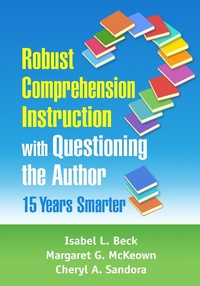
Robust Comprehension Instruction with Questioning the Author
15 Years Smarter
Published on 19. October 2020
192 pages
978-1-4625-4483-7 (ISBN)
Description

K-12 classroom teachers; literacy specialists and coaches; teacher educators and students in literacy programs. May serve as a supplementary text in graduate-level courses.
More details
Other editions
Additional editions
Isabel L. Beck | Margaret G. McKeown | Cheryl A. Sandora
Robust Comprehension Instruction with Questioning the Author
15 Years Smarter
Book
12/2020
1st Edition
Guilford Press
€40.00
Shipment within 15-20 days
Persons
Isabel L. Beck, PhD, is Professor Emerita of Education at the University of Pittsburgh. She has conducted extensive research and published widely on decoding, vocabulary, and comprehension. Dr. Beck is a recipient of the Oscar S. Causey Award from the Literacy Research Association, the William S. Gray Citation of Merit from the International Literacy Association, and the Contributing Researcher Award from the American Federation of Teachers. She was inducted into the Reading Hall of Fame and is an elected member of the National Academy of Education. Her books include Bringing Words to Life, Second Edition; Creating Robust Vocabulary; Illuminating Comprehension and Close Reading; Making Sense of Phonics, Third Edition; and Robust Comprehension Instruction with Questioning the Author.
Margaret G. McKeown, PhD, is Clinical Professor Emerita of Education at the University of Pittsburgh. Before her retirement, she was also a Senior Scientist at the University's Learning Research and Development Center. Her work addresses practical, current problems that classroom teachers and their students face. She has conducted research in the areas of learning, instruction, and teacher professional development in reading comprehension and vocabulary. Dr. McKeown is a recipient of the Outstanding Dissertation Award from the International Literacy Association, is a Fellow of the American Educational Research Association, and was inducted into the Reading Hall of Fame. She is coauthor of books including Bringing Words to Life, Second Edition; Creating Robust Vocabulary; Robust Comprehension Instruction with Questioning the Author; and Vocabulary Assessment to Support Instruction.
Cheryl A. Sandora, PhD, is an English Language Arts Fellow at the Institute for Learning, an outreach of the University of Pittsburgh, where she designs curricular materials and works with districts throughout the country, facilitating professional development sessions and supporting classroom-based instruction. Dr. Sandora was a research associate at the University of Pittsburgh Learning Research and Development Center for over 20 years, working closely with Isabel L. Beck and Margaret G. McKeown to conduct classroom-based research on instructional practices targeting vocabulary and comprehension. She is coauthor of Illuminating Comprehension and Close Reading and Robust Comprehension Instruction with Questioning the Author.
Margaret G. McKeown, PhD, is Clinical Professor Emerita of Education at the University of Pittsburgh. Before her retirement, she was also a Senior Scientist at the University's Learning Research and Development Center. Her work addresses practical, current problems that classroom teachers and their students face. She has conducted research in the areas of learning, instruction, and teacher professional development in reading comprehension and vocabulary. Dr. McKeown is a recipient of the Outstanding Dissertation Award from the International Literacy Association, is a Fellow of the American Educational Research Association, and was inducted into the Reading Hall of Fame. She is coauthor of books including Bringing Words to Life, Second Edition; Creating Robust Vocabulary; Robust Comprehension Instruction with Questioning the Author; and Vocabulary Assessment to Support Instruction.
Cheryl A. Sandora, PhD, is an English Language Arts Fellow at the Institute for Learning, an outreach of the University of Pittsburgh, where she designs curricular materials and works with districts throughout the country, facilitating professional development sessions and supporting classroom-based instruction. Dr. Sandora was a research associate at the University of Pittsburgh Learning Research and Development Center for over 20 years, working closely with Isabel L. Beck and Margaret G. McKeown to conduct classroom-based research on instructional practices targeting vocabulary and comprehension. She is coauthor of Illuminating Comprehension and Close Reading and Robust Comprehension Instruction with Questioning the Author.
Content
- Background and Basics
1. The Building Blocks of Questioning the Author
2. The Current Scene in Reading Comprehension
- Questioning the Author Essentials
3. Planning for Questioning the Author Lessons
4. Specific Plans for a Narrative and an Expository Text
5. Digging into Initiating and Follow-Up Queries
6. Specific Plans for a Narrative and an Expository Read-Aloud Text
- Special Topics
7. What Comes after Reading and Interspersed Discussion?
8. Vocabulary in the Context of Comprehension
9. Approaching Writing with a Questioning the Author Perspective
- Inside the Classroom
10. Moves to Keep Discussion Productive
11. One Teacher's Journey with Questioning the Author
12. Students Take the Wheel
Appendix. Lesson Texts from Chapters 4 and 6
Index
1. The Building Blocks of Questioning the Author
2. The Current Scene in Reading Comprehension
- Questioning the Author Essentials
3. Planning for Questioning the Author Lessons
4. Specific Plans for a Narrative and an Expository Text
5. Digging into Initiating and Follow-Up Queries
6. Specific Plans for a Narrative and an Expository Read-Aloud Text
- Special Topics
7. What Comes after Reading and Interspersed Discussion?
8. Vocabulary in the Context of Comprehension
9. Approaching Writing with a Questioning the Author Perspective
- Inside the Classroom
10. Moves to Keep Discussion Productive
11. One Teacher's Journey with Questioning the Author
12. Students Take the Wheel
Appendix. Lesson Texts from Chapters 4 and 6
Index
