

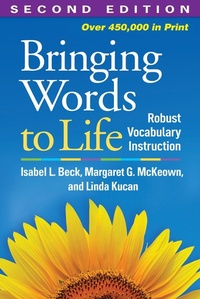
Bringing Words to Life
Robust Vocabulary Instruction
2nd Edition
Published on 31. January 2013
210 pages
978-1-4625-0826-6 (ISBN)
Description

K-12 classroom teachers; reading specialists and coaches; special educators; teacher educators and students in literacy programs. Serves as a text in advanced undergraduate- and graduate-level courses such as Vocabulary Instruction, Word Study, Elementary Reading Methods, and Teaching English Language Arts (6-12).
More details
Other editions
Additional editions
Isabel L. Beck | Margaret G. McKeown | Linda Kucan
Bringing Words to Life, Second Edition
Robust Vocabulary Instruction
Book
04/2013
2nd Edition
Guilford Press
€37.00
Shipment within 15-20 days
Persons
Isabel L. Beck, PhD, is Professor Emerita of Education at the University of Pittsburgh. She has conducted extensive research and published widely on decoding, vocabulary, and comprehension. Dr. Beck is a recipient of the Oscar S. Causey Award from the Literacy Research Association, the William S. Gray Citation of Merit from the International Literacy Association, and the Contributing Researcher Award from the American Federation of Teachers. She was inducted into the Reading Hall of Fame and is an elected member of the National Academy of Education. Her books include Bringing Words to Life, Second Edition; Creating Robust Vocabulary; Illuminating Comprehension and Close Reading; Making Sense of Phonics, Third Edition; and Robust Comprehension Instruction with Questioning the Author.
Margaret G. McKeown, PhD, is Clinical Professor of Education in the School of Education and Senior Scientist at the Learning Research and Development Center at the University of Pittsburgh.
Linda Kucan, PhD, is Associate Professor in the Department of Instruction and Learning at the University of Pittsburgh School of Education.
Margaret G. McKeown, PhD, is Clinical Professor of Education in the School of Education and Senior Scientist at the Learning Research and Development Center at the University of Pittsburgh.
Linda Kucan, PhD, is Associate Professor in the Department of Instruction and Learning at the University of Pittsburgh School of Education.
Content
1. Rationale for Robust Vocabulary Instruction
2. Choosing Words to Teach
3. Introducing Word Meanings
4. Bringing Vocabulary into the Earliest Grades
5. Instructional Sequences for Later Grades
6. Assessing and Maintaining New Vocabulary
7. Working with Instructional and Natural Contexts
8. Vocabulary and Writing
9. Differentiating Vocabulary Instruction
10. Energizing the Verbal Environment
Appendix. Menu of Instructional Activities
Study Guide
2. Choosing Words to Teach
3. Introducing Word Meanings
4. Bringing Vocabulary into the Earliest Grades
5. Instructional Sequences for Later Grades
6. Assessing and Maintaining New Vocabulary
7. Working with Instructional and Natural Contexts
8. Vocabulary and Writing
9. Differentiating Vocabulary Instruction
10. Energizing the Verbal Environment
Appendix. Menu of Instructional Activities
Study Guide
