

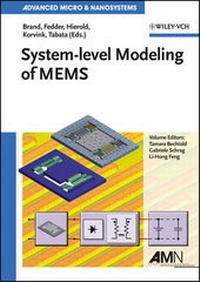
System-level Modeling of MEMS
1st Edition
Published on 20. December 2012
X, 496 pages
978-3-527-64712-5 (ISBN)
Description

System-level modeling of MEMS - microelectromechanical systems - comprises integrated approaches to simulate, understand, and optimize the performance of sensors, actuators, and microsystems, taking into account the intricacies of the interplay between mechanical and electrical properties, circuitry, packaging, and design considerations. Thereby, system-level modeling overcomes the limitations inherent to methods that focus only on one of these aspects and do not incorporate their mutual dependencies.
The book addresses the two most important approaches of system-level modeling, namely physics-based modeling with lumped elements and mathematical modeling employing model order reduction methods, with an emphasis on combining single device models to entire systems. At a clearly understandable and sufficiently detailed level the readers are made familiar with the physical and mathematical underpinnings of MEMS modeling. This enables them to choose the adequate methods for the respective application needs.
This work is an invaluable resource for all materials scientists, electrical engineers, scientists working in the semiconductor and/or sensor
industry, physicists, and physical chemists.
The book addresses the two most important approaches of system-level modeling, namely physics-based modeling with lumped elements and mathematical modeling employing model order reduction methods, with an emphasis on combining single device models to entire systems. At a clearly understandable and sufficiently detailed level the readers are made familiar with the physical and mathematical underpinnings of MEMS modeling. This enables them to choose the adequate methods for the respective application needs.
This work is an invaluable resource for all materials scientists, electrical engineers, scientists working in the semiconductor and/or sensor
industry, physicists, and physical chemists.
More details
Other editions
Additional editions

Tamara Bechtold | Gabriele Schrag | Lihong Feng
System-level Modeling of MEMS
Book
02/2013
1st Edition
Wiley-VCH
from
€175.00
Article exhausted; check different version
T. Bechtold
System-level Modeling of MEMS
Software
02/2013
Wiley-VCH
€239.57
No shipping information available
Persons
Tamara Bechtold is post-doctoral researcher at Philips/NXP Research Laboratories in the Netherlands. She obtained her PhD from the University of Freiburg, Germany, with a thesis on microsystems simulation conducted at the Institute of Microsystems Technology in the group of Jan Korvink. She is the author of one book and many scientific publications. As of 2009, Tamara Bechtold has more than ten years of experience in modeling and simulation of MEMS.
Gabriele Schrag is currently heading a research group at the Munich University of Technology, Germany, working in the field of MEMS modeling with a focus on virtual prototyping and predictive simulation methodologies, parameter extraction, and model verification for microdevices and microsystems. She studied physics at the University of Stuttgart and received her doctorate (with honors) from the Munich University of Technology in 2002, her thesis covering the 'Modeling of Coupled Effects in Microsystems' with a special emphasis on fluid-structure interaction and viscous damping effects. Gabriele Schrag authored and co-authored more than 70 publications in technical journals and conference proceedings.
Lihong Feng is a team leader in the research group of Computational Methods in Systems and Control theory headed by Professor Peter Benner, Max Planck Institute for Dynamics of Complex Technical Systems in Magdeburg, Germany. After her PhD from Fudan University in Shanghai, China, she joined the faculty of the State Key Laboratory of Application-Specific Integrated Circuits (ASIC) & System, Fudan University, Shanghai, China. From 2007 to 2008 she was a Humboldt research fellow in the working group of Mathematics in Industry and Technology at the Technical University of Chemnitz, Germany. In 2009-2010, she worked in the Laboratory for Microsystem Simulation, Department of Microsystems Engineering, University of Freiburg, Germany. Her research interests are in the field of reduced order modelling and fast numerical algorithms for control and optimization in Chemical Engineering, MEMS simulation, and circuit simulation.
Gabriele Schrag is currently heading a research group at the Munich University of Technology, Germany, working in the field of MEMS modeling with a focus on virtual prototyping and predictive simulation methodologies, parameter extraction, and model verification for microdevices and microsystems. She studied physics at the University of Stuttgart and received her doctorate (with honors) from the Munich University of Technology in 2002, her thesis covering the 'Modeling of Coupled Effects in Microsystems' with a special emphasis on fluid-structure interaction and viscous damping effects. Gabriele Schrag authored and co-authored more than 70 publications in technical journals and conference proceedings.
Lihong Feng is a team leader in the research group of Computational Methods in Systems and Control theory headed by Professor Peter Benner, Max Planck Institute for Dynamics of Complex Technical Systems in Magdeburg, Germany. After her PhD from Fudan University in Shanghai, China, she joined the faculty of the State Key Laboratory of Application-Specific Integrated Circuits (ASIC) & System, Fudan University, Shanghai, China. From 2007 to 2008 she was a Humboldt research fellow in the working group of Mathematics in Industry and Technology at the Technical University of Chemnitz, Germany. In 2009-2010, she worked in the Laboratory for Microsystem Simulation, Department of Microsystems Engineering, University of Freiburg, Germany. Her research interests are in the field of reduced order modelling and fast numerical algorithms for control and optimization in Chemical Engineering, MEMS simulation, and circuit simulation.
Editor
Technical University of Munich, Germany
University of Freiburg, Germany
Series Editor
Georgia Institute of Technology, Atlanta, GA, USA
Carnegie Mellon University, Pittsburgh, PA, USA
ETH Zürich, Zurich, Switzerland
Kyoto University, Kyoto, Japan
Content
PART I: PHYSICAL AND MATHEMATICAL FUNDAMENTALS
INTRODUCTION: ISSUES IN MICROSYSTEMS MODELING
The Need for System-Level Models for Microsystems
Coupled Multiphysics Microsystems
Multiscale Modeling and Simulation
System-Level Model Terminology
Automated Model Order Reduction Methods
Handling Complexity: Following the VLSI Paradigm
Analog Hardware Description Languages
General Attributes of System-Level Models
AHDL Simulation Capabilities
Composable Model Libraries
Parameter Extraction, Model Verification, and Model Validation
Conclusions
SYSTEM-LEVEL MODELING OF MEMS USING GENERALIZED KIRCHHOFFIAN NETWORKS - BASIC PRINCIPLES
Introduction and Motivation
Generalized Kirchhoffian Networks for the Tailored System-Level Modeling of Microsystems
Application 1: Physics-Based Electrofluidic Compact Model of an Electrostatically Actuated Micropump
Application 2: Electrostatically Actuated RF MEMS Switch
SYSTEM-LEVEL MODELING OF MEMS BY MEANS OF MODEL ORDER REDUCTION (MATHEMATICAL APPROXIMATIONS) - MATHEMATICAL BACKGROUND
Introduction
Brief Overview
Mathematical Preliminaries
Numerical Algorithms
Linear System Theory
Basic Idea of Model Order Reduction
Moment-Matching Model Order Reduction
Gramian-Based Model Order Reduction
Stability, Passivity, and Error Estimation of the Reduced Model
Dealing with Nonzero Initial Condition
MOR for Second-Order, Nonlinear, Parametric systems
Conclusion and Outlook
ALGORITHMIC APPROACHES FOR SYSTEM-LEVEL SIMULATION OF MEMS AND ASPECTS OF COSIMULATION
Introduction
Mathematical Structure of MEMS Models
General Approaches for System-Level Model Description
Numerical Methods for System-Level Simulation
Emerging Problems and Advanced Simulation Techniques
Conclusion
PART II: LUMPED ELEMENT MODELING METHOD FOR MEMS DEVICES
SYSTEM-LEVEL MODELING OF SURFACE MICROMACHINED BEAMLIKE ELECTROTHERMAL MICROACTUATORS
Introduction
Classification and Problem Description
Modeling
Solving
Case Study
Conclusion and Outlook
SYSTEM-LEVEL MODELING OF PACKAGING EFFECTS OF MEMS DEVICES
Introduction
Packaging Effects of MEMS and Their Impact on Typical MEMS Devices
System-Level Modeling
Conclusion and Outlook
MIXED-LEVEL APPROACH FOR THE MODELING OF DISTRIBUTED EFFECTS IN MICROSYSTEMS
General Concept of Finite Networks and Mixed-Level Models
Approaches for the Modeling of Squeeze Film Damping in MEMS
Mixed-Level Modeling of Squeeze Film Damping in MEMS
Evaluation
Conclusion
COMPACT MODELING OF RF-MEMS DEVICES
Introduction
Brief Description of the MEMS Compact Modeling Approach
RF-MEMS Multistate Attenuator Parallel Section
RF-MEMS Multistate Attenuator Series Section
Whole RF-MEMS Multistate Attenuator Network
Conclusions
PART III: MATHEMATICAL MODEL ORDER REDUCTION FOR MEMS DEVICES
MOMENT-MATCHING-BASED LINEAR MODEL ORDER REDUCTION FOR NONPARAMETRIC AND PARAMETRIC ELECTROTHERMAL MEMS MODELS
Introduction
Methodology for Applying Model Order Reduction to Electrothermal MEMS Models: Review of Achieved Results and Open Issues
MEMS Case Study - Silicon-Based Microhotplate
Application of the Reduced-Order Model for the Parameterization of the Controller
Application of Parametric Reduced-Order Model to the Extraction of Thin-Film Thermal Parameters
Conclusion and Outlook
PROJECTION-BASED NONLINEAR MODEL ORDER REDUCTION
Introduction
Problem Specification
Projection Principle and Evaluation Cost for Nonlinear Systems
Taylor Series Expansions
Trajectory Piecewise-Linear Method
Discrete Empirical Interpolation method
A Comparative Case Study of an MEMS Switch
Summary and Outlook
LINEAR AND NONLINEAR MODEL ORDER REDUCTION FOR MEMS ELECTROSTATIC ACTUATORS
Introduction
The Variable Gap Parallel Plate Capacitor
Model Order Reduction Methods
Example 1: IBM Scanning-Probe Data Storage Device
Example 2: Electrostatic Micropump Diaphragm
Results and Discussion
Conclusions
MODAL-SUPERPOSITION-BASED NONLINEAR MODEL ORDER REDUCTION FOR MEMS GYROSCOPES
Intro
INTRODUCTION: ISSUES IN MICROSYSTEMS MODELING
The Need for System-Level Models for Microsystems
Coupled Multiphysics Microsystems
Multiscale Modeling and Simulation
System-Level Model Terminology
Automated Model Order Reduction Methods
Handling Complexity: Following the VLSI Paradigm
Analog Hardware Description Languages
General Attributes of System-Level Models
AHDL Simulation Capabilities
Composable Model Libraries
Parameter Extraction, Model Verification, and Model Validation
Conclusions
SYSTEM-LEVEL MODELING OF MEMS USING GENERALIZED KIRCHHOFFIAN NETWORKS - BASIC PRINCIPLES
Introduction and Motivation
Generalized Kirchhoffian Networks for the Tailored System-Level Modeling of Microsystems
Application 1: Physics-Based Electrofluidic Compact Model of an Electrostatically Actuated Micropump
Application 2: Electrostatically Actuated RF MEMS Switch
SYSTEM-LEVEL MODELING OF MEMS BY MEANS OF MODEL ORDER REDUCTION (MATHEMATICAL APPROXIMATIONS) - MATHEMATICAL BACKGROUND
Introduction
Brief Overview
Mathematical Preliminaries
Numerical Algorithms
Linear System Theory
Basic Idea of Model Order Reduction
Moment-Matching Model Order Reduction
Gramian-Based Model Order Reduction
Stability, Passivity, and Error Estimation of the Reduced Model
Dealing with Nonzero Initial Condition
MOR for Second-Order, Nonlinear, Parametric systems
Conclusion and Outlook
ALGORITHMIC APPROACHES FOR SYSTEM-LEVEL SIMULATION OF MEMS AND ASPECTS OF COSIMULATION
Introduction
Mathematical Structure of MEMS Models
General Approaches for System-Level Model Description
Numerical Methods for System-Level Simulation
Emerging Problems and Advanced Simulation Techniques
Conclusion
PART II: LUMPED ELEMENT MODELING METHOD FOR MEMS DEVICES
SYSTEM-LEVEL MODELING OF SURFACE MICROMACHINED BEAMLIKE ELECTROTHERMAL MICROACTUATORS
Introduction
Classification and Problem Description
Modeling
Solving
Case Study
Conclusion and Outlook
SYSTEM-LEVEL MODELING OF PACKAGING EFFECTS OF MEMS DEVICES
Introduction
Packaging Effects of MEMS and Their Impact on Typical MEMS Devices
System-Level Modeling
Conclusion and Outlook
MIXED-LEVEL APPROACH FOR THE MODELING OF DISTRIBUTED EFFECTS IN MICROSYSTEMS
General Concept of Finite Networks and Mixed-Level Models
Approaches for the Modeling of Squeeze Film Damping in MEMS
Mixed-Level Modeling of Squeeze Film Damping in MEMS
Evaluation
Conclusion
COMPACT MODELING OF RF-MEMS DEVICES
Introduction
Brief Description of the MEMS Compact Modeling Approach
RF-MEMS Multistate Attenuator Parallel Section
RF-MEMS Multistate Attenuator Series Section
Whole RF-MEMS Multistate Attenuator Network
Conclusions
PART III: MATHEMATICAL MODEL ORDER REDUCTION FOR MEMS DEVICES
MOMENT-MATCHING-BASED LINEAR MODEL ORDER REDUCTION FOR NONPARAMETRIC AND PARAMETRIC ELECTROTHERMAL MEMS MODELS
Introduction
Methodology for Applying Model Order Reduction to Electrothermal MEMS Models: Review of Achieved Results and Open Issues
MEMS Case Study - Silicon-Based Microhotplate
Application of the Reduced-Order Model for the Parameterization of the Controller
Application of Parametric Reduced-Order Model to the Extraction of Thin-Film Thermal Parameters
Conclusion and Outlook
PROJECTION-BASED NONLINEAR MODEL ORDER REDUCTION
Introduction
Problem Specification
Projection Principle and Evaluation Cost for Nonlinear Systems
Taylor Series Expansions
Trajectory Piecewise-Linear Method
Discrete Empirical Interpolation method
A Comparative Case Study of an MEMS Switch
Summary and Outlook
LINEAR AND NONLINEAR MODEL ORDER REDUCTION FOR MEMS ELECTROSTATIC ACTUATORS
Introduction
The Variable Gap Parallel Plate Capacitor
Model Order Reduction Methods
Example 1: IBM Scanning-Probe Data Storage Device
Example 2: Electrostatic Micropump Diaphragm
Results and Discussion
Conclusions
MODAL-SUPERPOSITION-BASED NONLINEAR MODEL ORDER REDUCTION FOR MEMS GYROSCOPES
Intro
