

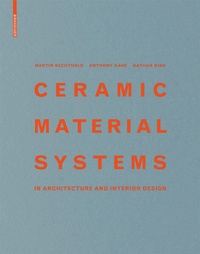
Ceramic Material Systems
Description

Far beyond its long-standing decorative and protective use, architectural ceramics has matured into a material system of great potential. Triggered by material research, design computation and digital fabrication methods, the innovations in ceramic technology are enabling expanded applications for ceramics as a multi-functional, performative material system.
Ceramic material systems comprise the full ecosystem from material extraction and processing to the assembly of construction elements and their eventual reuse and recycling. This book establishes the state of the art of this quickly emerging field, with a particular interest in presenting the knowledge needed for developing project-specific solutions that often involve custom ceramic elements. The authors provide a rigorous background of the materials and associated technologies as well as inspiration from the very best contemporary buildings using ceramic systems, along with an overview of emerging ceramic technologies and research.
The main section of the book is supplemented with a descriptive and critically commented listing of the most interesting and innovative ceramic products on the market today, ranging from interior tile products to complex active façade systems and roof products.
More details
Other editions
Additional editions
Persons
Content
- Intro
- Contents
- CHAPTER 1. CERAMIC MATERIAL SYSTEMS
- CHAPTER 2. FIRED CLAY - A MATERIAL LEGACY
- From the Origins to the 19th Century
- From the 20th Century to Today
- CHAPTER 3. MATERIALS AND MATERIAL PROPERTIES
- Clay
- Clay Bodies
- Shrinkage
- Properties of Ceramic Parts
- Glazes
- Other Surface Treatments and Coatings
- CHAPTER 4. PRODUCTION PROCESSES
- Dry-pressing
- Extrusion
- Slump Forming/Slump Molding
- Die-cutting
- Plastic Pressing
- Slip Casting
- Wheel-throwing
- Jiggering
- Firing and Kilns
- Glazing
- Post-processing
- Packaging and Distribution
- CHAPTER 5. APPLICATIONS: INTERIORS
- Adhered Tile Systems
- Mechanically Connected Tiles
- Sanitary Ware
- CHAPTER 6. APPLICATIONS: EXTERIORS
- Bonded Tile Facades
- Ventilated Facades
- Screen Surfaces
- Acoustic Surfaces
- Roofs
- Other Outdoor Applications
- CHAPTER 7. MATERIAL FLOWS: LIFE CYCLE ASPECTS
- Extraction-to-Production Phase
- Construction and Use Phase
- End-of-Life Scenarios
- Life Cycle Analysis (LCA) and Material Comparisons
- CHAPTER 8. SURFACE EFFECTS
- Introduction
- Surface Reliefs The Wallpaper Factory, Islington, North London, UK
- Color Variation Museum Brandhorst, Munich, Germany
- Custom Glazes The Holburne Museum Extension, Bath, Somerset, UK
- Three-dimensional Surfaces Museum der Kulturen Basel, Switzerland
- Pearlescent Glazes Algueña MUCA Music Hall and Auditorium, Alicante, Spain
- Glaze Transfers One Eagle Place, London, UK
- High Performance Surfaces West Beach Promenade, Benidorm, Spain
- Inkjet Printing La Mandarra de La Ramos, Pamplona, Spain
- Nano-coatings Pinnacle, Bologna, Italy
- CHAPTER 9. PATTERNS AND AGGREGATIONS
- Introduction
- Complex Geometry Pulsate, Primrose Hill, London, UK
- Complex Assembly Jewish Community Center, Mainz, Germany
- Non-repeating Patterns Zamet Center, Rijeka, Croatia
- Figurative Urban Mosaics Muhammad Ali Center, Louisville, Kentucky, USA
- Curved Surface Urban Mosaics Santa Caterina Market, Barcelona, Spain
- Robotic Tiling Iowa State Mural, Ames, Iowa, USA
- Tessellated Surfaces Urban Guerrilla, Valencia, Spain
- Hanging Assemblies Xinjin Zhi Museum, Chengdu, China
- Three-dimensional Assemblies 3Dx1, Milan, Italy
- Structural Assemblies Casalgrande Ceramic Cloud (CCCLoud), Reggio Emilia, Italy
- CHAPTER 10. THERMODYNAMIC SKINS
- Introduction
- Reclaimed Tile Tectonics Warehouse 8B Administrative Offices, Madrid, Spain
- Grão - Ceramic Pixels Jardim Botânico Tropical, Travessa do Marta Pinto, Belém/Lisbon, Portugal
- Masonic Louvers Student Services Building, University of Texas at Dallas, Texas, USA
- Modulating Light Addition to the Israel Museum, Jerusalem, Israel
- Perforated Slab School Library, Gando, Burkina Faso
- Cool Cavity Patio 2.12, Andalucía Team, Solar Decathlon Europe 2012, 2nd Prize, Madrid, Spain
- Breathing Columns Spanish Pavilion at the International Exposition of Zaragoza, Spain
- BIO SKIN. Sony Research and Development Office, Tokyo, Japan
- CHAPTER 11. FORM CUSTOMIZATION STRATEGIES
- Introduction
- Computer-aided Slump Molding Villa Nurbs, Empuriabrava, Spain
- Volumetric Pixelization Spanish Pavilion, Expo 2005, Aichi, Japan
- High-relief Slip-cast Surfaces Villa for an Industrialist, Shenzhen, China
- Low-volume Custom Extrusion Kosemo Brick, Archie Bray Foundation, Helena, Montana, USA
- Systemic Variation Ministry of Urban Development and Environment, Hamburg, Germany
- Digital Reconstruction Alberta Legislature Building Dome Reconstruction, Edmonton, Alberta, Canada
- Angular Variation Trumpf Industrial Campus Restaurant, Ditzingen, Germany
- Delineated Parallax La Riera de la Salut Remodel, Sant Feliu de Llobregat, Spain
- Aggregate Production Processes Oceanário Addition, Lisbon, Portugal
- Compound Surface Discretization Museum de Fundatie Extension, Zwolle, Overijssel, The Netherlands
- CHAPTER 12. EMERGING SYSTEMS
- Introduction
- Robotic Tile Mosaics Design Robotics Group at Harvard University Graduate School of Design
- Integrated Environmental Designto- Robotic Production Design Robotics Group at Harvard University Graduate School of Design
- Thermally Active Building Envelope The Center for Architecture, Science and Ecology, Rensselaer Polytechnic Institute and Skidmore, Owings & Merrill (SOM)
- Structural Ceramic Shell Material Processes and Systems Group at Harvard University, Graz University of Technology
- Photosensitive Blueware Studio Glithero
- Foamed Ceramics European Ceramic Work Center, Joris Laarman Studio BV
- Additive Ceramic Systems
- Automated Material Manipulation
- PRODUCTS AND TECHNOLOGIES
- Introduction
- Large-format Production Lines
- Large-format Tiles: Neolith, Techlam, Maximum
- High-strength Porcelain: SaphirKeramik Sink
- Bioactive Ceramics: Bionictile
- Slumped Tile: UP
- Slumped Tile: STAR
- Translucent Porcelain: SlimmKer-Light
- Modular Ceramic Stove
- Berlin Stove Tiles
- Keramos Cabinets
- Inkjet-printed Tiles: Emotile
- Physical Vapor Deposition: Metallic Coatings
- Laser Engraving
- Recycled Tiles
- Preassembled Systems: Flexbrick
- Ceramic-Concrete Composition System: Terraclad
- Ceramic Louver System: Shamal
- Photovoltaic Roof Tiles: Panotron
- Ceramic Wardrobe: Milky Star
- Acoustic Ceramics: Acoustic Shingle
- Industrial Tile: Acigres
- Material Mimicry: Age Wood, Age Beton, Age Blend
- APPENDIX
- About the Authors
- Index of Names
- Subject Index
- Sponsor's Profile
- Illustration Credits
