

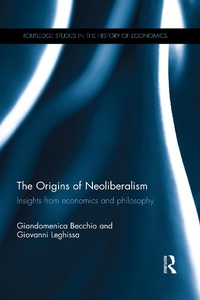
The Origins of Neoliberalism
Insights from economics and philosophy
Published on 25. November 2016
218 pages
978-1-317-90935-4 (ISBN)
Description

Neoliberalism is a doctrine that adopts a free market policy in a deregulated political framework. In recent years, neoliberalism has become increasingly prominent as a doctrine in Western society, and has been heavily discussed in both academia and the media.
In The Origins of Neoliberalism, the joint effort of an economist and a philosopher offers a theoretical overview of both neoliberalism's genesis within economic theory and social studies as well as its development outside academia. Tracing the sources of neoliberalism within the history of economic thought, the book explores the differences between neoliberalism and classical liberalism. This book's aim is to make clear that neoliberalism is not a natural development of the old classical liberalism, but rather that it represents a dramatic alteration of its original nature and meaning. Also, it fights against the current idea according to which neoliberalism would coincide with the triumph of free market economy.
In its use of both history of economics and philosophy, this book takes a highly original approach to the concept of neoliberalism. The analysis presented here will be of great interest to scholars and students of history of economics, political economy, and philosophy of social science.
In The Origins of Neoliberalism, the joint effort of an economist and a philosopher offers a theoretical overview of both neoliberalism's genesis within economic theory and social studies as well as its development outside academia. Tracing the sources of neoliberalism within the history of economic thought, the book explores the differences between neoliberalism and classical liberalism. This book's aim is to make clear that neoliberalism is not a natural development of the old classical liberalism, but rather that it represents a dramatic alteration of its original nature and meaning. Also, it fights against the current idea according to which neoliberalism would coincide with the triumph of free market economy.
In its use of both history of economics and philosophy, this book takes a highly original approach to the concept of neoliberalism. The analysis presented here will be of great interest to scholars and students of history of economics, political economy, and philosophy of social science.
More details
Series
Language
English
Place of publication
London
United Kingdom
Publishing group
Taylor & Francis Ltd
Target group
College/higher education
Illustrations
2 s/w Tabellen
2 Tables, black and white
File size
2,78 MB
ISBN-13
978-1-317-90935-4 (9781317909354)
Copyright in bibliographic data and cover images is held by Nielsen Book Services Limited or by the publishers or by their respective licensors: all rights reserved.
Schweitzer Classification
Other editions
Additional editions

Giandomenica Becchio | Giovanni Leghissa
The Origins of Neoliberalism
Insights from economics and philosophy
Book
12/2019
1st Edition
Routledge
€68.20
Shipment within 15-20 days
Giandomenica Becchio | Giovanni Leghissa
The Origins of Neoliberalism
Insights from economics and philosophy
Book
11/2016
1st Edition
Routledge
€241.70
Shipment within 15-20 days
Persons
Giandomenica Becchio is Assistant Professor of Economics at the University of Turin, Italy.
Giovanni Leghissa is Assistant Professor of Philosophy at the University of Turin, Italy.
Giovanni Leghissa is Assistant Professor of Philosophy at the University of Turin, Italy.
Content
Contents
List of tables
Introduction: The counter-revolution of neoliberalism
This book's contents
1 Foucault and beyond
1.1 Foucault's distinction between liberalism and neoliberalism
1.2 The neo-Marxist conception of neoliberalism
1.3 The relationship between state action and economy
1.4 Neoliberalism and the question of systemic complexity
2 The building of economics as a science
2.1 The revolution of marginalism: how political economy became economics
2.2 General economic equilibrium and econometrics in the 1930s: from Vienna to Chicago
2.3 The Americanization of the discipline: building mainstream economics
2.4 The rise of neoliberalism in Chicago: the hegemonic role of both neoliberalism and neoclassical economics
3 The building of individuals as rational agents
3.1 Economic rationality and homo oeconomicus: from Vienna and Lausanne to Chicago
3.2 The theoretical and methodological distance between Vienna and Chicago
3.3 Karl Polanyi's critique of neoliberalism
4 Turning the world into a firm
4.1 Neoliberalism and the political role of the firm
4.2 The neoliberal theory of organizations
4.3 Institutions, evolution and the frame of individual choices: or, farewell from the neoclassic nuts and bolts
Postscript: A new ethics for a new liberalism?
Index
List of tables
Introduction: The counter-revolution of neoliberalism
This book's contents
1 Foucault and beyond
1.1 Foucault's distinction between liberalism and neoliberalism
1.2 The neo-Marxist conception of neoliberalism
1.3 The relationship between state action and economy
1.4 Neoliberalism and the question of systemic complexity
2 The building of economics as a science
2.1 The revolution of marginalism: how political economy became economics
2.2 General economic equilibrium and econometrics in the 1930s: from Vienna to Chicago
2.3 The Americanization of the discipline: building mainstream economics
2.4 The rise of neoliberalism in Chicago: the hegemonic role of both neoliberalism and neoclassical economics
3 The building of individuals as rational agents
3.1 Economic rationality and homo oeconomicus: from Vienna and Lausanne to Chicago
3.2 The theoretical and methodological distance between Vienna and Chicago
3.3 Karl Polanyi's critique of neoliberalism
4 Turning the world into a firm
4.1 Neoliberalism and the political role of the firm
4.2 The neoliberal theory of organizations
4.3 Institutions, evolution and the frame of individual choices: or, farewell from the neoclassic nuts and bolts
Postscript: A new ethics for a new liberalism?
Index
