

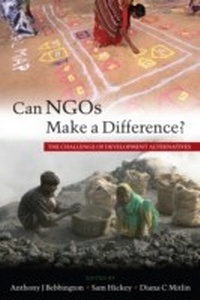
Can NGOs Make a Difference?
The Challenge of Development Alternatives
1st Edition
Published on 4. April 2013
368 pages
978-1-84813-621-2 (ISBN)
Description

Can non-governmental organisations contribute to more socially just, alternative forms of development? Or are they destined to work at the margins of dominant development models determined by others? Addressing this question, this book brings together leading international voices from academia, NGOs and the social movements. It provides a comprehensive update to the NGO literature and a range of critical new directions to thinking and acting around the challenge of development alternatives. The book's originality comes from the wide-range of new case-study material it presents, the conceptual approaches it offers for thinking about development alternatives, and the practical suggestions for NGOs.
At the heart of this book is the argument that NGOs can and must re-engage with the project of seeking alternative development futures for the world's poorest and more marginal. This will require clearer analysis of the contemporary problems of uneven development, and a clear understanding of the types of alliances NGOs need to construct with other actors in civil society if they are to mount a credible challenge to disempowering processes of economic, social and political development.
At the heart of this book is the argument that NGOs can and must re-engage with the project of seeking alternative development futures for the world's poorest and more marginal. This will require clearer analysis of the contemporary problems of uneven development, and a clear understanding of the types of alliances NGOs need to construct with other actors in civil society if they are to mount a credible challenge to disempowering processes of economic, social and political development.
Reviews / Votes
This book offers a novel and reflective framework for revisiting NGO's efficacy in fashioning alternative forms of development in the post-NGO boom period. Against current security agendas, the authors envision types of NGO practice, orientation, and focus that that hold out hope for their foundational mission of "being alternative." * Arturo Escobar, University of North Carolina at Chapel Hill * This is a timely addition to the literature on non-governmental organisations and development. Up-to-date, critical and historically informed, its seventeen chapters are written by a potent combination of both well-known experts and original new voices. * David Lewis, London School of Economics and Political Science * These essays ... provide a number of useful insights into the NGO world. * North South Magazine *More details
Edition
1. Auflage
Language
English
Place of publication
United Kingdom
Publishing group
Bloomsbury Publishing PLC
Target group
College/higher education
Professional and scholarly
ISBN-13
978-1-84813-621-2 (9781848136212)
Copyright in bibliographic data and cover images is held by Nielsen Book Services Limited or by the publishers or by their respective licensors: all rights reserved.
Schweitzer Classification
Other editions
Additional editions
Anthony J. Bebbington | Samuel Hickey | Diana C. Mitlin
Can NGOs Make a Difference?
The Challenge of Development Alternatives
Book
12/2007
Zed Books Ltd
€43.00
Shipment within 3-4 weeks
Persons
Anthony Bebbington is Professor of Nature, Society and Development in the Institute of Development Policy and Management at the University of Manchester, an ESRC Professorial Fellow, and also a member and research affiliate of the Centro Peruano de Estudios Sociales, Lima, Peru. He has previously held positions at the University of Colorado at Boulder, the University of Cambridge, the International Institute for Environment and Development, the Overseas Development Institute and the World Bank.
Sam Hickey is lecturer in International Development in the Institute of Development Policy and Management at the University of Manchester.
Diana Mitlin is an economist and social development specialist with staff posts at both the International Institute for Environment and Development and the Institute for Development Policy and Management at the University of Manchester.
Sam Hickey is lecturer in International Development in the Institute of Development Policy and Management at the University of Manchester.
Diana Mitlin is an economist and social development specialist with staff posts at both the International Institute for Environment and Development and the Institute for Development Policy and Management at the University of Manchester.
Content
Part One: Critical challenges
1. Introduction: Can NGOs make a difference? The challenge of development alternatives - Anthony Bebbington, Sam Hickey and Diana Mitlin
2. Have NGOs 'made a difference?': From Manchester to Birmingham with an elephant in the room - Michael Edwards
Part Two: NGO alternatives under pressure
3. Challenges to participation, citizenship and democracy: Perverse confluence and displacement of meanings - Evelina Dagnino
4. Learning from Latin America: Recent trends in European NGO policy-making - Kees Biekart
5. Whatever happened to reciprocity? Implications of donor emphasis on 'voice' and 'impact' as rationales for working with NGOs in development - Alan Thomas
6. Development and the new security agenda: W(h)ither(ing) NGO alternatives? - Alan Fowler
Part Three: Pursuing alternatives: NGO strategies in practice
7. How civil society organizations use evidence to influence policy processes - Amy Pollard and Julius Court
8. Civil society participation as the focus of Northern NGO support: The case of Dutch co-financing agencies - Irene Guijt
9. Producing knowledge, generating alternatives? Challenges to research oriented NGOs in Central America and Mexico - Cynthia Bazan, Nelson Cuellar, Ileana Gomez, Cati Illsley, Adrian Lopez, Iliana Monterroso, Joaline Pardo, Jose Luis Rocha, Pedro Torres, Anthony Bebbington
10. Anxieties and affirmations: NGO-donor partnerships for social transformation - Mary Racelis
Part Four: Being alternative
11. Pressures on international NGO's: Time to reinvent the system. A view from the Dutch co-financing system - Harry Derksen and Pim Verhallen
12. Transforming or conforming? NGOs training health promoters and the dominant paradigm of the development industry in Bolivia - Katie S. Bristow
13. Political entrepreneurs or development agents: An NGO's tale of resistance and acquiescence in Madhya Pradesh, India - Vasudha Chhotray
14. Is this really the end of the road for gender mainstreaming? : Getting to grips with gender and institutional change - Nicholas Pialek
15. The Ambivalent Cosmopolitanism of International NGOs - Helen Yanacopulos and Matt Baillie Smith
16. Development as reform and counter-reform: Paths travelled by Slum/Shack Dwellers International - Joel Bolnick
Five: Taking stock and thinking forward
17. Reflections on NGOs and development: The elephant, the dinosaur, several tigers but no owl - David Hulme
Contributors
1. Introduction: Can NGOs make a difference? The challenge of development alternatives - Anthony Bebbington, Sam Hickey and Diana Mitlin
2. Have NGOs 'made a difference?': From Manchester to Birmingham with an elephant in the room - Michael Edwards
Part Two: NGO alternatives under pressure
3. Challenges to participation, citizenship and democracy: Perverse confluence and displacement of meanings - Evelina Dagnino
4. Learning from Latin America: Recent trends in European NGO policy-making - Kees Biekart
5. Whatever happened to reciprocity? Implications of donor emphasis on 'voice' and 'impact' as rationales for working with NGOs in development - Alan Thomas
6. Development and the new security agenda: W(h)ither(ing) NGO alternatives? - Alan Fowler
Part Three: Pursuing alternatives: NGO strategies in practice
7. How civil society organizations use evidence to influence policy processes - Amy Pollard and Julius Court
8. Civil society participation as the focus of Northern NGO support: The case of Dutch co-financing agencies - Irene Guijt
9. Producing knowledge, generating alternatives? Challenges to research oriented NGOs in Central America and Mexico - Cynthia Bazan, Nelson Cuellar, Ileana Gomez, Cati Illsley, Adrian Lopez, Iliana Monterroso, Joaline Pardo, Jose Luis Rocha, Pedro Torres, Anthony Bebbington
10. Anxieties and affirmations: NGO-donor partnerships for social transformation - Mary Racelis
Part Four: Being alternative
11. Pressures on international NGO's: Time to reinvent the system. A view from the Dutch co-financing system - Harry Derksen and Pim Verhallen
12. Transforming or conforming? NGOs training health promoters and the dominant paradigm of the development industry in Bolivia - Katie S. Bristow
13. Political entrepreneurs or development agents: An NGO's tale of resistance and acquiescence in Madhya Pradesh, India - Vasudha Chhotray
14. Is this really the end of the road for gender mainstreaming? : Getting to grips with gender and institutional change - Nicholas Pialek
15. The Ambivalent Cosmopolitanism of International NGOs - Helen Yanacopulos and Matt Baillie Smith
16. Development as reform and counter-reform: Paths travelled by Slum/Shack Dwellers International - Joel Bolnick
Five: Taking stock and thinking forward
17. Reflections on NGOs and development: The elephant, the dinosaur, several tigers but no owl - David Hulme
Contributors
