

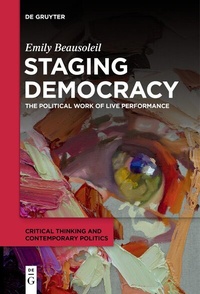
Staging Democracy
Description

Political theory and practice have traditionally overlooked the performing arts as a site of civic politics, and yet marginalized communities continually turn to them to communicate, challenge, and catalyze change. This book brings vivid moments of creative practice from three continents together with performance studies and political scholarship to argue that artistic performance offers a potent form of democratic voice for claims from the margins. Across political contexts, democratic aims, and artistic genres, Staging Democracy shows how the very qualities that lead some to think of the arts as unclear, irrational, and irresponsible - and thus politically suspect - shape artistic performance's distinct capacity to enact democratic engagement in conditions of deep difference and inequality.
Reviews / Votes
"Working with 'art's most unruly characteristics,' Emily Beausoleil looks past representational or referential art to theorize the power of performance for democratic politics. Improvisation, orality, and ephemerality are among the traits that make performance powerful, especially in repressive settings of apartheid or ongoingly colonial governance. From apartheid South Africa to Canada and New Zealand, Beausoleil shows the power of theatrical encounter to open new possibilities yet to be fully owned by democratic theory. Beausoleil brilliantly opens the way with this humane, intelligent work of theory oriented by practice. A must-read."
Bonnie Honig, Nancy Duke Lewis Professor of Modern Culture and Media and Political Science, Brown University (US), author of Emergency Politics: Paradox, Law, Democracy (Princeton, 2009, David Easton Prize), Antigone, Interrupted (Cambridge University Press, 2013), Public Things: Democracy in Disrepair (Fordham, 2017), and A Feminist Theory of Refusal (Harvard, 2021).
" Staging Democracy shows us how artistic performances can induce and maintain a democratic ethos, and how they are themselves modes of democratic deliberation and decision-making. Through fascinating case studies of anti-apartheid theater in South Africa, the anti-homelessness theater in Vancouver, Canada, and a tourist walk led by the character of Captain Cook in Aotearoa New Zealand, it reveals just how entangled 'the political' is with 'the aesthetic.' Beausoleil's beautiful and convincing defense of artistic performance will be of great interest to all of us who seek ways to combat the rise of anti-democratic, oligarchic, and fascist forces."
Jane Bennet, Andrew W. Mellon Professor in Humanities, Departments of Political Science and Comparative Thought and Literature, Johns Hopkins University (US), author of Vibrant Matter: The Political Ecology of Things (Duke, 2010) and founding editor of Theory & Event.
"Why are our aesthetic impulses often so much better than our political and public ones? Why is it that in traditional spaces of democratic politics, we find a political culture hungry for closure and impatient with complexity-while in the realm of performance, we show ourselves capable of taking pleasure in the ambiguity and multiplicity of the human condition? In Staging Democracy , political theorist Emily Beausoleil looks at anti-Apartheid theater in South Africa, the Vancouver-based after homelessness project, and decolonial performance in New Zealand to explore how artistic performance can cultivate a care for difference and forms of receptive generosity necessary for richer forms of democratic engagement. A lovely and necessary work of democratic theory."
Cristina Beltrán, Associate Professor, Department of Social and Cultural Analysis, New York University (US), author of The Trouble with Unity: Latino Politics and the Creation of Identity (Oxford University Press, 2010) and ruelty as Citizenship: How Migrant Suffering Sustains White Democracy (University Minnesota Press, 2020).
More details
Other editions
Additional editions
Person
Emily Beausoleil is a Senior Lecturer of Politics at Te Herenga Waka-Victoria University of Wellington and Editor-in-Chief of Democratic Theory journal. As a political theorist, she explores the conditions, challenges, and creative possibilities for democratic engagement in diverse and unequal societies. Connecting affect, critical democratic, postcolonial, neuroscience, and performance scholarship, Beausoleil's work explores how we might realize democratic ideals of voice and listening across difference in concrete terms. Her work has been published in Political Theory , Contemporary Political Theory , Theory & Event, New Political Science, and Constellations , as well as in various books.
Content
- Intro
- Contents
- Acknowledgments
- Chapter 1 The Art of Democratic Engagement
- Chapter 2 Limits of the Literal, Promise of the Performative
- Chapter 3 Staging Protest: The Role of Anti-Apartheid Theatre in Democratizing South Africa
- Chapter 4 Staging Deliberation: Forum Theatre as 'Living Laboratory' in Canada
- Chapter 5 Staging Revision: Clowning Around with Captain Cook in Aotearoa New Zealand
- Chapter 6 Challenges, Risks and Limits of Politically-Engaged Performance
- Conclusion. Embodying a Democratic Ethos: Future Directions for Performance-as- Democratic Politics
- Bibliography
- Index - Staging Democracy
