

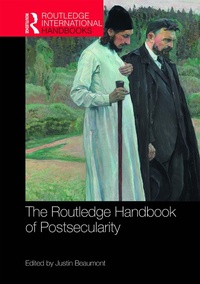
The Routledge Handbook of Postsecularity
1st Edition
Published on 26. October 2018
470 pages
978-1-315-30781-7 (ISBN)
Description

The Routledge Handbook of Postsecularity offers an internationally significant and comprehensive interdisciplinary collection which provides a series of critical reviews of the current state of the art and future trends in philosophical, theoretical, and conceptual terms. The volume likewise presents a range of empirical knowledges and engagements with postsecularity. A critical yet sympathetic dialogue across disciplinary divides in an international context ensures that the volume covers a wide and interrelated intellectual and geographical scope.
The editor's introduction with Klaus Eder offers a robust foundation for the volume, setting out the central aims and objectives, the rationale for the contributions, and an outline of the structure. Thorny issues of normativity and empirical challenges are highlighted for the reader. The handbook comprises four interrelated sections. Part I: Philosophical meditations discusses postsecularity from philosophical standpoints, and Part II: Theological perspectives presents contributions from a variety of theological viewpoints. Part III: Theory, space, social relations contains pieces from geography, planning, sociology, and religious studies that delve into theoretically informed empirical implications of postsecularity. Part IV: Political and social engagement offers chapters that emphasize the political and social implications of the debate. In the Afterword, Eduardo Mendieta joins the editor to reflect on the notion of reflexive secularization across the volume as a whole, alluding to new lines of inquiry.
The handbook is an invaluable guide for graduate and advanced undergraduate teaching, and a key reference for students and scholars of human geography, sociology, political science, applied philosophy, urban and public theology, planning, and urban studies.
The editor's introduction with Klaus Eder offers a robust foundation for the volume, setting out the central aims and objectives, the rationale for the contributions, and an outline of the structure. Thorny issues of normativity and empirical challenges are highlighted for the reader. The handbook comprises four interrelated sections. Part I: Philosophical meditations discusses postsecularity from philosophical standpoints, and Part II: Theological perspectives presents contributions from a variety of theological viewpoints. Part III: Theory, space, social relations contains pieces from geography, planning, sociology, and religious studies that delve into theoretically informed empirical implications of postsecularity. Part IV: Political and social engagement offers chapters that emphasize the political and social implications of the debate. In the Afterword, Eduardo Mendieta joins the editor to reflect on the notion of reflexive secularization across the volume as a whole, alluding to new lines of inquiry.
The handbook is an invaluable guide for graduate and advanced undergraduate teaching, and a key reference for students and scholars of human geography, sociology, political science, applied philosophy, urban and public theology, planning, and urban studies.
Reviews / Votes
'This is an exceptionally strong collection examining one of the defining issues of our era. Readers will find it both broadens and deepens their thinking about changing roles of religion and secularism in contemporary society.' - Craig Calhoun, Professor of Social Sciences, Arizona State University, USA'It is increasingly clear that what comes after postmodernity is not really the vaguely defined neo-modern, which is little more than a wave of nostalgia, but rather the post-secular, which is also a more genuine post-modern. It manifests itself variously as the challenge of other non-secular cultures, of the pre-modern and alternatively modern west, of the extra-human and the unavoidably metaphysical. This fine collection well represents this variety in both its disparity and its aspects of unity.' - John Milbank, Emeritus Professor of Religion, Politics and Ethics, University of Nottingham, UK
More details
Series
Edition
1. Auflage
Language
English
Place of publication
London
United Kingdom
Publishing group
Taylor & Francis Ltd
Target group
College/higher education
Product notice
Reflowable
Illustrations
2 Tables, black and white; 27 Halftones, black and white; 27 Illustrations, black and white
File size
5,17 MB
ISBN-13
978-1-315-30781-7 (9781315307817)
Copyright in bibliographic data and cover images is held by Nielsen Book Services Limited or by the publishers or by their respective licensors: all rights reserved.
Schweitzer Classification
Other editions
Additional editions
Justin Beaumont
The Routledge Handbook of Postsecularity
Book
12/2020
1st Edition
Routledge
€73.00
Shipment within 15-20 days
Justin Beaumont
The Routledge Handbook of Postsecularity
Book
11/2018
1st Edition
Routledge
€326.82
Shipment within 10-20 days
Person
Justin Beaumont is Honorary Research Fellow at the School of Geography, Queen Mary University of London, UK.
Content
INTRODUCTION: Concepts, processes, and antagonisms of postsecularity PART I: PHILOSOPHICAL MEDITATIONS PART II: THEOLOGICAL PERSPECTIVES PART III: THEORY, SPACE, SOCIAL RELATIONS PART IV: POLITICS AND SOCIAL ENGAGEMENT AFTERWORD: Reflexive secularization Index
