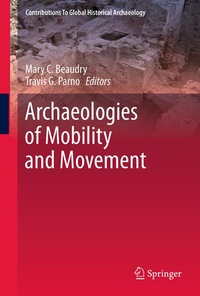
Archaeologies of Mobility and Movement
Description

This collection of essays in Archaeologies of Mobility and Movement draws inspiration from current archaeological interest in the movement of individuals, things, and ideas in the recent past. Movement is fundamentally concerned with the relationship(s) among time, object, person, and space. The volume argues that understanding movement in the past requires a shift away from traditional, fieldwork-based archaeological ontologies towards fluid, trajectory-based studies. Archaeology, by its very nature, locates objects frozen in space (literally in their three-dimensional matrices) at sites that are often stripped of people. An archaeology of movement must break away from this stasis and cut new pathways that trace the boundary-crossing contextuality inherent in object/person mobility.
Essays in this volume build on these new approaches, confronting issues of movement from a variety of perspectives. They are divided into four sections, based on how the act of moving is framed. The groups into which these chapters are placed are not meant to be unyielding or definitive. The first section, "Objects in Motion," includes case studies that follow the paths of material culture and its interactions with groups of people. The second section of this volume, "People in Motion," features chapters that explore the shifting material traces of human mobility. Chapters in the third section of this book, "Movement through Spaces," illustrate the effects that particular spaces have on the people and objects who pass through them. Finally, there is an afterward that cohesively addresses the issue of studying movement in the recent past. At the heart of Archaeologies of Mobility and Movement is a concern with the hybridity of people and things, affordances of objects and spaces, contemporary heritage issues, and the effects of movement onarchaeological subjects in the recent and contemporary past.
Reviews / Votes
From the reviews:
"The volume covers a wide range of topics, temporalities and geographical extents, from Austrian fifteenth century pocket sundials to the modern ruins of the AIR studios on the Caribbean island of Montserrat. . This volume is also a useful addition to the corpora of movement studies in archaeology in that it extends the reach of this research to the recent past. . it is a well-produced volume with a good number of quality illustrations. It will serve the interests of historical archaeologists well . ." (Alice J. Rogers, Archaeological Review from Cambridge, Vol. 28 (2), 2013)More details
Other editions
Additional editions