

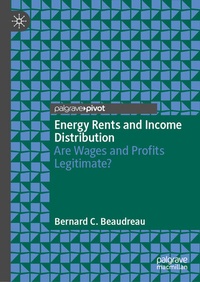
Energy Rents and Income Distribution
Description

This book explores into the dynamics of income distribution, challenging the established approaches of 19 th -century political economist Karl Marx and 21 st -century economist Thomas Piketty. Re-examinining the foundational principles of wealth creation through the lens of physical sciences, particularly mechanics, thermodynamics, and kinetics, Bernard C. Beaudreau argues that energy, rather than labor or capital, drives material processes and the accumulation of wealth.
In the book, Beaudreau critiques current distribution theories, highlighting their connections to the basic laws of physics. He introduces the energy-organization approach, positing that labor and capital are organizationally productive rather than physically productive. This perspective can be used to observe income distribution as they connect to energy rents, which are the returns to energy after accounting for its costs. The book touches on globalization, presenting this approach as a form of energy rent seeking rather than a result of comparative advantage. Beaudreau proposes alternative systems for distributing energy rents and examines their implications for the legitimacy of wages and profits.
Integrating scientific principles with economic theory, this book offers a unique approach to conversations surrounding income inequality.
More details
Other editions
Additional editions
Person
Bernard C. Beaudreau is a professor in the department of economics at Université Laval in Québec, Canada. He is the author of The Economics of Speed (2019).
Content
Chapter 1: Introduction.- Chapter 2: The Trouble with Distribution Theory.- Chapter 3: The Energy Organization Approach to Understanding Material Processes.- Chapter 4: Energy Rents and Distribution.- Chapter 5: Energy Rents in Historical Perspective.- Chapter 6: Automation and Globalization as Energy Rent Seeking.- Chapter 7: Alternative Energy Rent Distribution Mechanisms.- Chapter 8: Energy Rents and Development.- Chapter 9: Can Energy Rents Based Wages and Profits Increase in the Future.- Chapter 10: Looking Ahead.
