

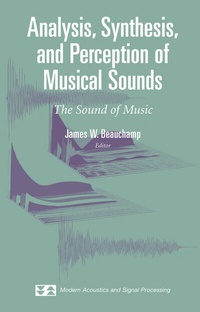
Analysis, Synthesis, and Perception of Musical Sounds
Description

The problems of analyzing and synthesizing musical timbres have been prevalent for over half a century, and a book length exploration of this large and complex subject has been long overdue. Analysis, Synthesis, and Perception of Musical Sounds: Sound of Music consists of eight chapters that span the range from tutorial introduction to advanced research and application to speculative assessment of its various techniques. All of the contributors use a generalized additive sine wave model for describing musical timbre which gives a conceptual unity but is of sufficient utility to be adapted to many different tasks. The authors represent an international community of researchers and teachers in the field of analysis/synthesis/perception, and this book reflects the important trends and interests current in the subject. Due to its breadth, students will find the book a thorough introduction to current thinking and implementation of additive sine wave timbral models. Researchers new to the field will find a canvas of applications with citations to the relevant literature, which will also benefit the teacher searching for an effective syllabus. Due to its scope, Analysis, Synthesis, and Perception of Musical Sounds will become the standard reference in the field and will be seen as the catalyst for exciting research in the years ahead.
More details
Other editions
Additional editions
Person
James W. Beauchamp has been working in the area of analysis, synthesis, and perception of musical sounds for over 40 years. He is editor and co-author of Music by Computers (Wiley, 1969), a fellow of the Audio Engineering Society and of the Acoustical Society of America, former president and board member of the International Computer Music Association, and has published numerous papers in the Journal of the Audio Engineering Society, the Journal of the Acoustical Society of America, the Computer Music Journal, Proceedings of the International Computer Music Conference, Proceedings of the International Conference on Music Perception and Cognition, Proceedings of the International Society of Musical Acoustics, and Proceedings of the IEEE Workshop on Applicatiions of Signal Processing to Audio and Acoustics. For over thirty years at the University of Illinois at Urbana-Champaign he taught courses on musical acoustics, electronic music, and computer music (in the School of Music) and audio engineering, electronic music synthesis, and acoustics (in the Department of Electrical and Computer Engineering). During spring, 1988 he was a visiting scholar at the Center for Research in Music and Acoustics at Stanford University, and during 1994-95 he was a visiting researcher at the Institute for Research and Coordination in Acoustics and Music in Paris. His research interests have been in electronic and computer music synthesis systems, analysis, synthesis, and perception of musical instrument sounds, automatic pitch detection, and instrument separation.
