Principles of Engineering Mechanics
Description

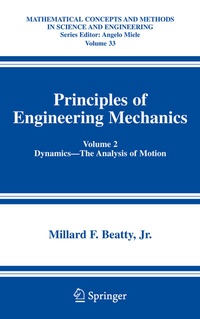
Separation of the elements of classical mechanics into kinematics and dynamics is an uncommon tutorial approach, but the author uses it to advantage in this two-volume set. Students gain a mastery of kinematics first - a solid foundation for the later study of the free-body formulation of the dynamics problem.
A key objective of these volumes, which present a vector treatment of the principles of mechanics, is to help the student gain confidence in transforming problems into appropriate mathematical language that may be manipulated to give useful physical conclusions or specific numerical results. In the first volume, the elements of vector calculus and the matrix algebra are reviewed in appendices. Unusual mathematical topics, such as singularity functions and some elements of tensor analysis, are introduced within the text. A logical and systematic building of well-known kinematic concepts, theorems, and formulas, illustrated by examples and problems, is presented offering insights into both fundamentals and applications. Problems amplify the material and pave the way for advanced study of topics in mechanical design analysis, advanced kinematics of mechanisms and analytical dynamics, mechanical vibrations and controls, and continuum mechanics of solids and fluids.
Volume I of Principles of Engineering Mechanics provides the basis for a stimulating and rewarding one-term course for advanced undergraduate and first-year graduate students specializing in mechanics, engineering science, engineering physics, applied mathematics, materials science, and mechanical, aerospace, and civil engineering. Professionals working in related fields of applied mathematics will find it a practical review and a quick reference for questions involving basic kinematics.
Reviews / Votes
From the reviews:
"The book is the second of two volumes on principles of engineering mechanics. . The book can serve as a basis for a course and a self-study for advanced undergraduate or first-year graduate students, specializing in mechanics, engineering science, engineering physics, applied mathematics, material science, mechanical, aerospace and civil engineering. . Interesting historical remarks are scattered throughout the text, and extensive lists of references with short annotations follow each chapter." (Boris Ivanovich Konosevich, Zentralblatt MATH, Vol. 1113 (15), 2007)
More details
Other editions
Additional editions