

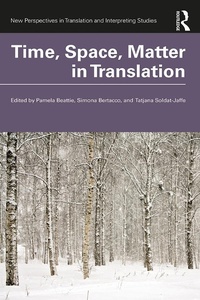
Time, Space, Matter in Translation
1st Edition
Published on 28. September 2022
200 pages
978-1-000-64162-2 (ISBN)
Description

Time, Space, Matter in Translation considers time, space, and materiality as legitimate habitats of translation. By offering a linked series of interdisciplinary case studies that show translation in action beyond languages and texts, this book provides a capacious and innovative understanding of what translation is, what it does, how, and where.
The volume uses translation as a means through which to interrogate processes of knowledge transfer and creation, interpretation and reading, communication and relationship building-but it does so in ways that refuse to privilege one discipline over another, denying any one of them an entitled perspective. The result is a book that is grounded in the disciplines of the authors and simultaneously groundbreaking in how its contributors incorporate translation studies into their work.
This is key reading for students in comparative literature-and in the humanities at large-and for scholars interested in seeing how expanding intellectual conversations can develop beyond traditional questions and methods.
The volume uses translation as a means through which to interrogate processes of knowledge transfer and creation, interpretation and reading, communication and relationship building-but it does so in ways that refuse to privilege one discipline over another, denying any one of them an entitled perspective. The result is a book that is grounded in the disciplines of the authors and simultaneously groundbreaking in how its contributors incorporate translation studies into their work.
This is key reading for students in comparative literature-and in the humanities at large-and for scholars interested in seeing how expanding intellectual conversations can develop beyond traditional questions and methods.
Reviews / Votes
"Entschuldigung"-"Apologies"-is the last word spoken by a WELT TV live show simultaneous interpreter after bursting into tears while lending her voice and German words to Ukrainian President Volodymyr Zelenskyj. Translation moves, emotionally as much as etymologically. Jorge Luis Borges maintained that translation is "a more advanced stage of civilization". Time, Space and Matter in Translation powerfully proves it. "The continuation of our civilizations, and the continuation of the natural world," David Attenborough insists, "is in your hands" but time and time again humans have demonstrated to lose sight of their responsibilities. Not only will this book remind us that translation continues and will continue to make the difference in and for our world, it will also hold us accountable for our thoughts and actions if we really care to have a world and a civilised future in it. Kudos to the editors and contributors for their vision, expertise and intellectual honesty-we are in their debt, and much more than many of us are ready to admit.Marco Sonzogni, Victoria University of Wellington, New Zealand
A dozen scintillating, ambitious essays that bring translation studies to bear on ecology, migration, indigeneity, visual culture and more, with case studies from the Middle Ages to the present. Theoretically driven, this book aims to make the case for translation studies as an "ideal transdisciplinary field".
Mary Louise Pratt, New York University, USA
Translation involves much more than just language. As the authors of this volume demonstrate in different ways, translation opens up new horizons and invites us to think again about how we communicate and how we create in a world that is increasingly complex and unpredictable.
Susan Bassnett, University of Warwick and University of Glasgow, UK
More details
Series
Edition
1. Auflage
Language
English
Place of publication
London
United Kingdom
Publishing group
Taylor & Francis Ltd
Target group
College/higher education
Product notice
Reflowable
Illustrations
1 Line drawings, black and white; 18 Halftones, black and white; 19 Illustrations, black and white
ISBN-13
978-1-000-64162-2 (9781000641622)
Copyright in bibliographic data and cover images is held by Nielsen Book Services Limited or by the publishers or by their respective licensors: all rights reserved.
Schweitzer Classification
Other editions
Additional editions
Pamela Beattie | Simona Bertacco | Tatjana Soldat-Jaffe
Time, Space, Matter in Translation
Book
09/2022
1st Edition
Routledge
€205.30
Shipment within 10-20 days
Pamela Beattie | Simona Bertacco | Tatjana Soldat-Jaffe
Time, Space, Matter in Translation
Book
09/2022
1st Edition
Routledge
€61.00
Shipment within 10-20 days
Persons
Pamela Beattie is Associate Professor of Medieval Studies in the Department of Comparative Humanities at the University of Louisville, USA. She is the author of the critical edition and study of Ramon Llull's Liber contra Antichristum in the Corpus Christianorum Continuatio Mediaevalis (2015) and co-editor of Translation and the Global Humanities, a special issue of The New Centennial Review (2016).
Simona Bertacco is Professor of Post Colonial Studies in the Department of Comparative Humanities at the University of Louisville, USA. She is the author of The Relocation of Culture: Translations, Migrations, Borders (2021) with N. Vallorani and the co-editor of the special issue of The New Centennial Review: Translation and the Global Humanities (2016).
Tatjana Soldat-Jaffe is Associate Professor in the Modern Languages and Linguistics Department at Florida State University, USA. She is the author of Twenty-First Century Yiddishism: Language, Identity, and the New Jewish Studies (2012) and the co-editor of the special issue of The New Centennial Review: Translation and the Global Humanities (2016). Her research focuses on language and religion, identity, and minority literature in translation studies.
Simona Bertacco is Professor of Post Colonial Studies in the Department of Comparative Humanities at the University of Louisville, USA. She is the author of The Relocation of Culture: Translations, Migrations, Borders (2021) with N. Vallorani and the co-editor of the special issue of The New Centennial Review: Translation and the Global Humanities (2016).
Tatjana Soldat-Jaffe is Associate Professor in the Modern Languages and Linguistics Department at Florida State University, USA. She is the author of Twenty-First Century Yiddishism: Language, Identity, and the New Jewish Studies (2012) and the co-editor of the special issue of The New Centennial Review: Translation and the Global Humanities (2016). Her research focuses on language and religion, identity, and minority literature in translation studies.
Content
List of Figures
Foreword - Thinking Translationally by Sherry Simon
List of Contributors
Acknowledgements
Introduction
1. Michael Cronin, Translation, Ecology and Deep Time
2. Vicente Rafael, The Experience of Translation
3. Rita Raley, Translation Degree Zero
4. Hedwig Fraunhofer, Translating Plants: A Starting Point
5. Tatjana Soldat-Jaffe, Translation, Language Meaning, and Intentionality
6. Lisa Wakamiya, Somatic Metaphors and Retranslation
7. Reid Gomez, The Story Process: Writing in Translation
8. Garry Sparks, Shifts in Semantic Souls, Transmigration of Meanings: From a Mendicant toward a Maya Theory of Translation
9. Zainab Cheema, Foreignizing the Nation: Fletcher and Massinger's Translation of Cervantes' Immigrants in The Custom of the Country
10. Simona Bertacco, Translatio and Migration
11. Evelyn Nien-Ming Ch'ien, An Alphabet Inventor
12. Pamela Beattie, Thomas Le Myesier's Breviculum as a 'Translation Site'
13. A Collaborative Model of Research
Index
Foreword - Thinking Translationally by Sherry Simon
List of Contributors
Acknowledgements
Introduction
1. Michael Cronin, Translation, Ecology and Deep Time
2. Vicente Rafael, The Experience of Translation
3. Rita Raley, Translation Degree Zero
4. Hedwig Fraunhofer, Translating Plants: A Starting Point
5. Tatjana Soldat-Jaffe, Translation, Language Meaning, and Intentionality
6. Lisa Wakamiya, Somatic Metaphors and Retranslation
7. Reid Gomez, The Story Process: Writing in Translation
8. Garry Sparks, Shifts in Semantic Souls, Transmigration of Meanings: From a Mendicant toward a Maya Theory of Translation
9. Zainab Cheema, Foreignizing the Nation: Fletcher and Massinger's Translation of Cervantes' Immigrants in The Custom of the Country
10. Simona Bertacco, Translatio and Migration
11. Evelyn Nien-Ming Ch'ien, An Alphabet Inventor
12. Pamela Beattie, Thomas Le Myesier's Breviculum as a 'Translation Site'
13. A Collaborative Model of Research
Index
