

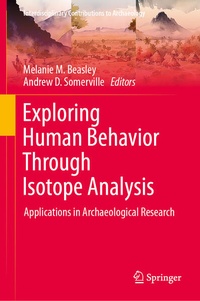
Exploring Human Behavior Through Isotope Analysis
Description

This edited volume compiles a series of chapters written by experts of isotopic analysis in order to highlight the utility of various isotope systems in the reconstruction of past human behaviors. Rather than grouping contributions by specific isotopes or analytical techniques, as many isotope review articles are arranged, the volume organizes chapters by broadly defined themes of archaeological research. These include: paleodiet and life histories, human-animal interactions, and migration and mobility. In this sense, the book is arranged with the intent of being as much question based as method based.
Chapters under these themes provide background information on the principles of the techniques and on the theoretical underpinnings of the research; yet they are written with the non-specialist in mind and attempt to convey these ideas clearly and succinctly. In addition to the case studies and reviews, three chapters provide greater context to the field of isotopicarchaeology, discussing its history, basic principles, and future potential. The volume aims to serve as a reference source for students and practicing archaeologists seeking to apply isotopic studies to their own research projects or to act as a reader for courses in archaeological science.
Chapter 6 is available open access under a Creative Commons Attribution 4.0 International License via link.springer.com.
More details
Other editions
Additional editions
Persons
Andrew D. Somerville received his MAand PhD in Anthropology at the University of California-San Diego. He spent a year in Mexico City as a UC MEXUS Postdoctoral Research Fellow at the Universidad Nacional Autónoma de México. His research focuses on the archaeology and ecology of the ancient Americas. He is the co-director of excavations for the Proyecto Hacienda Metepec at the ancient Mexican metropolis of Teotihuacan and is leading new research on the origins of agriculture in the Tehuacan Valley of Puebla, Mexico. Currently, he is an Assistant Professor of Anthropology in the Department of World Languages and Cultures at Iowa State University where he directs the Paleoecology Laboratory and is a faculty member of the Ecology and Evolutionary Biology interdisciplinary PhD program.
Content
Preface.- Part I: History and Introduction.- Chapter 1. Stable Isotope Analyses and Human Behavior: A Science Driven by Ideas and Tools (Margaret J. Schoeninger).- Chapter 2. Exploring Human Behavior through Isotopic Analyses: Tools, Scales, and Questions (Andrew D. Somerville and Melanie M. Beasley).- Part II: Paleodiet and Life History.- Chapter 3. Stable Isotope Evidence for Breastfeeding and Weaning Variables in Past Populations: Infant and Child Feeding in Ancient Siberian Foragers (Andrea L. Waters-Rist).- Chapter 4. Human Paleodiet on Tutuila Island, American Samoa: Isotopic Evidence of Dietary Continuity through the Medieval Warm Period-Little Ice Age Transition (Eric J. Bartelink, Phillip R. Johnson, Olaf Nehlich, Benjamin T. Fuller, and Michael P. Richards).- Chapter 5. Multi-Isotopic Evidence for Prehispanic Maya use of Multiple Subsistence Catchments at Caledonia, Cayo District, Belize (Asta J. Rand).- Chapter 6. The Potential of Dental Calculus as a Novel Source of Biological Isotopic Data (Domingo C. Salazar-García, Christina Warinner, Jelmer W. Eerkens, Amanda G. Henry).- Part III: Human-Animal Interactions.- Chapter 7. Isotopes, Domestication, and Past Animal Husbandry Practices: A Review of the Formative Studies (Rebecca L. Kinaston).- Chapter 8. Human-Animal Interactions in the Pre-Colonial Americas: Insights from Stable Carbon Isotope Analysis (Andrew D. Somerville).- Chapter 9. Reassessing the Abandonment of Pig Husbandry in Post-Viking Iceland: an Isotopic Approach (Eric Guiry, Céline Dupont-Hébert and Vaughan Grimes).- Chapter 10. Ratting out the Past: Investigating Anthropogenic Landscapes in Polynesia through Stable Isotope Analysis of the Pacific Rat (Rattus exulans) (Jillian A. Swift).- Part IV: Mobility of Humans.- Chapter 11. Migration and Paleomobility in the Face of Environmental Change and Political Collapse: Case Studies from San Pedro de Atacama, Northern Chile (Kelly J. Knudson and Christina M. Torres).- Chapter 12: Isotopic Investigation of Tiwanaku Mobility During the Middle Horizon: Preliminary Data from the Site of Piñami in the Cochabamba Valley of Bolivia (Cristin A. Lucas, Corina M. Kellner, Frank C. Ramos, Karen Anderson, and Zulema Terceros).- Part V: Future Directions.- Chapter 13: Epilogue: Stable Isotope Analysis in Archaeology: Current Perspectives and Future Directions (Paul Szpak).
