

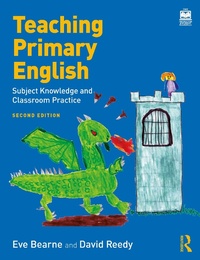
Teaching Primary English
Subject Knowledge and Classroom Practice
2nd Edition
Published on 31. July 2023
544 pages
978-1-000-88742-6 (ISBN)
Description

Now in its second edition, Teaching Primary English is a bestselling, comprehensive, evidence-informed guide designed to support and inspire teaching and learning in the primary school. Written in a clear and accessible way, it draws on the very latest research and theory to describe and exemplify a full and rich English curriculum. It offers those on teacher training courses, as well as qualified teachers who are looking to develop their practice, invaluable subject knowledge and guidance for effective, enjoyable classroom practice.
Throughout there is an emphasis on equity and inclusion. Advice and ideas are supported by explicit examples of good teaching linked to video clips filmed in real schools, reflective activities, observational tasks and online resources. Each chapter includes suggestions for great children's literature, considers assessment throughout and offers support in planning for inclusion and special educational needs. New and expanded areas for this edition include:
Multimodal texts
Increased coverage of Early Years
Dialogic learning and oracy
Comprehensive companion website with revised and additional resources
A new section on digital literacies
Reading for pleasure
Teaching grammar in context
Critical literacy
With a focus on connecting all modes of English, the global and the local, and home and school experience, this detailed, uplifting book, includes inspiring case studies throughout and will support you in developing a curious, critical approach to teaching and learning English.
Additional content can be found on the fantastic supporting website. Features include:
Video clips from within the classroom to demonstrate English teaching techniques
Audio resources, including an interactive quiz, to check understanding and provide real-life examples and case studies
Downloadable resources to support teaching and incorporate into lesson plans.
Throughout there is an emphasis on equity and inclusion. Advice and ideas are supported by explicit examples of good teaching linked to video clips filmed in real schools, reflective activities, observational tasks and online resources. Each chapter includes suggestions for great children's literature, considers assessment throughout and offers support in planning for inclusion and special educational needs. New and expanded areas for this edition include:
Multimodal texts
Increased coverage of Early Years
Dialogic learning and oracy
Comprehensive companion website with revised and additional resources
A new section on digital literacies
Reading for pleasure
Teaching grammar in context
Critical literacy
With a focus on connecting all modes of English, the global and the local, and home and school experience, this detailed, uplifting book, includes inspiring case studies throughout and will support you in developing a curious, critical approach to teaching and learning English.
Additional content can be found on the fantastic supporting website. Features include:
Video clips from within the classroom to demonstrate English teaching techniques
Audio resources, including an interactive quiz, to check understanding and provide real-life examples and case studies
Downloadable resources to support teaching and incorporate into lesson plans.
More details
Edition
2nd edition
Language
English
Place of publication
London
United Kingdom
Publishing group
Taylor & Francis Ltd
Target group
College/higher education
Professional and scholarly
Product notice
Reflowable
Illustrations
29 Line drawings, color; 83 Halftones, color; 112 Illustrations, color
ISBN-13
978-1-000-88742-6 (9781000887426)
Copyright in bibliographic data and cover images is held by Nielsen Book Services Limited or by the publishers or by their respective licensors: all rights reserved.
Schweitzer Classification
Other editions
Additional editions
Book
07/2023
2nd Edition
Routledge
€215.77
Shipment within 10-20 days
Book
07/2023
2nd Edition
Routledge
€54.50
Shipment within 10-20 days
Persons
Eve Bearne was Project Officer for the National Writing Project after working for 20 years in schools and colleges. She then worked at Homerton College, University of Cambridge as a senior lecturer in language and Assistant Director in Research before moving to the University Faculty of Education as a researcher and lecturer. Eve was President of the United Kingdom Literacy Association from 2003 to 2005 and is a Fellow of the English Association. She has written and edited many books on English, literacy and children's literature, the most recent of which include Teaching Grammar Effectively in the Primary Classroom (2nd Edition, 2020 UKLA) and Talk for Teaching and Learning: The Dialogic Classroom (UKLA 2021) both with David Reedy.
David Reedy is Past President of the UK Literacy Association (UKLA). Until 2014 he was Principal Adviser for primary schools in the London Borough of Barking and Dagenham. Publications include Talk for Teaching and Learning: The Dialogic Classroom (UKLA 2021) and Teaching Grammar Effectively in the Primary Classroom (2nd Edition, 2020 UKLA) with Eve Bearne, and Guiding Readers: A handbook for teaching reading comprehension to 7-11 year olds (2016 UCL IoE Press) with Wayne Tennant, Nikki Gamble and Angela Hobsbaum. David is a Fellow of the Chartered College of Teaching.
David Reedy is Past President of the UK Literacy Association (UKLA). Until 2014 he was Principal Adviser for primary schools in the London Borough of Barking and Dagenham. Publications include Talk for Teaching and Learning: The Dialogic Classroom (UKLA 2021) and Teaching Grammar Effectively in the Primary Classroom (2nd Edition, 2020 UKLA) with Eve Bearne, and Guiding Readers: A handbook for teaching reading comprehension to 7-11 year olds (2016 UCL IoE Press) with Wayne Tennant, Nikki Gamble and Angela Hobsbaum. David is a Fellow of the Chartered College of Teaching.
Content
Introduction
Part One Spoken language
Introduction to Part One
1 Developing talk
2 Spoken language for teaching and learning
3 Storytelling, drama and role play
4 Planning for, developing and assessing spoken language
Part Two Reading
Introduction to Part Two
5 Perspectives on reading
6 Reading for pleasure
7 Early reading including phonics
8 Comprehension
9 Describing and assessing progress in reading
10 Poetry
Part Three Writing
Introduction to Part Three
11 What writing involves
12 Writing composition
13 Spelling and handwriting
14 Grammar and punctuation
15 Responding to and assessing writing
Part Four 21st century literacies
Introduction to Part Four
16 Digital literacies
17 Multimodality
18 Critical literacy
Part One Spoken language
Introduction to Part One
1 Developing talk
2 Spoken language for teaching and learning
3 Storytelling, drama and role play
4 Planning for, developing and assessing spoken language
Part Two Reading
Introduction to Part Two
5 Perspectives on reading
6 Reading for pleasure
7 Early reading including phonics
8 Comprehension
9 Describing and assessing progress in reading
10 Poetry
Part Three Writing
Introduction to Part Three
11 What writing involves
12 Writing composition
13 Spelling and handwriting
14 Grammar and punctuation
15 Responding to and assessing writing
Part Four 21st century literacies
Introduction to Part Four
16 Digital literacies
17 Multimodality
18 Critical literacy
