

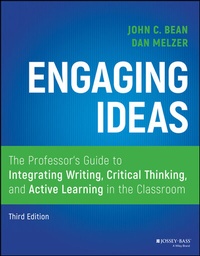
Engaging Ideas
The Professor's Guide to Integrating Writing, Critical Thinking, and Active Learning in the Classroom
3rd Edition
Published on 26. May 2021
400 pages
978-1-119-70541-3 (ISBN)
Description

Use your course's big ideas to accelerate students' growth as writers and critical thinkers
The newly revised third edition of Engaging Ideas delivers a step-by-step guide for designing writing assignments and critical thinking activities that engage students with important subject-matter questions. This new edition of the celebrated book (now written by the co-author team of Bean and Melzer) uses leading and current research and theory to help you link active learning pedagogy to your courses' subject matter. You'll learn how to:
* Design formal and informal writing assignments that guide students toward thinking like experts in your discipline
* Use time-saving strategies for coaching the writing process and handling the paper load including alternatives to traditional grading such as portfolio assessment and contract grading
* Help students use self-assessment and peer response to improve their work
* Develop better ways than the traditional research paper to teach undergraduate reading and research
* Integrate social media, multimodal genres, and digital technology into the classroom to promote active learning
This book demonstrates how writing can easily be integrated with other critical thinking activities such as inquiry discussions, simulation games, classroom debates, and interactive lectures. The reward of this book is watching students come to class better prepared, more vested in the questions your course investigates, more apt to study purposefully, and more likely to submit high-quality work. Perfect for higher education faculty and curriculum designers across all disciplines, Engaging Ideas will also earn a place in the libraries of graduate students in higher education.
The newly revised third edition of Engaging Ideas delivers a step-by-step guide for designing writing assignments and critical thinking activities that engage students with important subject-matter questions. This new edition of the celebrated book (now written by the co-author team of Bean and Melzer) uses leading and current research and theory to help you link active learning pedagogy to your courses' subject matter. You'll learn how to:
* Design formal and informal writing assignments that guide students toward thinking like experts in your discipline
* Use time-saving strategies for coaching the writing process and handling the paper load including alternatives to traditional grading such as portfolio assessment and contract grading
* Help students use self-assessment and peer response to improve their work
* Develop better ways than the traditional research paper to teach undergraduate reading and research
* Integrate social media, multimodal genres, and digital technology into the classroom to promote active learning
This book demonstrates how writing can easily be integrated with other critical thinking activities such as inquiry discussions, simulation games, classroom debates, and interactive lectures. The reward of this book is watching students come to class better prepared, more vested in the questions your course investigates, more apt to study purposefully, and more likely to submit high-quality work. Perfect for higher education faculty and curriculum designers across all disciplines, Engaging Ideas will also earn a place in the libraries of graduate students in higher education.
More details
Other editions
Additional editions
John C. Bean | Daniel Melzer
Engaging Ideas
The Professor's Guide to Integrating Writing, Critical Thinking, and Active Learning in the Classroom
Book
08/2021
Jossey-Bass
€44.00
Shipment within 15-20 days
Persons
JOHN C. BEAN, PhD, is Emeritus Professor of English at Seattle University. He received his doctorate in Renaissance Literature from the University of Washington. He is
Co-author of three composition textbooks -- Writing Arguments, The Allyn and Bacon Guide to Writing, and Reading Rhetorically.
DAN MELZER, PhD, is Professor in the University Writing Program and Director of
First-Year Composition at the University of California. He received his doctorate in Rhetoric and Composition from Florida State University. He is a frequent speaker and lecturer at universities across the United States.
Co-author of three composition textbooks -- Writing Arguments, The Allyn and Bacon Guide to Writing, and Reading Rhetorically.
DAN MELZER, PhD, is Professor in the University Writing Program and Director of
First-Year Composition at the University of California. He received his doctorate in Rhetoric and Composition from Florida State University. He is a frequent speaker and lecturer at universities across the United States.
Content
Preface
About the Authors
1 Using Writing to Promote Thinking: A Busy Professor's Guide to the Whole Book
PART 1 UNDERSTANDING CONNECTIONS BETWEEN THINKING AND WRITING
2 How Writing Is Related to Critical Thinking
3 Helping Students Think Rhetorically
PART 2 DESIGNING PROBLEM-BASED WRITING ASSIGNMENTS
4 Formal Writing Assignments Situated in Rhetorical Contexts
5 Informal, Exploratory Writing Activities
PART 3 COACHING STUDENTS AS LEARNERS, THINKERS, AND WRITERS
6 Designing Tasks to Promote Active Thinking and Learning
7 Helping Students Read Mindfully across the Disciplines
8 Using Small Groups to Coach Thinking and Teach Disciplinary Argument
9 Bringing More Critical Thinking into Lectures and Discussions
10 Designing and Sequencing Assignments to Teach Undergraduate Research
PART 4 RESPONDING TO AND GRADING STUDENT WRITING
11 Helping Students Use Self-Assessment and Peer Review to Promote Revision and Reflection
12 Using Rubrics to Develop and Apply Assessment Criteria
13 Coaching the Writing Process and Handling the Paper Load
14 Providing Effective and Efficient Feedback
15 Responding to Grammar and Other Sentence-Level Concerns
16 Alternatives to Traditional Grading: Portfolio Assessment and Contract Grading
References
Index
About the Authors
1 Using Writing to Promote Thinking: A Busy Professor's Guide to the Whole Book
PART 1 UNDERSTANDING CONNECTIONS BETWEEN THINKING AND WRITING
2 How Writing Is Related to Critical Thinking
3 Helping Students Think Rhetorically
PART 2 DESIGNING PROBLEM-BASED WRITING ASSIGNMENTS
4 Formal Writing Assignments Situated in Rhetorical Contexts
5 Informal, Exploratory Writing Activities
PART 3 COACHING STUDENTS AS LEARNERS, THINKERS, AND WRITERS
6 Designing Tasks to Promote Active Thinking and Learning
7 Helping Students Read Mindfully across the Disciplines
8 Using Small Groups to Coach Thinking and Teach Disciplinary Argument
9 Bringing More Critical Thinking into Lectures and Discussions
10 Designing and Sequencing Assignments to Teach Undergraduate Research
PART 4 RESPONDING TO AND GRADING STUDENT WRITING
11 Helping Students Use Self-Assessment and Peer Review to Promote Revision and Reflection
12 Using Rubrics to Develop and Apply Assessment Criteria
13 Coaching the Writing Process and Handling the Paper Load
14 Providing Effective and Efficient Feedback
15 Responding to Grammar and Other Sentence-Level Concerns
16 Alternatives to Traditional Grading: Portfolio Assessment and Contract Grading
References
Index
