

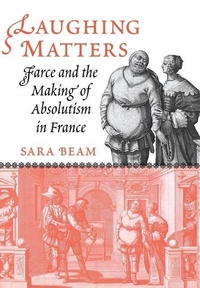
Laughing Matters
Farce and the Making of Absolutism in France
1st Edition
Published on 5. July 2018
280 pages
978-1-5017-3237-9 (ISBN)
Description

Bawdy satirical plays-many starring law clerks and seminarians-savaged corrupt officials and royal policies in fifteenth- and sixteenth-century France. The Church and the royal court tolerated-and even commissioned-such performances, the audiences for which included men and women from every social class. From the mid-sixteenth century, however, local authorities began to temper and in some cases ban such performances.Sara Beam, in revealing how theater and politics were intimately intertwined, shows how the topics we joke about in public reflect and shape larger religious and political developments. For Beam, the eclipse of the vital tradition of satirical farce in late medieval and early modern France is a key aspect of the complex political and cultural factors that prepared the way for the emergence of the absolutist state. In her view, the Wars of Religion were the major reason attitudes toward the farceurs changed; local officials feared that satirical theater would stir up violence, and Counter-Reformation Catholicism proved hostile to the bawdiness that the clergy had earlier tolerated.In demonstrating that the efforts of provincial urban officials prepared the way for the taming of popular culture throughout France, Laughing Matters provides a compelling alternative to Norbert Elias's influential notion of the "civilizing process," which assigns to the royal court at Versailles the decisive role in the shift toward absolutism.
More details
Language
English
Place of publication
NY
United States
Target group
College/higher education
Professional and scholarly
Edition type
Digital original
Illustrations
8 halftones
8 halftones
ISBN-13
978-1-5017-3237-9 (9781501732379)
Copyright in bibliographic data and cover images is held by Nielsen Book Services Limited or by the publishers or by their respective licensors: all rights reserved.
Schweitzer Classification
Other editions
Additional editions
Book
04/2007
Cornell University Press
€90.52
Shipment within 10-20 days
Person
BeamSara:
Sara Beam is Assistant Professor of History at the University of Victoria.
Sara Beam is Assistant Professor of History at the University of Victoria.
Content
- Cover
- Laughing Matters
- Title
- Copyright
- Contents
- List of Illustrations
- Acknowledgments
- List of Abbreviations
- Introduction
- 1 Farce, Honor, and the Bounds of Satire
- 2 The Politics of Farcical Performance in Renaissance France
- 3 The Growing Cost of Laughter: Basoche and Student Performance
- 4 Farce during the Wars of Religion
- 5 Professional Farceurs in Paris, 1600-1630
- 6 Absolutism and the Marginalization of Festive Societies
- 7 Jesuit Theater: Christian Civility and Absolutism on the Civic Stage
- Conclusion
- Bibliography
- Index
