

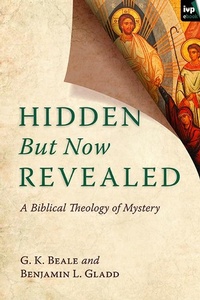
Hidden But Now Revealed
A Biblical Theology of Mystery
Published on 21. November 2014
392 pages
978-1-78359-274-6 (ISBN)
Description

This book explores the biblical conception of mystery as an initial, partially hidden revelation that is subsequently more fully revealed, shedding light not only on the richness of the concept itself, but also on the broader relationship between the Old and New Testaments. As such, it is a model for attentive and faithful biblical theology.
More details
Language
English
Place of publication
Nottingham
United Kingdom
Product notice
Reflowable
ISBN-13
978-1-78359-274-6 (9781783592746)
Copyright in bibliographic data and cover images is held by Nielsen Book Services Limited or by the publishers or by their respective licensors: all rights reserved.
Schweitzer Classification
Other editions
Additional editions
Book
11/2014
Apollos
€43.55
Article not available at the moment
Persons
G K Beale and Benjamin L Gladd
Content
- Intro
- Title Page
- Copyright
- Contents
- Preface
- Abbreviations
- Introduction
- 1 The Use of Mystery in Daniel
- Mystery in Daniel
- The Hymn of Daniel 2:20-23
- Form of the Mystery
- The End-Time Component of the Mystery
- Conclusion
- Excursus 1.1: The Greek Old Testament's Interpretation of Daniel 4
- 2 The Use of Mystery in Early Judaism
- Mystery in the Dead Sea Scrolls
- Mystery in the Targums
- Conclusion
- Excursus 2.1: Mystery in First Enoch and Other Jewish Texts
- 3 The Use of Mystery in Matthew
- Immediate Context
- Hiddenness in Daniel and Matthew
- Psalm 78:2 in Matthew 13:35
- Mysteries of the Kingdom
- The Presence of Mystery in the Synoptics
- Conclusion
- Excursus 3.1: Expectation of the Latter-Day Kingdom in the Old Testament and Early Judaism
- 4 The Use of Mystery in Romans
- Mystery in Romans 11
- Mystery in Romans 16
- Conclusion
- Excursus 4.1: The Old Testament Context of Deuteronomy 32:21
- Excursus 4.2: The Possible Old Testament Context of Deuteronomy 29:22-30:10
- 5 The Use of Mystery in 1 Corinthians
- The Mystery of the Cross in 1 Corinthians 2:1, 7
- Paul as a "Steward of Mysteries" in 1 Corinthians 4:1
- Mysteries of Prophecy and Tongues in 1 Corinthians 13:2
- 14:2
- The Mystery of the Resurrection in 1 Corinthians 15:51
- Conclusion
- Excursus 5.1: Messianic Expectations and the Idea of the Messiah in 1 Corinthians 2:1-8
- Excursus 5.2: Eschatological Transformation in Early Judaism
- 6 The Use of Mystery in Ephesians
- Cosmic Mystery in Ephesians 1
- The Ethnic Mystery in Ephesians 3
- Marital Mystery in Ephesians 5
- The Mystery of the Gospel in Ephesians 6
- Conclusion
- Excursus 6.1: End-Time Conversion of the Gentiles in the Old Testament and Judaism
- 7 The Use of Mystery in Colossians
- Kingdom, Gentiles and the Unveiled Mystery of Christ in Colossians 1:26-27
- Daniel 2 and the Mystery of God in Colossians 2:1-4
- Imprisoned for the Mystery of Christ in Colossians 4:3
- Conclusion
- 8 The Use of Mystery in 2 Thessalonians
- Immediate Context
- Daniel 11-12 and the "Man of Lawlessness"
- Content of the Mystery
- Permanent Hiddenness
- Conclusion
- Excursus 8.1: The Book of Daniel and Israel's Latter-Day Antagonist
- Excursus 8.2: Other New Testament References to the Antichrist
- Excursus 8.3: The End-Time Opponent in Early Judaism
- 9 The Use of Mystery in 1 Timothy
- Immediate Context
- Mysteries of Faith and Godliness
- The Hymn
- Content of the Mystery
- Christ's Resurrection as the Beginning of the New Creation
- Conclusion
- Excursus 9.1: The Origins of Christ's Divinity and the Mystery in 1 Timothy 3:16
- 10 The Use of Mystery in Revelation
- The Mystery of the Seven Stars in Revelation 1:20
- The Mystery of God in Revelation 10:7
- Mystery and Babylon the Great in Revelation 17:5, 7
- Conclusion
- 11 Mystery Without Mystery in the New Testament
- Resurrection
- The Christological Understanding of the Old Testament
- Jesus, the Temple and the New Creation
- Inaugurated Eschatology
- The Gospel
- Conclusion
- Excursus 11.1: Possible Old Testament Anticipations of a Two-Stage Resurrection
- 12 The Christian Mystery and the Pagan Mystery Religions
- Brief Introduction to the Mystery Religions
- Examples of Mystery Religions
- The Biblical Mystery and the Mystery Religions
- A Polemic Against the Pagan Mysteries?
- Conclusion
- 13 Conclusion
- The Revealed Mystery of the Old Testament and the Person of Christ
- Mystery of the Cross and Cruciform Lifestyle
- Hermeneutical Implications of the New Testament Use of the Old Testament
- Practical Implications
- Appendix: The Cognitive Peripheral Vision of Biblical Authors
- Modern-Day Examples of Explicit and Implicit Meaning
- The Concept of Cognitive Peripheral Vision
- E. D. Hirsch's Concept of a "Willed Type"
- Michael Polanyi's Notion of Tacit or Subsidiary Knowledge
- Some Old-Testament-in-the-New Examples of Tacit Knowledge, Willed Type or Cognitive Peripheral Vision
- The Subsidiary Presuppositional Perspectives of the New Testament Writers in Their Use of the Old Testament
- Conclusion
- Bibliography
- Modern Authors Index
- Scripture Index
- Ancient Texts Index
- Notes
- Introduction
- Chapter 1
- Chapter 2
- Chapter 3
- Chapter 4
- Chapter 5
- Chapter 6
- Chapter 7
- Chapter 8
- Chapter 9
- Chapter 10
- Chapter 11
- Chapter 12
- Chapter 13
- Appendix
- Praise for Hidden But Now Revealed
- About the Authors
