

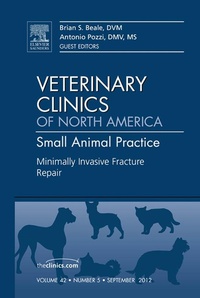
Minimally Invasive Fracture Repair, An Issue of Veterinary Clinics: Small Animal Practice
Published on 28. September 2012
240 pages
978-1-4557-4799-3 (ISBN)
Description

A complete primer on minimally invasive plate osteosynthesis (MIPO) for the small animal practitioner! Topics will include concepts of the biomechanics in fracture repair, MIPO techniques for articular fractures, bone plate and plate-rod for MIPO, MIPO techniques of the tibia, MIPO techniques of the femur, percutaneous pinning, MIPO techniques of the radius and ulna, percutaneous arthrodesis, MIPO techniques of the metacarpus and metatarsus, fracture reduction techniques, minimally invasive repair of sacroiliac luxation, external fixators and MIPO, intraoperative imaging and interlocking nail and MIPO and much more!
More details
Other editions
Additional editions
Brian S. Beale | Antonio Pozzi
Minimally Invasive Fracture Repair, An Issue of Veterinary Clinics: Small Animal Practice: Volume 42-5
Volume 42-5
Book
10/2012
Saunders
€100.50
Shipment within 10-15 days
Content
- Front Cover
- Veterinary Clinics of North America: Small Animal Practice: Minimally Invasive Fracture Repair
- Copyright Page
- Table of Contents
- Contributors
- Preface: Minimally Invasive Fracture Repair
- Chapter 1. Biomechanical Concepts Applicable to Minimally Invasive Fracture Repair in Small Animals
- INTRODUCTION
- BASIC MECHANICS OF MATERIALS
- APPLIED BIOMECHANICS
- SUMMARY
- REFERENCES
- Chapter 2. Minimally Invasive Plate Osteosynthesis Fracture Reduction Techniques in Small Animals
- INTRODUCTION
- SKELETAL TRACTION TABLE
- LIMB HANGING
- IM PINNING
- LINEAR EXTERNAL FIXATION
- CIRCULAR EXTERNAL FIXATION
- BONE-HOLDING FORCEPS
- FRACTURE DISTRACTOR
- REDUCTION THROUGH PLATE APPLICATION
- ASSESSMENT OF ALIGNMENT
- SUMMARY
- REFERENCES
- Chapter 3. Perioperative Imaging in Minimally Invasive Osteosynthesis in Small Animals
- PREOPERATIVE IMAGING
- INTRAOPERATIVE IMAGING
- POSTOPERATIVE IMAGING
- SUMMARY
- REFERENCES
- Chapter 4. External Fixators and Minimally Invasive Osteosynthesis in Small Animal Veterinary Medicine
- INDICATIONS
- TYPES OF ESFs
- EXTERNAL FIXATOR CONFIGURATIONS
- EXTERNAL FIXATOR PRINCIPLES
- BIOLOGIC CONSIDERATIONS
- MECHANICAL CONSIDERATIONS
- CLINICAL APPLICATION
- ASSESSMENT OF BONE HEALING AND OUTCOME
- POSTOPERATIVE PATIENT MANAGEMENT
- SUMMARY
- ACKNOWLEDGMENTS
- REFERENCES
- Chapter 5. Interlocking Nails and Minimally Invasive Osteosynthesis
- INTRODUCTION
- HISTORY OF ILN USE
- ILN DESIGNS
- BIOMECHANICAL PROPERTIES OF ILNS
- INDICATIONS FOR INTERLOCKING NAILING
- CLINICAL USE OF ILNS
- SUMMARY
- REFERENCES
- Chapter 6. Percutaneous Pinning for Fracture Repair in Dogs and Cats
- INTRODUCTION
- SURGICAL TECHNIQUE
- CLINICAL RESULTS IN THE LITERATURE
- SUMMARY
- REFERENCES
- Chapter 7. MIPO Techniques for the Humerus in Small Animals
- REGIONAL ANATOMY
- INDICATIONS AND CASE SELECTION
- PREOPERATIVE PLANNING
- CLINICAL CASES
- COMMON ERRORS WITH MIPO
- REFERENCES
- Chapter 8. Minimally Invasive Plate Osteosynthesis in Small Animals: Radius and Ulna Fractures
- INTRODUCTION
- ANATOMY OF THE RADIUS AND ULNA
- INDICATIONS AND DECISION-MAKING
- PREOPERATIVE PLANNING
- PREPARATION AND POSITIONING
- INDIRECT REDUCTION TECHNIQUES
- SURGICAL APPROACH
- APPLICATION OF IMPLANTS
- IMMEDIATE POSTOPERATIVE CARE
- MANAGEMENT DURING THE POSTOPERATIVE CONVALESCENT PERIOD
- ASSESSMENT OF REPAIR AND OUTCOME
- SUMMARY
- REFERENCES
- Chapter 9. Minimally Invasive Osteosynthesis Techniques of the Femur
- CLINICAL ANATOMY OF THE FEMUR
- FEMORAL CAPITAL PHYSEAL AND FEMORAL NECK FRACTURE
- FEMORAL DIAPHYSEAL, PROXIMAL, AND DISTAL METAPHYSEAL FRACTURES
- SUMMARY
- REFERENCES
- Chapter 10. Minimally Invasive Plate Osteosynthesis: Tibia and Fibula
- INTRODUCTION
- ANATOMY OF THE TIBIA AND FIBULA
- INDICATIONS
- DECISION MAKING
- SURGICAL APPROACH
- SURGICAL PROCEDURE
- IMMEDIATE POSTOPERATIVE CARE
- MANAGEMENT DURING THE POSTOPERATIVE CONVALESCENT PERIOD
- ASSESSMENT OF REPAIR AND OUTCOME
- SUMMARY
- REFERENCES
- Chapter 11. Minimally Invasive Repair of Meta-bones
- INTRODUCTION
- META-BONES ANATOMY
- PREOPERATIVE PATIENT ASSESSMENT AND DECISION MAKING
- ORTHOPEDIC EQUIPMENT, IMPLANTS, AND ANCILLARY EQUIPMENT
- PREOPERATIVE PREPARATION
- SURGICAL TECHNIQUE
- DISCUSSION
- REFERENCES
- Chapter 12. Minimally Invasive Osteosynthesis Technique for Articular Fractures
- INTRODUCTION
- GOALS OF REPAIR OF ARTICULAR FRACTURES
- FRACTURE ASSESSMENT
- INDICATIONS FOR MIO
- POSTOPERATIVE CARE
- REFERENCES
- Chapter 13. Minimally Invasive Repair of Sacroiliac Luxation in Small Animals
- INTRODUCTION
- SACROILIAC ANATOMY
- PREOPERATIVE PATIENT ASSESSMENT AND DECISION MAKING
- ORTHOPEDIC EQUIPMENT, IMPLANTS, AND ANCILLARY EQUIPMENT
- PREOPERATIVE PREPARATION
- SURGICAL TECHNIQUE
- DISCUSSION
- REFERENCES
- Chapter 14. Percutaneous Plate Arthrodesis in Small Animals
- INTRODUCTION
- SUMMARY
- REFERENCES
- Index
