

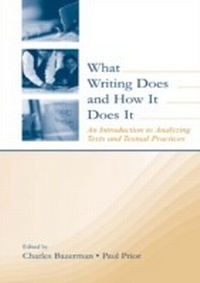
What Writing Does and How It Does It
An Introduction to Analyzing Texts and Textual Practices
1st Edition
Published on 8. December 2003
372 pages
978-1-135-64968-5 (ISBN)
Description

In What Writing Does and How It Does It, editors Charles Bazerman and Paul Prior offer a sophisticated introduction to methods for understanding, studying, and analyzing texts and writing practices. This volume addresses a variety of approaches to analyzing texts, and considers the processes of writing, exploring textual practices and their contexts, and examining what texts do and how texts mean rather than what they mean. Included are traditional modes of analysis (rhetorical, literary, linguistic), as well as newer modes, such as text and talk, genre and activity analysis, and intertextual analysis.
The chapters have been developed to provide answers to a specified set of questions, with each one offering:
*a preview of the chapter's content and purpose;
*an introduction to basic concepts, referring to key theoretical and research studies in the area;
*details on the types of data and questions for which the analysis is best used;
*examples from a wide-ranging group of texts, including educational materials, student writing, published literature, and online and electronic media;
*one or more applied analyses, with a clear statement of procedures for analysis and illustrations of a particular sample of data; and
*a brief summary, suggestions for additional readings, and a set of activities.
The side-by-side comparison of methods allows the reader to see the multi-dimensionality of writing, facilitating selection of the best method for a particular research question.
The volume contributors are experts from linguistics, communication studies, rhetoric, literary analysis, document design, sociolinguistics, education, ethnography, and cultural psychology, and each utilizes a specific mode of text analysis. With its broad range of methodological examples, What Writing Does and How It Does It is a unique and invaluable resource for advanced undergraduate and graduate students and for researchers in education, composition, ESL and applied linguistics, communication, L1 and L2 learning, print media, and electronic media. It will also be useful in all social sciences and humanities that place importance on texts and textual practices, such as English, writing, and rhetoric.
The chapters have been developed to provide answers to a specified set of questions, with each one offering:
*a preview of the chapter's content and purpose;
*an introduction to basic concepts, referring to key theoretical and research studies in the area;
*details on the types of data and questions for which the analysis is best used;
*examples from a wide-ranging group of texts, including educational materials, student writing, published literature, and online and electronic media;
*one or more applied analyses, with a clear statement of procedures for analysis and illustrations of a particular sample of data; and
*a brief summary, suggestions for additional readings, and a set of activities.
The side-by-side comparison of methods allows the reader to see the multi-dimensionality of writing, facilitating selection of the best method for a particular research question.
The volume contributors are experts from linguistics, communication studies, rhetoric, literary analysis, document design, sociolinguistics, education, ethnography, and cultural psychology, and each utilizes a specific mode of text analysis. With its broad range of methodological examples, What Writing Does and How It Does It is a unique and invaluable resource for advanced undergraduate and graduate students and for researchers in education, composition, ESL and applied linguistics, communication, L1 and L2 learning, print media, and electronic media. It will also be useful in all social sciences and humanities that place importance on texts and textual practices, such as English, writing, and rhetoric.
Reviews / Votes
"What Writing Does and How It Does It provides a satisfactory beginning for advanced students of writing and researchers in any field that uses texts. The book and its individual chapters is a good example of the kind of "bootstrapping operation" that any teacher or researcher might employ in order to assist their students or themselves to move beyond a "naturalized" outlook and revise their understanding of their own work as well as others".-KAIROS A Journal of Rhetoric, Pedagogy and Technology
"...the book is unique in its grounding in North American Writing Studies and in that the chapters offer doable and practical research procedures for the teacher/researcher. The book will be a valuable resource for graduate students and teachers of writing interested in learning about how to use discourse analysis as a research and teaching tool."
-Rhetoric Review
More details
Language
English
Place of publication
London
United Kingdom
Publishing group
Taylor & Francis Ltd
Target group
Professional and scholarly
Product notice
Reflowable
File size
3,98 MB
ISBN-13
978-1-135-64968-5 (9781135649685)
Copyright in bibliographic data and cover images is held by Nielsen Book Services Limited or by the publishers or by their respective licensors: all rights reserved.
Schweitzer Classification
Other editions
Additional editions
Charles Bazerman | Paul Prior
What Writing Does and How It Does It
An Introduction to Analyzing Texts and Textual Practices
Book
09/2003
Routledge
€208.50
Shipment within 10-20 days
Charles Bazerman | Paul Prior
What Writing Does and How It Does It
An Introduction to Analyzing Texts and Textual Practices
Book
09/2003
Routledge
€109.70
Shipment within 10-20 days
Persons
Bazerman, Charles; Prior, Paul
Content
Contents: C. Bazerman, P. Prior, Introduction. Part I:Analyzing Texts.T. Huckin, Content Analysis: What Texts Talk About. P. Eubanks,Poetics and Narrativity: How Texts Tell Stories.E. Barton, Linguistic Discourse Analysis: How the Language in Texts Works. C. Bazerman, Intertextuality: How Texts Rely on Other Texts. M.Z. Buell, Code-Switching and Second Language Writing: How Multiple Codes Are Combined in a Text. A.F. Wysocki, The Multiple Media of Texts: How Onscreen and Paper Texts Incorporate Words, Images, and Other Media. Part II:Analyzing Textual Practices.P. Prior, Tracing Process: How Texts Come Into Being. K. Leander, P. Prior, Speaking and Writing: How Talk and Text Interact in Situated Practices. G. Kamberelis, L. de la Luna, Children's Writing: How Textual Forms, Contextual Forces, and Textual Politics Co-Emerge. J. Selzer, Rhetorical Analysis: Understanding How Texts Persuade Readers. C. Bazerman, Speech Acts, Genres, and Activity Systems: How Texts Organize Activity and People.
