

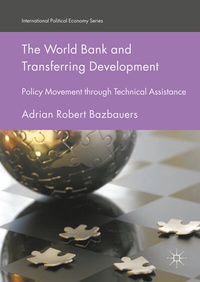
The World Bank and Transferring Development
Description

This book analyses the World Bank's provision of technical assistance from 1946 to the present day. It argues that the relational dynamics between technical assistance provider and recipient affects the legitimacy of policy norms travelling from the 'international' to the 'domestic'. Beginning from the constructivist position that 'development' is a social construct, the author contends that successful policy movement via technical assistance depends on the recipient's perception of the validity of policy reforms, with perception being influenced by the way those ideas and practices are presented, packaged, and transferred. In advancing this argument, Bazbauers analyses four pillars of World Bank technical assistance: technical assistance components (advisory services incorporated within lending operations), stand-alone technical assistance projects (projects designed to solely deliver technical assistance), survey missions (activities involved in measuring the development status of developing countries), and training institutes (the courses of the Economic Development Institute and World Bank Institute).
More details
Other editions
Additional editions
Person
Adrian Robert Bazbauers is Lecturer in Government and Politics in the School of Government & Policy at the University of Canberra, Australia. His research interests include the World Bank, global development, policy movement, and crises in capitalism.
Content
Chapter 1. Transferring Development.- Chapter 2. Policy Movement and Technical Assistance.- Chapter 3. The World Bank.- Chapter 4. Technical Assistance Components.- Chapter 5. Technical Assistance Loans.- Chapter 6. Survey Missions.- Chapter 7. Training Institutes.- Chapter 8. Development Transferred?
