

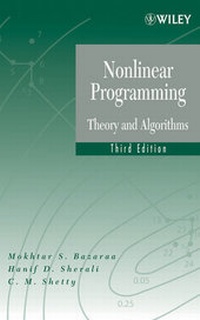
Nonlinear Programming
Description

Reviews / Votes
"The promotional message on the back cover proclaims 'this book isa solid reference for professionals and a useful text forstudents..."; and I fully agree." (Technometrics,February 2007) "Noted and recommended for its logical format and sharp editingthat never wavers in its focus." (Electric Review,September/October 2006) "...highly recommended for a course in the theory ofnonlinear programming..." (MAA Reviews, July 17,2006) '... 'the Bazaraa' is a must if youare interested in optimization...' (Journal of theOperational Research Society, 2007)More details
Other editions
Additional editions
Persons
Content
1.1 Problem Statement and Basic Definitions.
1.2 Illustrative Examples.
1.3 Guidelines for Model Construction.
Exercises.
Notes and References.
Part 1 Convex Analysis.
Chapter 2 Convex Sets.
2.1 Convex Hulls.
2.2 Closure and Interior of a Set.
2.3 Weierstrass's Theorem.
2.4 Separation and Support of Sets.
2.5 Convex Cones and Polarity.
2.6 Polyhedral Sets, Extreme Points, and Extreme Directions.
2.7 Linear Programming and the Simplex Method.
Exercises.
Notes and References.
Chapter 3 Convex Functions and Generalizations.
3.1 Definitions and Basic Properties.
3.2 Subgradients of Convex Functions.
3.3 Differentiable Convex Functions.
3.4 Minima and Maxima of Convex Functions.
3.5 Generalizations of Convex Functions.
Exercises.
Notes and References.
Part 2 Optimality Conditions and Duality.
Chapter 4 The Fritz John and Karush-Kuhn-Tucker Optimality Conditions.
4.1 Unconstrained Problems.
4.2 Problems Having Inequality Constraints.
4.3 Problems Having Inequality and Equality Constraints.
4.4 Second-Order Necessary and Sufficient Optimality Conditions for Constrained Problems.
Exercises.
Notes and References.
Chapter 5 Constraint Qualifications.
5.1 Cone of Tangents.
5.2 Other Constraint Qualifications.
5.3 Problems Having Inequality and Equality Constraints.
Exercises.
Notes and References.
Chapter 6 Lagrangian Duality and Saddle Point Optimality Conditions.
6.1 Lagrangian Dual Problem.
6.2 Duality Theorems and Saddle Point Optimality Conditions.
6.3 Properties of the Dual Function.
6.4 Formulating and Solving the Dual Problem
6.5 Getting the Primal Solution.
6.6 Linear and Quadratic Programs.
Exercises.
Notes and References.
Part 3 Algorithms and Their Convergence.
Chapter 7 The Concept of an Algorithm.
7.1 Algorithms and Algorithmic Maps.
7.2 Closed Maps and Convergence.
7.3 Composition of Mappings.
7.4 Comparison Among Algorithms.
Exercises.
Notes and References.
Chapter 8 Unconstrained Optimization.
8.1 Line Search Without Using Derivatives.
8.2 Line Search Using Derivatives.
8.3 Some Practical Line Search Methods.
8.4 Closedness of the Line Search Algorithmic Map.
8.5 Multidimensional Search Without Using Derivatives.
8.6 Multidimensional Search Using Derivatives.
8.7 Modification of Newton's Method: Levenberg-Marquardt and Trust Region Methods.
8.8 Methods Using Conjugate Directions: Quasi-Newton and Conjugate Gradient Methods.
8.9 Subgradient Optimization Methods.
Exercises.
Notes and References.
Chapter 9 Penalty and Barrier Functions.
9.1 Concept of Penalty Functions.
9.2 Exterior Penalty Function Methods.
9.3 Exact Absolute Value and Augmented Lagrangian Penalty Methods.
9.4 Barrier Function Methods.
9.5 Polynomial-Time Interior Point Algorithms for Linear Programming Based on a Barrier Function.
Exercises.
Notes and References.
Chapter 10 Methods of Feasible Directions.
10.1 Method of Zoutendijk.
10.2 Convergence Analysis of the Method of Zoutendijk.
10.3 Successive Linear Programming Approach.
10.4 Successive Quadratic Programming or Projected Lagrangian Approach.
10.5 Gradient Projection Method of Rosen.
10.6 Reduced Gradient Method of Wolfe and Generalized Reduced Gradient Method.
10.7 Convex-Simplex Method of Zangwill.
10.8 Effective First- and Second-Order Variants of the Reduced Gradient Method.
Exercises.
Notes and References.
Chapter 11 Linear Complementary Problem, and Quadratic, Separable, Fractional, and Geometric Programming.
11.1 Linear Complementary Problem.
11.2 Convex and Nonconvex Quadratic Programming: Global Optimization Approaches.
11.3 Separable Programming.
11.4 Linear Fractional Programming.
11.5 Geometric Programming.
Exercises.
Notes and References.
Appendix A Mathematical Review.
Appendix B Summary of Convexity, Optimality Conditions, and Duality.
Bibliography.
Index.
