

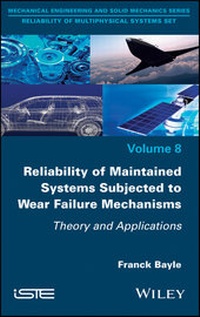
Reliability of Maintained Systems Subjected to Wear Failure Mechanisms
Theory and Applications
1st Edition
Published on 15. April 2019
240 pages
978-1-119-61059-5 (ISBN)
Description

Today, the reliability of systems has become a major issue in most industrial applications. The theoretical approach to estimating reliability was largely developed in the 1960s for maintenance-free systems, and more recently, in the late 1990s, it was developed for maintenance-based systems.
Customers' expectations concerning reliability (as well as maintenance, safety, etc.) are growing ever more demanding over the generations of systems. However, the theoretical methods used to handle the systems are not suitable when aging mechanisms are present.
This book proposes a theoretical approach to estimate all of these quantities correctly. In addition to the theoretical aspect, it details a number of issues that any industrial system will meet sooner or later, whether due to design flaws, the batch of components, manufacturing problems or new technologies that result in the aging of mechanisms during their operational use.
More details
Other editions
Additional editions
Franck Bayle
Reliability of Maintained Systems Subjected to Wear Failure Mechanisms
Theory and Applications
Book
04/2019
1st Edition
Wiley-ISTE
€164.50
Shipment within 3-4 weeks
Content
- Cover
- Half-Title Page
- Title Page
- Copyright Page
- Contents
- Foreword by Christian Moreau
- Foreword by Claude Sarno
- Acknowledgments
- Introduction
- Purpose of this book
- List of Acronyms
- List of Notations
- 1. Reliability of Systems Without Maintenance
- 1.1. Classification of systems
- 1.1.1. Maintenance-free systems
- 1.1.2. Systems with maintenance
- 1.2. Principal quantities of reliability
- 1.2.1. The probability density
- 1.2.2. The probability of failure
- 1.2.3. The survival function
- 1.2.4. The instantaneous failure rate
- 1.2.5. The mode of a distribution
- 1.2.6. The cumulative failure rate
- 1.2.7. Links between different functions
- 1.2.8. MTTF notion
- 1.2.9. Residual lifespan
- 1.3. The main distributions
- 1.3.1. The exponential distribution
- 1.3.2. The Weibull distribution
- 1.3.3. Normal distribution
- 1.3.4. The log-normal distribution
- 1.4. Context
- 1.4.1. Theoretical basis of JESD85
- 1.4.2. Problem when there are no observed failures
- 1.4.3. Theoretical analysis
- 1.4.4. Example of a HTOL test on integrated circuits
- 2. Reliability of Systems with Maintenance
- 2.1. Counting process
- 2.2. Different types of maintenance
- 2.3. Preventive maintenance
- 2.3.1. General formulation
- 2.3.2. Formulation for accidental failures
- 2.3.3. Formulation for aging failures
- 2.4. Corrective maintenance
- 2.4.1. Hypothesis
- 2.4.2. Renewal process
- 2.4.3. Analytical solutions
- 3. Application to Aging Mechanisms with Maintenance
- 3.1. Characteristics
- 3.2. Approximate solutions
- 3.2.1. The stabilization time of the Rocof is very low compared to the operational period
- 3.2.2. The asymptotic value of the Rocof is never reached
- 3.2.3. Other cases
- 3.3. Generalizations
- 3.3.1. Mix of distributions
- 3.3.2. Competitive mechanisms
- 3.3.3. Serial system
- 3.3.4. Parallel systems
- 3.3.5. "K/n" redundancy systems
- 3.3.6. Summary
- 3.4. Impact of physical factors
- 3.5. Impact of the mission profile
- 3.5.1. Sedyakin's principle
- 3.5.2. Physical equivalent contribution with Sedyakin's principle
- 3.5.3. Case of a heterogeneous profile
- 4. Impact at the Reliability Level
- 4.1. Concept of MTBF
- 4.2. Estimation of MTBF
- 4.3. Impact of the delivery flow
- 4.4. Example of a digital component with a fine engraving size
- 4.4.1. Case where the Weibull shape parameter is equal to 1
- 4.4.2. Case where the shape parameter is not equal to 1
- 4.5. Application at the cost of a burn-in
- 4.5.1. Cases where no burn-in is done
- 4.5.2. Cases where a burn-in is done
- 5. Application to Maintenance
- 5.1. Reliability growth
- 5.2. BTN maintenance "Better than New"
- 5.3. WTO "Worse than Old" maintenance
- 5.4. Maintenance by attrition
- 5.5. Maintenance on a complete subset
- 5.5.1. Cases where we replace the defective system with a new one
- 5.5.2. Cases where we replace the complete system with a new one
- 5.6. Systems with k/n redundancy
- 5.6.1. Cases where we replace the defective system with a new one
- 5.6.2. Cases where we replace the complete system
- 6. Application to Safety
- 6.1. Estimation of exposure time
- 6.2. Case of components with aging
- 6.2.1. Theoretical approach for systems with maintenance
- 6.2.2. Case of catastrophic failures
- 6.2.3. Case of aging failures
- 6.2.4. OR gate
- 6.2.5. AND gate
- 7. Maintenance Strategy in Operational Safety
- Appendix
- A.1. The indicator
- A.2. The factorial function
- A.3. The complete gamma function
- A.4. Incomplete gamma function
- A.5. Error function
- References
- Index
- Other titles from iSTE in Mechanical Engineering and Solid Mechanics
- EULA
