

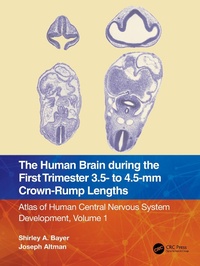
The Human Brain during the First Trimester 3.5- to 4.5-mm Crown-Rump Lengths
Atlas of Human Central Nervous System Development, Volume 1
1st Edition
Published on 26. September 2022
129 pages
978-1-000-63179-1 (ISBN)
Description

This first of 15 short atlases reimagines the classic 5-volume Atlas of Human Central Nervous System Development. This volume presents serial sections from specimens between 3.5 mm and 4.5 mm with detailed annotations, together with 3D reconstructions. An introduction summarizes human CNS development by using high-resolution photos of methacrylate-embedded rat embryos at a similar stage of development as the human specimens in this volume. The accompanying Glossary gives definitions for all the terms used in this volume and all the others in the Atlas.
Features
Classic anatomical atlas
Detailed labeling of structures in the developing brain offers updated terminology and the identification of unique developmental features, such as germinal matrices of specific neuronal populations and migratory streams of young neurons
Appeals to neuroanatomists, developmental biologists, and clinical practitioners
A valuable reference work on brain development that will be relevant for decades
Features
Classic anatomical atlas
Detailed labeling of structures in the developing brain offers updated terminology and the identification of unique developmental features, such as germinal matrices of specific neuronal populations and migratory streams of young neurons
Appeals to neuroanatomists, developmental biologists, and clinical practitioners
A valuable reference work on brain development that will be relevant for decades
More details
Edition
1. Auflage
Language
English
Place of publication
London
United Kingdom
Publishing group
Taylor & Francis Ltd
Target group
College/higher education
Professional and scholarly
Illustrations
1 Tables, black and white; 108 Halftones, black and white; 108 Illustrations, black and white
ISBN-13
978-1-000-63179-1 (9781000631791)
Copyright in bibliographic data and cover images is held by Nielsen Book Services Limited or by the publishers or by their respective licensors: all rights reserved.
Schweitzer Classification
Other editions
Additional editions
Shirley A. Bayer | Joseph Altman
The Human Brain during the First Trimester 3.5- to 4.5-mm Crown-Rump Lengths
Atlas of Human Central Nervous System Development, Volume 1
Book
09/2022
1st Edition
CRC Press
€71.60
Shipment within 10-20 days
Shirley A. Bayer | Joseph Altman
The Human Brain during the First Trimester 3.5- to 4.5-mm Crown-Rump Lengths
Atlas of Human Central Nervous System Development, Volume 1
Book
09/2022
1st Edition
CRC Press
€207.98
Shipment within 10-20 days
Persons
Shirley A. Bayer received her PhD from Purdue University in 1974 and spent most of her scientific career working with Joseph Altman. She was a professor of biology at Indiana-Purdue University in Indianapolis for several years, where she taught courses in human anatomy and developmental neurobiology while continuing to do research in brain development. Her lengthy publication record of dozens of peer-reviewed scientific journal articles extends back to the mid 1970s. She has co-authored several books and many articles with her late spouse, Joseph Altman. It was her research (published in Science in 1982) that proved that new neurons are added to granule cells in the dentate gyrus during adult life, a unique neuronal population that grows. That paper stimulated interest in the dormant field of adult neurogenesis.
Joseph Altman, now deceased, was born in Hungary and migrated with his family via Germany and Australia to the United States. In New York, he became a graduate student in psychology in the laboratory of Hans-Lukas Teuber, earning a PhD in 1959 from New York University. He was a postdoctoral fellow at Columbia University, and later joined the faculty at the Massachusetts Institute of Technology. In 1968, he accepted a position as a professor of biology at Purdue University. During his career, he collaborated closely with Shirley A. Bayer. From the early 1960s to 2016, he published many articles in peer-reviewed journals, books, monographs, and online free books that emphasized developmental processes in brain anatomy and function. His most important discovery was adult neurogenesis, the creation of new neurons in the adult brain. This discovery was made in the early 1960s while he was based at MIT and was largely ignored in favor of the prevailing dogma that neurogenesis is limited to prenatal development. After Dr. Bayer's paper proved that new neurons are adding to granule cells in the hippocampus, his monumental discovery became more accepted. During the 1990s, new researchers "rediscovered" and confirmed his original finding. Adult neurogenesis has recently been proven to occur in the dentate gyrus, olfactory bulb, and striatum through the measurement of Carbon-14-the levels of which changed during nuclear bomb testing throughout the 20th century-in postmortem human brains. Today, many laboratories around the world are continuing to study the importance of adult neurogenesis in brain function. In 2011, Altman was awarded the Prince of Asturias Award, an annual prize given in Spain by the Prince of Asturias Foundation to individuals, entities, or organizations from around the world who make notable achievements in the sciences, humanities, and public affairs. In 2012 he received the International Prize for Biology, an annual award from the Japan Society for the Promotion of Science (JSPS) for "outstanding contribution to the advancement of research in fundamental biology." This Prize is one of the most prestigious honors a scientist can receive. Dr. Altman died in 2016, and Dr. Bayer continues the work they started over 50 years ago. In his honor, she has set up the Altman Prize, awarded each year to an outstanding young researcher in developmental neuroscience by JSPS.
Joseph Altman, now deceased, was born in Hungary and migrated with his family via Germany and Australia to the United States. In New York, he became a graduate student in psychology in the laboratory of Hans-Lukas Teuber, earning a PhD in 1959 from New York University. He was a postdoctoral fellow at Columbia University, and later joined the faculty at the Massachusetts Institute of Technology. In 1968, he accepted a position as a professor of biology at Purdue University. During his career, he collaborated closely with Shirley A. Bayer. From the early 1960s to 2016, he published many articles in peer-reviewed journals, books, monographs, and online free books that emphasized developmental processes in brain anatomy and function. His most important discovery was adult neurogenesis, the creation of new neurons in the adult brain. This discovery was made in the early 1960s while he was based at MIT and was largely ignored in favor of the prevailing dogma that neurogenesis is limited to prenatal development. After Dr. Bayer's paper proved that new neurons are adding to granule cells in the hippocampus, his monumental discovery became more accepted. During the 1990s, new researchers "rediscovered" and confirmed his original finding. Adult neurogenesis has recently been proven to occur in the dentate gyrus, olfactory bulb, and striatum through the measurement of Carbon-14-the levels of which changed during nuclear bomb testing throughout the 20th century-in postmortem human brains. Today, many laboratories around the world are continuing to study the importance of adult neurogenesis in brain function. In 2011, Altman was awarded the Prince of Asturias Award, an annual prize given in Spain by the Prince of Asturias Foundation to individuals, entities, or organizations from around the world who make notable achievements in the sciences, humanities, and public affairs. In 2012 he received the International Prize for Biology, an annual award from the Japan Society for the Promotion of Science (JSPS) for "outstanding contribution to the advancement of research in fundamental biology." This Prize is one of the most prestigious honors a scientist can receive. Dr. Altman died in 2016, and Dr. Bayer continues the work they started over 50 years ago. In his honor, she has set up the Altman Prize, awarded each year to an outstanding young researcher in developmental neuroscience by JSPS.
Content
Introduction
4.0 mm Crown Rump (CR) Length, M714
3.5 mm CR, C7724
4.0 mm CR, C836
4.5 mm CR, C9297
4.0 mm Crown Rump (CR) Length, M714
3.5 mm CR, C7724
4.0 mm CR, C836
4.5 mm CR, C9297
