

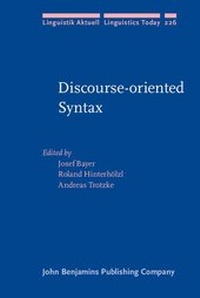
Discourse-oriented Syntax
1st Edition
Published on 16. December 2015
V, 253 pages
978-90-272-6772-6 (ISBN)
Description

Until recently, little attention has been paid within syntax to components of discourse meaning that go beyond information structure and fall into the domain of non-at-issue meaning operating at the level of illocutionary force. To approach this domain, many of the contributions of this volume deal with the syntax of discourse particles. However, the issue of how to account for discourse particles within a more explicit map of the illocutionary domain is a good starting point for considering further phenomena related to the syntax of speech acts. By focusing on speech-act related particles and/or meaning domains, this volume makes a new contribution to the field, as existing collections either do not offer a comparatively narrow focus on particles or are not limited to syntax-oriented approaches. The primary audience of this volume are researchers and graduate students interested in state-of-the-art approaches to the syntax-discourse interface within the cartographic approach to syntax.
More details
Other editions
Additional editions
Josef Bayer | Roland Hinterhoelzl | Andreas Trotzke
Discourse-oriented Syntax
Book
12/2015
John Benjamins Publishing Co
€100.70
Shipment within 10-15 days
Persons
Content
- Discourse-oriented Syntax
- Editorial page
- Title page
- LCC data
- Table of contents
- Issues in discourse-oriented syntax
- 1. Issues at the syntax-discourse interface
- 2. The contributions
- References
- The derivation and interpretation of left peripheral discourse particles
- 1. Introduction
- 2. The derivation of left peripheral particles
- 2.1 Left peripheral particles and syntactic constituency
- 2.2 Left peripheral particles and generalized transformations
- 2.3 Stacked left peripheral particles
- 3. Left peripheral particles and emphasis
- 3.1 The notion of emphasis for intensity
- 3.2 Emphasis for intensity in the left periphery
- 3.3 Emphasis for intensity and left peripheral particles
- 4. Conclusion and outlook
- References
- On the interpretation of modal particles in non-assertive speech acts in German and Bellunese
- 1. Introduction
- 2. Bellunese particles and their German correspondents
- 2.1 Particles deriving from pronouns
- 2.1.1 Lu
- 2.1.2 Ti
- 2.2 Particles deriving from adverbs
- 2.2.1 Mo
- 2.2.2 Po
- 2.3 On the interaction between particles and wh-movement
- 2.4 Interim summary
- 3. Interpretation of the basic facts
- 3.1 Deriving the expressive meanings as secondary illocutionary effects
- 3.1.1 doch
- 3.1.2 denn
- 3.1.3 nun
- 3.1.4 ja
- 3.1.5 The impact of intonation
- 3.2 Some consequences and implications of the modular approach
- 4. Towards a syntactic analysis of modal particles in standard and special questions
- 4.1 On the distinction between information questions and special questions
- 4.2 The analysis of standard and special questions in Bellunese
- 4.3 The analysis of standard and special questions in German.
- 5. Conclusions
- References
- Italian verb-based discourse particles in a comparative perspective
- 1. Introduction
- 2. On verb-based particles
- 3. Italian sentence-final particles occur in the IP layer
- 3.1 Adverb-based particles
- 3.2 Verb-based particles
- 4. Sentence-initial particles
- 4.1 Semantic contribution
- 4.2 Clause types
- 4.3 Agreement patterns.
- 4.4 Ordering restrictions
- 4.5 The discourse particle dai
- 4.6 Interim conclusions
- 5. Cross-linguistic evidence
- 5.1 The distribution
- 5.2 The analysis
- 5.3 Particles and vocatives
- 5.4 The refinement of the analysis
- 6. Back to Italian: The interaction of discourse particles and vocatives
- 7. Conclusions
- References
- Italian adverbs and discourse particles
- 1. Discourse particles as functional heads
- 1.1 Complementizers and wh-pronouns
- 1.2 The pa/po particle in varieties of the Trentino - Alto Adige
- 2. Discourse particles as weak adverbs
- 2.1 The strong-weak pronoun opposition
- 2.2 Italian poi 'then'
- 3. The (scopal) ambiguity of adverbs and particles.
- 3.1 Three short case studies
- 3.2 Conclusions
- References
- Is particle a (unified) category?
- 1. Introduction
- 2. The modal particles: Core properties
- 3. Particles as grammatical markers in the left periphery
- 4. Particles as verbal bases: Tha and as
- 4.1 Verbal bases and modality
- 4.2 Their position in the left periphery
- 5. Particles as nominals: Na and mi
- 5.1 An overview and an analysis of na
- 5.2 The curious status of mi
- 5.3 The unification of mi
- 6. Conclusions
- References
- The particle how
- 1. Introduction
- 2. Complementizer how
- 3. Interrogative how
- 4. How as part of an Adjective Phrase
- 5. Minimalism and features
- 6. Conclusion
- References
- The cartography of yes and no in West Flemish
- 1. Introduction: Aim and scope of the paper
- 1.1 A typology of West Flemish response particles
- 1.1.1 Agreeing particles
- 1.1.2 Bare particles
- 1.2 Focus of the paper
- 1.3 Outline of the paper
- 2. The data
- 2.1 The basic patterns in Lapscheure West Flemish
- 2.1.1 Agreement marking
- 2.1.2 Reversal particles
- 2.2 The shape of the agreement: Cross-dialectal microvariation
- 2.3 The shape of the agreement marking
- 3. Arguments against a PF-deletion analysis
- 3.1 Non-optionality of 'clausal silence'
- 3.2 Absence of agreement marking in clearer cases of PF-deletion
- 3.3 Lack of extraction
- 4. Van Craenenbroeck (2010): A TP pro-form
- 4.1 Summary
- 4.2 Some problems for the analysis
- 5. Our analysis
- 5.1 Explaining 'clausal silence': Ja/nee as TP proforms
- 5.2 A sui generis agreement marking
- 5.3 Agreeing yes/no and V2
- 5.3.1 Background assumptions: Cartography and SubjP
- 5.3.2 The syntax of ja/nee replies
- 5.3.3 The syntax of reversal ja/nee responses
- 5.3.4 The syntax of 'reversal doet'
- 5.3.4.1 The empirical data. We have said that conjugated ja/nee move as heads through Fin+Phi to satisfy V2. But the 'emphatic'/reversal forms with the reversal schwa can also co-occur with the verb doen ('do'). We summarize the core empirical data first.
- 5.3.4.2 The syntax of reversal responses. We first consider the derivation of (53b) in which reversal ja-j-e/nee-j-e combine with reversal doet.
- 6. Summary and questions for future research
- References
- On polarity particles in Italian varieties
- 1. Introduction
- 2. The syntax of emphasis: A summary of Poletto & Zanuttini (2013)
- 3. Emphatic structures with a final polarity particle
- 4. The syntax of reinforced particles in Southern Italian dialects
- 5. An overview on emphasis as repetition
- 6. Conclusion
- References
- Discourse and the syntax of the left periphery
- 1. Introduction
- 2. A brief characterization of Clitic Left Dislocation and Hanging Topic
- 3. An alternative analysis
- 3.1 A few words on parentheticals
- 4. Back to CLLD and HT
- 5. Concluding remarks
- References
- Index
