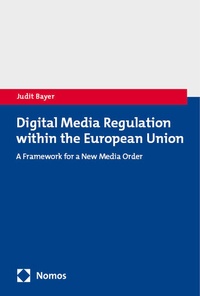
Digital Media Regulation within the European Union
A Framework for a New Media Order
Judit Bayer(Author)
Nomos (Publisher)
1st Edition
Published on 13. August 2024
383 pages
978-3-7489-4535-2 (ISBN)
System requirements
for PDF without DRM
E-Book Single Licence
You are acquiring a single user licence for this eBook, which you might not transfer. [L]
Available for download
Description
Alles über E-Books | Antworten auf Fragen rund um E-Books, Kopierschutz und Dateiformate finden Sie in unserem Info- & Hilfebereich.
This book analyses the new structure of democratic public discourse and reinterprets the meaning of media freedom. It discusses the development of European electronic media regulation in a historical and regulatory perspective and presents how the new digital regulation has organically developed on its grounds. The new digital regulation is introduced primarily from the perspective of how it contributes to establishing a new media order.
This interdisciplinary discussion intersects law, media science and political studies and addresses readers interested in the development of new media, democracy, or technology regulation.
The author's research focuses on media freedom and media regulation, with a particular interest in new technologies.
More details
Language
English
Place of publication
Baden-Baden
Germany
File size
1,80 MB
ISBN-13
978-3-7489-4535-2 (9783748945352)
DOI
10.5771/9783748945352
Schweitzer Classification
Other editions
Additional editions

Book
07/2024
1st Edition
Nomos
€94.00
Shipment within 5-7 days

System requirements
File format: PDF
Copy protection: without DRM (Digital Rights Management)
System requirements:
- Computer (Windows; MacOS X; Linux): Use the free software Adobe Reader, Adobe Digital Editions, or any other PDF viewer of your choice (see eBook Help).
- Tablet/Smartphone (Android; iOS): Install the free app Adobe Digital Editions or another reading app for eBooks, e.g., PocketBook (see eBook Help).
- E-reader: Bookeen, Kobo, Pocketbook, Sony, Tolino and many more (only limited: Kindle).
The file format PDF always displays a book page identically on any hardware. This makes PDF suitable for complex layouts such as those used in textbooks and reference books (images, tables, columns, footnotes). Unfortunately, on the small screens of e-readers or smartphones, PDFs are rather annoying, requiring too much scrolling.
This eBook does not use copy protection or Digital Rights Management.
For more information, see our eBook Help page.