

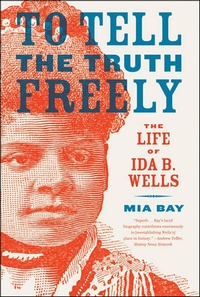
To Tell the Truth Freely
Description

"Finally, we have a biography worthy of one of the bravest and most influential activists in U.S. history." ¿Michael Kazin, author of What It Took to Win
Born to slaves in 1862, Ida B. Wells became a fearless anti-lynching crusader, women's rights advocate, and journalist. Wells's refusal to accept any compromise on racial inequality caused her to be labeled a "dangerous radical" in her day but made her a model for later civil rights activists as well as a powerful witness to the troubled racial politics of her era.
Wells's fight for racial and gender justice began in 1883, when she was a young schoolteacher who traveled to her rural schoolhouse by rail. Forcibly ejected from her seat one day on account of her race, Wells sued the railroad. Though she ultimately lost her case on appeal in the Supreme Court of Tennessee, the published account of her legal challenge to Jim Crow changed her life, propelling her into a career as an outspoken journalist and social activist.
A fierce critic of the racial violence, Wells went on to launch a crusade against lynching that took her across the United States and eventually to Britain. Though she helped found the NAACP in 1910 after resettling in Chicago, she would not remain a member for long. Always militant in her quest for racial justice, Wells rejected not only Booker T. Washington's accommodationism but also the moderating influence of white reformers within the early NAACP.
The life of Ida B. Wells and her enduring achievements are dramatically recovered in Mia Bay's To Tell the Truth Freely.
More details
Other editions
Additional editions

Person
Mia Bay is an associate professor of history at Rutgers University and the associate director of Rutgers's Center for Race and Ethnicity. She is also the author of The White Image in the Black Mind: African-American Ideas About White People, 1830-1925.
