

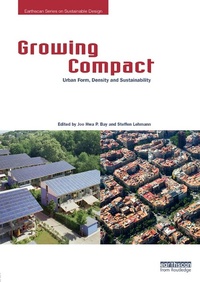
Growing Compact
Urban Form, Density and Sustainability
Published on 6. July 2017
416 pages
978-1-317-19086-8 (ISBN)
Description

Growing Compact: Urban Form, Density and Sustainability explores and unravels the phenomena, links and benefits between density, compactness and the sustainability of cities. It looks at the socio-climatic implications of density and takes a more holistic approach to sustainable urbanism by understanding the correlations between the social, economic and environmental dimensions of the city, and the challenges and opportunities with density. The book presents contributions from internationally well-known scholars, thinkers and practitioners whose theoretical and practical works address city planning, urban and architectural design for density and sustainability at various levels, including challenges in building resilience against climate change and natural disasters, capacity and integration for growth and adaptability, ageing, community and security, vegetation, food production, compact resource systems and regeneration.
Reviews / Votes
'This book uses different prisms to shed new light on the multi-faceted topic of urban density. It contributes to understanding how we can make cities more compact, integrated and connected. It also helps to contextualize the land use efficiency indicator of the sustainable development goals.' - Rafael Tuts - Coordinator, Urban Planning and Design, UN-Habitat, Nairobi, Kenya'This book tackles one of the most important challenges that shape future cities: Contextualising urban densities in the face of climate change. The book provides wide discussion; looking at possible urban densities that would guide future configuration of our cities.' - Professor Hisham Elkadi - Dean, Built Environment, Salford University, UK
'This book puts the "ability" in sustainability, and the "intensity" in density towards new forms of resplendent urbanity.' - Associate Professor Mitchell Joachim - Terreform ONE and New York University, USA
'Each of the chapters in this volume provide "lenses" to view the challenges of compact and dense cities. How does one build to high density and raise standards of public health and safety and well-being? This book is replete with insights and provocations that set forth a new horizon for urban design research and practice and thus provides a hopeful vision for a resilient future.' - Professor Donald Watson , EarthRise Design, USA
More details
Series
Language
English
Place of publication
London
United Kingdom
Publishing group
Taylor & Francis Ltd
Target group
College/higher education
Professional and scholarly
Illustrations
123 s/w Abbildungen, 11 s/w Tabellen, 76 s/w Photographien bzw. Rasterbilder, 47 s/w Zeichnungen
11 Tables, black and white; 47 Line drawings, black and white; 76 Halftones, black and white; 123 Illustrations, black and white
File size
13,25 MB
ISBN-13
978-1-317-19086-8 (9781317190868)
Copyright in bibliographic data and cover images is held by Nielsen Book Services Limited or by the publishers or by their respective licensors: all rights reserved.
Schweitzer Classification
Other editions
Additional editions
Book
07/2017
1st Edition
Routledge
€202.50
Shipment within 10-20 days
Book
06/2017
1st Edition
Routledge
€74.00
Shipment within 10-20 days
Persons
Joo Hwa Philip Bay has practised architecture and urban design since the mid-1980s, has been a company director of a large practice, and has designed and completed about half a billion dollars of projects. He was a Council Member of the Singapore Institute of Architects, and has won several design awards. He received his PhD in Technische Universiteit Delft, The Netherlands, researched and taught at the National University of Singapore, and has been an Associate Professor at the University of Western Australia and an Adjunct Associate Professor of the Curtin University Sustainable Policy (CUSP) Institute. One of his design research consultancies was to advise the Singapore JTC Corporation on new urban housing for a 35,000 expatriate population at the 'new economy' hub called 'one north'. His published works include Tropical Sustainable Architecture: Social and Environmental Dimensions, and 'Towards a Fourth Ecology', in the Journal of Green Building. He founded and chaired the International Network for Tropical Architecture from 2004 to 2009, and has been invited to speak in many international conferences and seminars. He is on the specialist register, LandCorp Western Australia, on editorial boards for two journals, and has been referee and advisor to major conferences, member of jury for design competitions, reviewer of journal papers and examiner of PhD dissertations internationally.
Steffen Lehmann is a Professor of Sustainable Architecture in the Faculty of Creative and Cultural Industries at the University of Portsmouth (UK), where he is also Director of the Cluster for Sustainable Cities, a university-wide research group with 36 researchers. Prior to this, he has been a full professor for 14 years at high-ranking universities in Australia, holding senior leadership positions ranging from Director of research centres to Head of School and Head of Discipline. For most of this time, Steffen was a tenured Chair Professor of Sustainable Design at the University of South Australia in Adelaide, where he was also Founding Director of the Centre for Sustainable Design & Behaviour, and the China-Australia Centre for Sustainable Urban Development. From 2008 to 2010, based on the international significance of his research, he was appointed as chair holder of the UNESCO Chair in Sustainable Urban Development for Asia and the Pacific. Prior to becoming a full-time academic, Steffen ran for over ten years his successful architectural practice Steffen Lehmann Architekten Berlin (s_Lab) in Berlin, where he was instrumental in the design of the 'New Berlin'. After studying at the Architectural Association School in London and completing a PhD at the TU Berlin, he worked from 1990 to 1993 with architects James Stirling in London and Arata Isozaki in Tokyo. See also www.city-futures.org.uk.
Steffen Lehmann is a Professor of Sustainable Architecture in the Faculty of Creative and Cultural Industries at the University of Portsmouth (UK), where he is also Director of the Cluster for Sustainable Cities, a university-wide research group with 36 researchers. Prior to this, he has been a full professor for 14 years at high-ranking universities in Australia, holding senior leadership positions ranging from Director of research centres to Head of School and Head of Discipline. For most of this time, Steffen was a tenured Chair Professor of Sustainable Design at the University of South Australia in Adelaide, where he was also Founding Director of the Centre for Sustainable Design & Behaviour, and the China-Australia Centre for Sustainable Urban Development. From 2008 to 2010, based on the international significance of his research, he was appointed as chair holder of the UNESCO Chair in Sustainable Urban Development for Asia and the Pacific. Prior to becoming a full-time academic, Steffen ran for over ten years his successful architectural practice Steffen Lehmann Architekten Berlin (s_Lab) in Berlin, where he was instrumental in the design of the 'New Berlin'. After studying at the Architectural Association School in London and completing a PhD at the TU Berlin, he worked from 1990 to 1993 with architects James Stirling in London and Arata Isozaki in Tokyo. See also www.city-futures.org.uk.
Content
Foreword. Donald Watson. 1. Introduction: Compact urban form, density and sustainability: Correlations and holistic approaches. Joo Hwa Philip Bay and Steffen Lehmann. Part 1: Framing the Question: Unravelling the Link between Density, Sustainability and Compact Cities. 2. Urban lifelines to achieve climate resiliency.
Donald Watson. 3. Planning ethics and urban density: Overcoming fear in Anglo Saxon cities.
Peter Newman. 4. Density, sprawl and sustainable urban development: Perspectives from the Asian and Pacific region. Paul Jones and Donovan Storey. 5. The challenge of transforming low-density cities into compact cities: The case of the City of Perth. Steffen Lehmann. 6. Compact city and sustainable high-density living: Social-environmental holistic approach. Joo Hwa Philip Bay. Part 2: Quality of Living and Social Dimensions Relating to Environmental Sustainability. 7. The sustainable city: A good and secure quality of life?
Mike Jenks. 8. Density, Compact Urban Form and Sustainability in the Netherlands.
Jeroen Mensink and Frank D. van der Hoeven. 9. Security and density: A paradox of public protection at the expense of personal privacy. Emil Jonescu. 10. Dense and aging: Social sustainability of public places amidst high-density development. Keng Hua Chong, Kien To and Michael M.J. Fischer. 11. Creating green space in the compact city: A Swedish perspective on a global issue. Walker Wells, Tigran Haas and Helene Littke. Part 3: Compact Resource Management, Greening and Integration with Urban Form. 12. Green Plot Ratio and MUtopia. Boon Lay Ong, Ole Fryd, Dominique Hes, Tuan Duc Ngo and Lu Aye. 13. Density and sustainable integration of decentralised water and energy systems. Martin Anda. 14. The shape of resilience: A framework for integrating regenerative production of localised food and energy within a urban community. Steve Herselman and Joo Hwa Philip Bay. 15. Food production and high-density living in Singapore. Joo Hwa Philip Bay, Owen L.C. Wee and Sunjyot Singh. Part 4: Design Systems and Structural Approaches Impacting Density and Sustainability. 16. Hong Kong: Appearing dense, yet growing smarter. Tom Verebes. 17. Relationship between density, urban form and environmental performance. Chye Kiang Heng, Lai Choo Malone-Lee and Ji Zhang. 18. Housing innovation for compact, resilient cities. Caitlin McGee, Laura Wynne and Steffen Lehmann. 19. To follow the Australian dream or to embrace urban densification: A prolonged debate? Shahed Khan and Andrew Carville. Part 5: Policies, Guidelines, Methods and Decision Making Relating to Development for Density and Sustainability. 20. Imagining optimum, not hyper, density: Lessons learnt from high-density cases and a proposed framework for quality density. Steffen Lehmann. 21.Growing Sydney: Advocacy for urban density. Chris Johnson. 22. Shrinking compact: Lessons from Japanese cities. Tadashi Matsumoto. 23. Density and sustainability: Strange bedfellows? Christopher T. Boyko and Rachel Cooper. Index.
Donald Watson. 3. Planning ethics and urban density: Overcoming fear in Anglo Saxon cities.
Peter Newman. 4. Density, sprawl and sustainable urban development: Perspectives from the Asian and Pacific region. Paul Jones and Donovan Storey. 5. The challenge of transforming low-density cities into compact cities: The case of the City of Perth. Steffen Lehmann. 6. Compact city and sustainable high-density living: Social-environmental holistic approach. Joo Hwa Philip Bay. Part 2: Quality of Living and Social Dimensions Relating to Environmental Sustainability. 7. The sustainable city: A good and secure quality of life?
Mike Jenks. 8. Density, Compact Urban Form and Sustainability in the Netherlands.
Jeroen Mensink and Frank D. van der Hoeven. 9. Security and density: A paradox of public protection at the expense of personal privacy. Emil Jonescu. 10. Dense and aging: Social sustainability of public places amidst high-density development. Keng Hua Chong, Kien To and Michael M.J. Fischer. 11. Creating green space in the compact city: A Swedish perspective on a global issue. Walker Wells, Tigran Haas and Helene Littke. Part 3: Compact Resource Management, Greening and Integration with Urban Form. 12. Green Plot Ratio and MUtopia. Boon Lay Ong, Ole Fryd, Dominique Hes, Tuan Duc Ngo and Lu Aye. 13. Density and sustainable integration of decentralised water and energy systems. Martin Anda. 14. The shape of resilience: A framework for integrating regenerative production of localised food and energy within a urban community. Steve Herselman and Joo Hwa Philip Bay. 15. Food production and high-density living in Singapore. Joo Hwa Philip Bay, Owen L.C. Wee and Sunjyot Singh. Part 4: Design Systems and Structural Approaches Impacting Density and Sustainability. 16. Hong Kong: Appearing dense, yet growing smarter. Tom Verebes. 17. Relationship between density, urban form and environmental performance. Chye Kiang Heng, Lai Choo Malone-Lee and Ji Zhang. 18. Housing innovation for compact, resilient cities. Caitlin McGee, Laura Wynne and Steffen Lehmann. 19. To follow the Australian dream or to embrace urban densification: A prolonged debate? Shahed Khan and Andrew Carville. Part 5: Policies, Guidelines, Methods and Decision Making Relating to Development for Density and Sustainability. 20. Imagining optimum, not hyper, density: Lessons learnt from high-density cases and a proposed framework for quality density. Steffen Lehmann. 21.Growing Sydney: Advocacy for urban density. Chris Johnson. 22. Shrinking compact: Lessons from Japanese cities. Tadashi Matsumoto. 23. Density and sustainability: Strange bedfellows? Christopher T. Boyko and Rachel Cooper. Index.
