

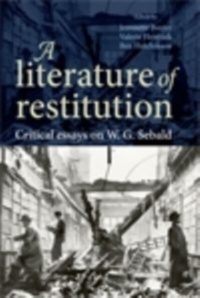
A Literature of Restitution
Critical Essays on W. G. Sebald
1st Edition
Published on 1. November 2015
336 pages
978-1-5261-0203-4 (ISBN)
Available for download
Description

This book investigates the crucial question of 'restitution' in the work of W. G. Sebald. Written by leading scholars from a range of disciplines, with a foreword by his English translator Anthea Bell, the essays collected in this volume place Sebald's oeuvre within the broader context of European culture in order to better understand his engagement with the ethics of aesthetics.
Whilst opening up his work to a range of under-explored areas including dissident surrealism, Anglo-Irish relations, contemporary performance practices and the writings of H. G. Adler, the volume notably returns to the original German texts. The recurring themes identified in the essays - from Sebald's carefully calibrated syntax to his self-consciousness about 'genre', from his interest in liminal spaces to his literal and metaphorical preoccupation with blindness and vision - all suggest that the 'attempt at restitution' constitutes the very essence of Sebald's understanding of literature. -- .
Whilst opening up his work to a range of under-explored areas including dissident surrealism, Anglo-Irish relations, contemporary performance practices and the writings of H. G. Adler, the volume notably returns to the original German texts. The recurring themes identified in the essays - from Sebald's carefully calibrated syntax to his self-consciousness about 'genre', from his interest in liminal spaces to his literal and metaphorical preoccupation with blindness and vision - all suggest that the 'attempt at restitution' constitutes the very essence of Sebald's understanding of literature. -- .
Reviews / Votes
"The assembled essays discuss familiar issues - including intertextuality, photography, memory and architecture - but often from original perspectives, focusing on lesser known aspects such as Sebald's poetry and his unfinished "Corsica project"." [Carolin Duttlinger; Times Literary Supplement; 07/02/2014]"The volume's organizing principle, the question of restitution, lends this book a much clearer profile than other edited volumes on Sebald. Taken together, the contributions provide readers with an excellent overview of Sebald's oeuvre...The variety of perspectives from both within and beyond German Studies further sets this volume apart from other publications by offering fresh insights and new contexts within which to consider Sebald's works." - Lynn L. Wolff, Michigan State University. Modern Language Review, Volume 111, Part 2, April 2016
'I enjoyed every essay in this collection and recommend this book to students who encounter Sebald in any of their university courses, and for any reader who has already embarked on a journey with Sebald. The collection is fresh, adding a completely new set of reference points for the scholar and opens up underdeveloped areas for further research, for example, Sebald and the theatre. This book adds to the already rich body of work surrounding Sebald, and reading it will leave the reader in even greater awe of this great writer.'
Tielman de Villiers. University of Hertfordshire, British Society for Literature and Science reviews, September 2016 -- .
More details
Language
English
Place of publication
Manchester
United Kingdom
Edition type
Digital original
Illustrations
Illustrations, black & white
Illustrations, black & white
ISBN-13
978-1-5261-0203-4 (9781526102034)
Copyright in bibliographic data and cover images is held by Nielsen Book Services Limited or by the publishers or by their respective licensors: all rights reserved.
Schweitzer Classification
Other editions
Additional editions
Jeannette Baxter | Valerie Henitiuk | Ben Hutchinson
A Literature of Restitution
Critical Essays on W. G. Sebald
Book
04/2016
Manchester University Press
€47.00
Shipment within 3-4 weeks
Persons
Jeannette Baxter is Senior Lecturer in Modern and Contemporary Literature at Anglia Ruskin University, Cambridge
Valerie Henitiuk is Director of the Faculty Commons at Grant MacEwan University in Edmonton, Canada, where she also holds an academic appointment in English
Ben Hutchinson is Professor of European Literature at the University of Kent -- .
Valerie Henitiuk is Director of the Faculty Commons at Grant MacEwan University in Edmonton, Canada, where she also holds an academic appointment in English
Ben Hutchinson is Professor of European Literature at the University of Kent -- .
Content
Introduction: 'A quoi bon la litterature?'
Foreword: translating W. G. Sebald, with and without the author - Anthea Bell
Part I: Translation and style
1. W. G. Sebald's three-letter word: on the parallel world of the English translations - Arthur Williams
2. Encounter and cry: W. G. Sebald as poet - George Szirtes
3. Unquiet prose: W. G. Sebald and the writing of the negative - Shane Weller
Part II: Texts and contexts
4. Surrealist vertigo in Schwindel. Gefuehle.- Jeannette Baxter
5. Memoirs of the blind: W. G. Sebald's Die Ausgewanderten - Dora Osborne
6. 'Like refugees who have come through dreadful ordeals': the theme of the Anglo-Irish in Die Ringe des Saturn. Eine englische Wallfahrt - Helen Finch
7. The 'Arca Project': W. G. Sebald's Corsica - Graeme Gilloch
8. Twisted threads: the entwined narratives of W. G. Sebald and H. G. Adler - Peter Filkins
9. Stations, dark rooms and false worlds in W. G. Sebald's Austerlitz - David Darby
Part II: 'Prose' and photography
10. Fields of association: W. G. Sebald and contemporary performance practices - Simon Murray
11. Still life, portrait, photograph, narrative in the work of W. G. Sebald - Clive Scott
12. The return of the repressed mother in W. G. Sebald's fiction - Graley Herren
13. The question of genre in W. G. Sebald's 'prose' (towards a post-memorial literature of restitution) - Russell J. A. Kilbourn
References
Index -- .
Foreword: translating W. G. Sebald, with and without the author - Anthea Bell
Part I: Translation and style
1. W. G. Sebald's three-letter word: on the parallel world of the English translations - Arthur Williams
2. Encounter and cry: W. G. Sebald as poet - George Szirtes
3. Unquiet prose: W. G. Sebald and the writing of the negative - Shane Weller
Part II: Texts and contexts
4. Surrealist vertigo in Schwindel. Gefuehle.- Jeannette Baxter
5. Memoirs of the blind: W. G. Sebald's Die Ausgewanderten - Dora Osborne
6. 'Like refugees who have come through dreadful ordeals': the theme of the Anglo-Irish in Die Ringe des Saturn. Eine englische Wallfahrt - Helen Finch
7. The 'Arca Project': W. G. Sebald's Corsica - Graeme Gilloch
8. Twisted threads: the entwined narratives of W. G. Sebald and H. G. Adler - Peter Filkins
9. Stations, dark rooms and false worlds in W. G. Sebald's Austerlitz - David Darby
Part II: 'Prose' and photography
10. Fields of association: W. G. Sebald and contemporary performance practices - Simon Murray
11. Still life, portrait, photograph, narrative in the work of W. G. Sebald - Clive Scott
12. The return of the repressed mother in W. G. Sebald's fiction - Graley Herren
13. The question of genre in W. G. Sebald's 'prose' (towards a post-memorial literature of restitution) - Russell J. A. Kilbourn
References
Index -- .

