

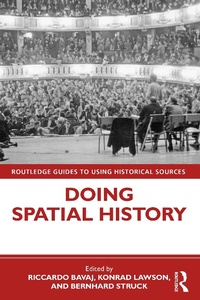
Doing Spatial History
1st Edition
Published on 30. December 2021
322 pages
978-1-000-51880-1 (ISBN)
Description

This volume provides a practical introduction to spatial history through the lens of the different primary sources that historians use. It is informed by a range of analytical perspectives and conveys a sense of the various facets of spatial history in a tangible, case-study based manner.
The chapter authors hail from a variety of fields, including early modern and modern history, architectural history, historical anthropology, economic and social history, as well as historical and human geography, highlighting the way in which spatial history provides a common forum that facilitates discussion across disciplines. The geographical scope of the volume takes readers on a journey through central, western, and east central Europe, to Russia, the Mediterranean, the Ottoman Empire, and East Asia, as well as North and South America, and New Zealand. Divided into three parts, the book covers particular types of sources, different kinds of space, and specific concepts, tools and approaches, offering the reader a thorough understanding of how sources can be used within spatial history specifically but also the different ways of looking at history more broadly.
Very much focusing on doing spatial history, this is an accessible guide for both undergraduate and postgraduate students within modern history and its related fields.
The chapter authors hail from a variety of fields, including early modern and modern history, architectural history, historical anthropology, economic and social history, as well as historical and human geography, highlighting the way in which spatial history provides a common forum that facilitates discussion across disciplines. The geographical scope of the volume takes readers on a journey through central, western, and east central Europe, to Russia, the Mediterranean, the Ottoman Empire, and East Asia, as well as North and South America, and New Zealand. Divided into three parts, the book covers particular types of sources, different kinds of space, and specific concepts, tools and approaches, offering the reader a thorough understanding of how sources can be used within spatial history specifically but also the different ways of looking at history more broadly.
Very much focusing on doing spatial history, this is an accessible guide for both undergraduate and postgraduate students within modern history and its related fields.
Reviews / Votes
"Doing Spatial History provides a rich, diverse and compelling exploration of sources, spaces and concepts useful for conducting spatially sensitive historical research. More than that, it showcases vibrant and accessible conversations across historical disciplines, different periods and an array of places, underlining the enormous potential of the emerging and energetic field of spatial history."Diarmid A. Finnegan, Queen's University Belfast, UK
"With an ecumenical spirit, Doing Spatial History offers a concrete guide to researching the lived experience of the past. Authors from various fields show us how sources ranging from police records and maritime contracts to novels and maps can enrich and complicate the humanities. Researchers will especially appreciate the introduction, which offers both a helpful entry point to the field and an overview of its literature."
Susan Schulten, University of Denver, USA
"For a spatial historian who has been working for some 20 years to introduce space as an analytical category into the historical and cultural sciences, it is a particular pleasure to see this 'guide to using historical sources' published. It is long overdue. For real and imagined places - from bars to borders - the volume shows what difference 'doing spatial history' can make."
Susanne Rau, University of Erfurt, Germany
"Taken together, the chapters provide a rich introduction to the sources and themes that have played a key role in developing spatial history as a distinct approach. From newspapers and maps to ships and architectural drawings, the chapters elucidate why such sources, spaces, and concepts are useful and important historiographical tools. ... [They] will be exceptional tools for students and scholars who seek to incorporate spatial history into their practice."
Kate McDonald, University of California, Santa Barbara, USA, Cultural History: Vol 13, No1
"Although primarily aimed at undergraduate and postgraduate students, the book is also highly recommended to more experienced scholars, whether they are looking for inspiration or want to learn more about different concepts and approaches. By illustrating how spatial concepts can be used to interrogate seemingly familiar sources or topics, the authors open up a wealth of new ideas and lines of inquiry. Doing Spatial History encourages the readers to think about history in different and novel ways. It is truly inspirational."
Maria Fritsche, Norwegian University of Science and Technology, Norway, Cultural History: Vol 13, No1
"This volume provides an introduction to this recently so successful sub-discipline and is, at the same time, an original contribution to its continued development. ... One can only hope that this volume will be widely used in academic teaching so that the innovation of spatial history is firmly anchored in the history curriculum."
Matthias Middell, Leipzig University, Germany, Comparativ: Vol 34, No 3
More details
Series
Edition
1. Auflage
Language
English
Place of publication
London
United Kingdom
Publishing group
Taylor & Francis Ltd
Target group
College/higher education
Illustrations
2 Tables, black and white; 39 Halftones, black and white; 39 Illustrations, black and white
ISBN-13
978-1-000-51880-1 (9781000518801)
Copyright in bibliographic data and cover images is held by Nielsen Book Services Limited or by the publishers or by their respective licensors: all rights reserved.
Schweitzer Classification
Other editions
Additional editions
Riccardo Bavaj | Konrad Lawson | Bernhard Struck
Doing Spatial History
Book
12/2021
1st Edition
Routledge
€60.80
Shipment within 15-20 days
Riccardo Bavaj | Konrad Lawson | Bernhard Struck
Doing Spatial History
Book
12/2021
1st Edition
Routledge
€206.90
Shipment within 15-20 days
Persons
Riccardo Bavaj is Professor of Modern History, University of St Andrews, UK, and Co-Director of the Institute for Transnational and Spatial History. His research focuses on the intellectual and spatial history of 20th-century Germany. He has co-edited Germany and 'the West' and Zivilisatorische Verortungen (with Martina Steber).
Konrad Lawson is Lecturer in Modern History, University of St Andrews, UK, and Co-Director of the Institute for Transnational and Spatial History. His research focuses on modern East Asian history and the aftermaths of Japanese empire.
Bernhard Struck is Reader of Modern History, University of St Andrews, UK, and Founding Director of the Institute for Transnational and Spatial History. His research focuses on continental European History, c.1750 to early 20th-century, comparative and transnational history. He has co-edited Shaping the Transnational Sphere (with Davide Rodogno and Jakob Vogel).
Konrad Lawson is Lecturer in Modern History, University of St Andrews, UK, and Co-Director of the Institute for Transnational and Spatial History. His research focuses on modern East Asian history and the aftermaths of Japanese empire.
Bernhard Struck is Reader of Modern History, University of St Andrews, UK, and Founding Director of the Institute for Transnational and Spatial History. His research focuses on continental European History, c.1750 to early 20th-century, comparative and transnational history. He has co-edited Shaping the Transnational Sphere (with Davide Rodogno and Jakob Vogel).
Content
Introduction - Spatial history: an expansive field Part 1: Working with sources 1. Maps 2. Travel guides 3. Novels, autobiographies and memoirs 4. Newspaper archives 5. Architectural drawings Part 2: Exploring spaces 6. Ships 7. Bars 8. Rivers 9. Infrastructures 10. Border zones Part 3: Reflecting on concepts, tools, and approaches 11. Lefebvrean landscapes 12. Maritoriality 13. Regional imaginaries 14. Economic geographies 15. Digital mapping Selected Bibliography
