

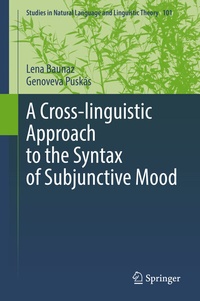
A Cross-linguistic Approach to the Syntax of Subjunctive Mood
Description

This monograph gives a unified account of the syntactic distribution of subjunctive mood across languages, including Romance, Balkan (South Slavic and Modern Greek), and Hungarian, among others. Starting from a close scrutiny of the environments in which subjunctive mood occurs and of its semantic contribution, we present a feature-based approach which reveals the common properties of the class of verbs which embed subjunctive, and which takes into account the variation in subjunctive-related complementizers. Two main proposals can be highlighted: (i) the lexical semantics of the main clause predicate plays a crucial role in mood selection. More specifically subjunctive mood is regulated by a specific property of the main predicate, the emotive property, which is associated with the external argument of the embedding verb (usually the Subject). The book proposes a nanosyntactic analysis of the internal structure of embedding verbs. (ii) Cross- and intra-linguistic variations are dealt with according to different patterns of lexicalization, i.e., variations depend on what portions of the verb's and complementizer's functional sequence is lexicalized and on how it is packaged by languages. In doing so, this approach provides a uniform account of the phenomenon of embedded subjunctives. The monograph takes a novel, feature-based approach to the question of subjunctive licensing, providing a detailed analysis of the features of the matrix verb, of the complementizer and of the embedded subjunctive clause. It is also based on a wide empirical coverage, ranging from the relatively well-studied groups of Romance and Balkan languages to less explored languages from non-Indo-European families (Hungarian).
More details
Other editions
Additional editions
Persons
Genoveva Puskas is Associate professor of linguistics at the University of Geneva. Her areas of specialization include the syntax and semantics of quantification and of negation, the syntax of the left peripheral markers such as focus, contrastive and non-contrastive topic, and the syntax of the DP, with a focus onHungarian. She recently extended her research to syntax-pragmatics interface questions from a cross-linguistic perspective, namely to how and what modal expressions and mood markers contribute to the organization of information, both in terms of structural constraints and of contextual framing.
