

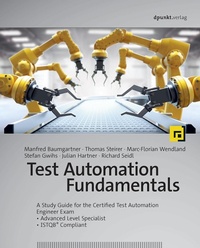
Test Automation Fundamentals
Description

Test automation is an essential tool in today's software development environments. It increases testing efficiency and makes test procedures reliably repeatable.
This book provides a complete overview of how to design test automation processes and integrate them into your organization or existing projects. It details functional and technical strategies and goes into detail on the relevant concepts and best practices. The book's main focus is on functional system testing.
Topics covered:
• An introduction to test automation
• Objectives and success factors
• Preparing for test automation
• Introduction to generic test automation architectures
• Design and development of a test automation solution
• Risks and contingencies during deployment
• Metrics and reporting
• Transitioning manual testing to an automated environment
• Verifying a test automation solution
• Continuous improvement
The appendix contains an overview of software quality characteristics according to the ISO 25010 standard, and lists potential test automation applications within this context. It also provides an introduction to load and performance testing, and a sample catalog of criteria for selecting test automation tools.
This book is fully compliant with the ISTQB® syllabus and, with its many explanatory examples, is equally suitable for preparation for certification, as a concise reference book for anyone who wants to acquire this essential skill, or for university-level study.
More details
Other editions
Additional editions

Content
- Cover
- About the Authors
- Title Page
- Copyright
- Preface
- Acknowledgements
- Foreword by Armin Metzger
- Overview
- Contents
- 1. An Introduction to Test Automation and Its Goals
- 1.1. Introduction
- 1.1.1. Standards and Norms
- 1.1.2. The Use of Machines
- 1.1.3. Quantities and Volumes
- 1.2. What is Test Automation?
- 1.3. Test Automation Goals
- 1.4. Success Factors in Test Automation
- 1.4.1. Test Automation Strategy
- 1.4.2. Test Automation Architecture (TAA)
- 1.4.3. Testability of the SUT
- 1.4.4. Test Automation Framework
- 1.5. Excursus: Test Levels and Project Types
- 1.5.1. Test Automation on Different Test Levels
- 1.5.2. Test Automation Approaches for Different Types of Projects
- 2. Preparing for Test Automation
- 2.1. SUT Factors that influence Test Automation
- 2.2. Tool Evaluation and Selection
- 2.2.1. Responsibilities
- 2.2.2. Typical Challenges
- 2.2.3. Excursus: Evaluating Automation Tools
- 2.2.4. Excursus: Evaluation made easy
- 2.3. Testability and Automatability
- 3. Generic Test Automation Architecture
- 3.1. Introducing Generic Test Automation Architecture (gTAA)
- 3.1.1. Why is a Sustainable Test Automation Architecture important?
- 3.1.2. Developing Test Automation Solutions
- 3.1.3. The Layers in the gTAA
- 3.1.4. Project Managing a TAS
- 3.1.5. Configuration Management in a TAS
- 3.1.6 Support for Test Management and other Target Groups
- 3.2. Designing a TAA
- 3.2.1. Fundamental Questions
- 3.2.2. Which Approach to Test Case Automation Should Be Supported?
- 3.2.3. Technical Considerations for the SUT
- 3.2.4. Considerations for Development and QA Processes
- 3.3. TAS Development
- 3.3.1. Compatibility between the TAS and the SUT
- 3.3.2. Synchronization between the TAS and the SUT
- 3.3.3. Building Reusability into the TAS
- 3.3.4. Support for Multiple Target Systems
- 3.3.5. Excursus: Implementation Using Different Approaches and Methods
- 4. Deployment Risks and Contingencies
- 4.1. Selecting a Test Automation Approach and Planning Deployment/Rollout
- 4.1.1. Pilot Project
- 4.1.2. Deployment
- 4.2. Risk Assessment and Mitigation Strategies
- 4.2.1. Specific Risks During the Initial Rollout
- 4.2.2. Specific Risks during Maintenance Deployment
- 4.3. Test Automation Maintenance
- 4.3.1. Types of Maintenance Activities and What Triggers Them
- 4.3.2. Considerations when Documenting Automated Testware
- 4.3.3. The Scope of Maintenance Activities
- 4.3.4. Maintenance of Third-Party Components
- 4.3.5. Maintaining Training Materials
- 4.3.6. Improving maintainability
- 4.4. Excursus: Application Areas According to System Types
- 4.4.1. Desktop Applications
- 4.4.2. Client-Server Systems
- 4.4.3. Web Applications
- 4.4.4. Mobile Applications
- 4.4.5. Web Services
- 4.4.6. Data Warehouses
- 4.4.7. Dynamic GUIs: Form Solutions
- 4.4.8. Cloud-Based Systems
- 4.4.9. Artificial Intelligence and Machine Learning
- 5. Reporting and Metrics
- 5.1. Metrics and Validity
- 5.2. Metrics Examples
- 5.3. Precise Implementation and Feasibility Within a TAS
- 5.3.1. TAS and SUT as Sources for Logs
- 5.3.2. Centralized Log Management and Evaluation
- 5.3.3. Implementing Logging in a TAS
- 5.4. Test Automation Reporting
- 5.4.1. Quality Criteria for Reports
- 6. Transitioning Manual Testing to an Automated Environment
- 6.1. Criteria for Automation
- 6.1.1. Suitability Criteria for the Transition to Automated Testing
- 6.1.2. Preparing for the Transition to Automated Testing
- 6.2. Steps Required to Automate Regression Testing
- 6.3. Factors to Consider when Automating Testing for New or Changed Functionality
- 6.4. Factors to Consider when Automating Confirmation Testing
- 7. Verifying the Test Automation Solution
- 7.1. Why Quality Assurance Is Important for a TAS
- 7.2. Verifying Automated Test Environment Components
- 7.3. Verifying the Automated Test Suite
- 8. Continuous Improvement
- 8.1. Ways to Improve Test Automation
- 8.2. Planning the Implementation of Test Automation Improvement
- 9. Excursus: Looking Ahead
- 9.1. Challenges Facing Test Automation
- 9.1.1. Omnipresent Connectivity
- 9.1.2. Test Automation in IT Security
- 9.1.3. Test Automation in Autonomous Systems
- 9.2. Trends and Potential Developments
- 9.2.1. Agile Software Development Is Inconceivable without Test Automation
- 9.2.2. New Outsourcing Scenarios for Automation
- 9.2.3. Automating Automation
- 9.2.4. Training and Standardization
- 9.3. Innovation and Refinement
- Appendices
- A. Software Quality Characteristics
- A.1. Functional Suitability
- A.2. Performance Efficiency
- A.3. Compatibility
- A.4. Usability
- A.5. Reliability
- A.6. Security
- A.7. Maintainability
- A.8. Portability
- B. Load and Performance Testing
- B.1. Types of Load and Performance Tests
- B.2. Load and Performance Testing Activities
- B.3. Defining Performance Goals
- B.4. Identifying Transactions and/or Scenarios
- B.5. Creating Test Data
- B.6. Creating Test Scenarios
- B.7. Executing Load And Performance Tests
- B.8. Monitoring
- B.9. Typical Components of Performance/Load Testing Tools
- B.10. Checklists
- C. Criteria Catalog for Test Tool Selection
- D. Glossary
- E. Abbreviations
- F. References
- F.1. Literature
- F.2. Norms and Standards
- F.3. URLs
- Index
